
Winning at Yukon solitaire when every card is in play
Yukon is a patience game where luck takes the back seat and planning drives the result. Every card is dealt face up or face down into seven columns from the start, there is no stock to turn, and one unusual rule changes everything: you can pick up any face-up card and drag along whatever sits on top of it, regardless of order. This guide covers the full rules, the controls, and the thinking that turns a tangled layout into a clean sweep.
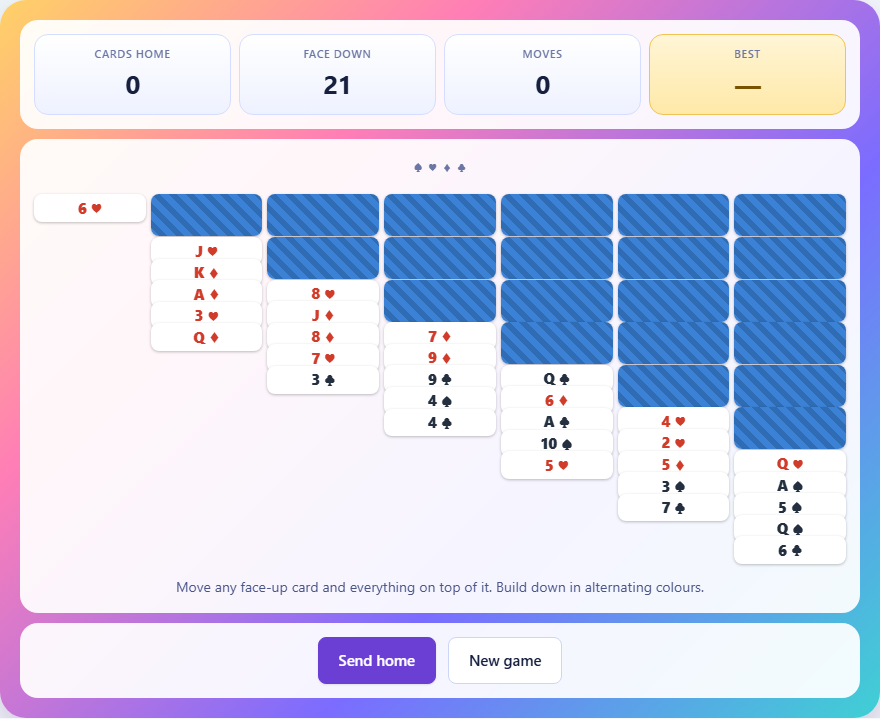
The deal and the seven columns
A standard fifty-two card deck is shuffled and dealt into seven columns. The first column gets a single face-up card. Each column after that gets one more face-down card than the one before it, and then five face-up cards on top. Column two has one face-down card followed by five face-up. Column three has two face-down followed by five face-up, and so on through column seven, which has six face-down cards under its five face-up ones. Every card in the deck is somewhere on the table. There is no stock pile and no waste pile.
The four foundation slots sit above the columns. Each foundation builds from ace up to king in a single suit. Getting all fifty-two cards onto the foundations is how you win.
Moving cards and the rule that changes everything
Columns build downward in alternating colours. A black six goes onto a red seven. A red jack goes onto a black queen. So far this matches many solitaire games. The rule that makes Yukon different is what travels with the card you pick up. When you select a face-up card, every card sitting on top of it comes along, no matter what those cards are. They do not need to be in sequence or alternating colours. Only the bottom card of the group you are moving has to fit legally onto the card where it lands.
This means a column might hold a red five with a black three, a red ten, and a black two piled on top of it in no useful order. You can still pick up that red five and move the entire jumble onto a black six somewhere else. The pile transfers intact. This is the lever that makes Yukon solvable where stricter games would be stuck.
Turning face-down cards and filling empty columns
Whenever the last card in a column is removed or moved away, the card beneath it is flipped face up automatically. These reveals are the fuel of the game. Every face-down card is an unknown, and turning it over gives you new options. Much of Yukon strategy is about choosing moves specifically because they will turn a hidden card over.
An empty column is a special space. Only a king, along with whatever sits on top of it, may be placed into an empty column. Because a king can carry a tall pile of cards with it, an empty column is one of the most powerful tools in the game. It lets you rearrange large sections of the layout in a single move.
Sending cards to the foundations
A card goes to the foundations when it is the next in sequence for its suit. Aces go first, then twos, then threes, all the way up to kings. You can send a card home by selecting the last card in a column and tapping one of the foundation slots. There is also a Send home button that automatically moves every card that can legally go up, repeating until nothing else fits.
The automatic send is convenient at the end of a game when the columns are nearly empty and most remaining cards belong on the foundations. Earlier in the game, though, you may want to send cards home one at a time so you keep control of the order.
Controls and how to play on a screen
Tap any face-up card to select it. The card and everything above it in the column are highlighted. Tap a legal destination and the group moves there. Tapping the selected card again deselects it without doing anything. If you try to move a card somewhere it cannot go, nothing happens and you can try a different target.
The stats bar at the top tracks three numbers. Cards home shows how many of the fifty-two cards have reached the foundations. Face down tells you how many hidden cards remain in the columns. Moves counts every move you have made. Since the goal is to solve the game, not to race, a lower move count simply means you found a more direct path. The New game button deals a fresh layout at any time.
Strategy: uncover the face-down cards first
The most valuable move in Yukon is almost always the one that turns a hidden card face up. Until you see what is underneath, you cannot plan ahead. Two columns might each offer a legal move, but one of them will reveal a face-down card and the other will not. Pick the one that reveals.
This principle overrides tidiness. A neat column where every card alternates perfectly is satisfying to look at, but if building it did not turn any hidden cards over, it did nothing to bring you closer to winning. A messy column that exposed a new card is worth more every time. Count the face-down cards and watch that number fall. When it reaches zero, the game is almost always solvable from that point forward.
Strategy: value empty columns like gold
An empty column accepts a king and everything piled on top of it. That one move can relocate a dozen cards at once, clearing the way for new reveals and new paths to the foundations. Protecting and creating empty columns is one of the strongest habits you can build.
The temptation is to fill an empty column the moment it appears, because there is usually a king available somewhere. Resist that urge unless the king you are moving will uncover a face-down card or free another useful card behind it. An empty column is a parking space. Once you fill it, you lose the parking space. Use it when the payoff is clear, and hold it open when nothing urgent needs it.
Strategy: do not rush cards to the foundations
It feels productive to send cards home early. Every card on the foundations is a card you never have to think about again. But a card on the foundations is also a card you can no longer use for building in the columns. A three that went home early might have served as a stepping stone for a four that needed to move. Once it is on the foundation, that path is closed.
The safe rule is to send cards home when they are no longer useful below. Aces and twos can almost always go up immediately, because no card in the columns ever needs to land on them. Threes and fours are borderline. Fives and above should stay in the columns until you are sure nothing else needs them. When the end of the game is in sight and you are just draining the columns, press Send home and let the automatic sweep finish the job.
Common mistakes that block a winnable deal
Burying a needed card under a tall pile is the most frequent dead end. You moved a king into an empty column and stacked a long group on top of it, but somewhere in that group is a card the foundations need next, and now it is trapped under six other cards. Before you make a big move, check whether any card in the group you are carrying is needed elsewhere first.
Ignoring face-down cards in the rightmost columns is another trap. Column seven starts with six hidden cards. If you focus on the shorter columns because they are easier to clear, column seven sits untouched and its secrets stay hidden until it is too late. Balance your attention across all seven columns.
Moving a card just because you can is the subtlest mistake. Every legal move is available, but not every legal move helps. Ask what the move accomplishes. Does it reveal a hidden card? Does it free a needed foundation card? Does it open or preserve an empty column? If the answer to all three is no, the move is probably a waste.
Why most deals can be won
In many patience games a large share of deals are simply unwinnable, no matter how well you play. Yukon is different. Because every card is in play from the start and because you can move any face-up card with everything above it, the paths through a deal are far more numerous than in games with a stock. The great majority of Yukon deals can be solved with enough thought. When you lose, it is almost always a planning mistake rather than bad luck, which is what makes the game rewarding to come back to. Everything runs in your browser and nothing about your game is sent anywhere.