
Reading the numbers and living to tell about it
What the digits on the board actually mean, how to turn a single number into a safe click, the three board sizes and what changes between them, and the habits that separate someone who clears a hard board from someone who keeps stepping on mines.
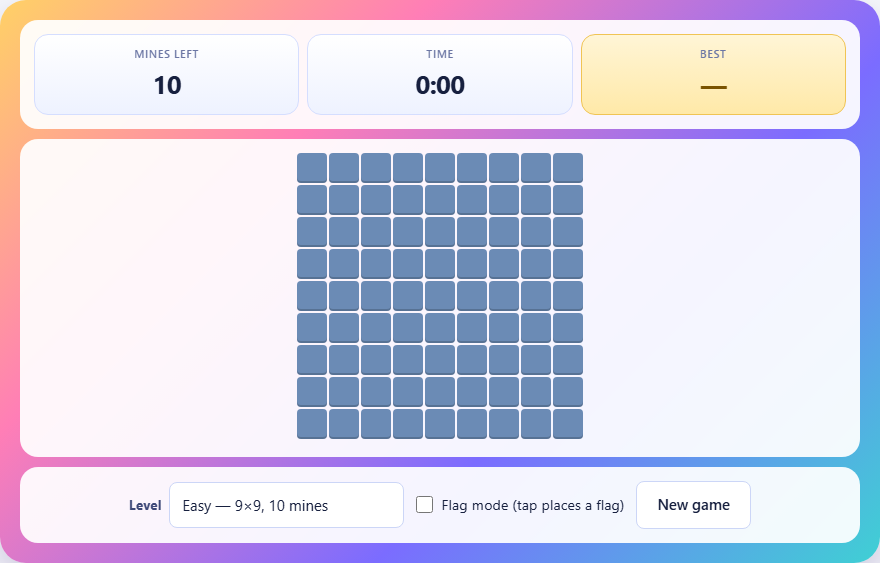
Mines, numbers, and what you are trying to do
Somewhere under the board are hidden mines. You cannot see them. All you can do is click a square and find out what is there. If the square is empty you survive and it opens. If it holds a mine the game is over.
When a safe square opens it shows either a blank or a number. A blank means none of the eight surrounding squares has a mine, and so all of them open automatically. A number tells you exactly how many of those eight neighbours are mines. A one means one mine, a two means two, and so on up to eight in theory, though you will rarely see anything above a four.
Your goal is to open every safe square on the board without clicking a mine. You do not need to flag the mines. Flags are a thinking tool, not a victory condition.
Your first click is always safe
The mines are not placed until after your first click. The square you click and all of its neighbours are kept clear, so the opening move always opens a region rather than killing you on the spot. This is not a kindness. It is what makes the game work. Without it, a large share of games would end on the first move, which would be a coin toss dressed up as a puzzle.
Because the opening click produces a guaranteed open area, you always have something to reason from. The numbers around the edge of that area are your first clues. Start reading them immediately.
Three board sizes
Easy is a nine by nine grid with ten mines. It is small enough to scan in a glance and most boards can be solved in under two minutes once you know the patterns. Medium is sixteen by sixteen with forty mines. The board is big enough that you need to scroll on a phone, and the density of mines means you will see higher numbers. Hard is twenty-four columns wide and sixteen rows tall with seventy mines. It is a serious puzzle and a hard board can take ten minutes or more.
Your score on every level is the time it took you, so the fastest clear wins. Your best time for each level is saved separately.
Clicking, flagging, and flag mode
On a desktop, left-click opens a square and right-click places or removes a flag. A flag is a marker you put on a square you believe is a mine. It does nothing to the mine itself. It just stops you from accidentally clicking that square later and reminds you of your reasoning.
On a phone there is no right-click. Instead, press and hold a square to place a flag. If that feels awkward, tick the Flag mode box below the board. While Flag mode is on, a normal tap places a flag instead of opening a square. Untick it to go back to opening squares.
The mines-left counter in the stats bar shows how many mines remain minus how many flags you have placed. It does not check whether your flags are correct. If you place a flag on a safe square the counter still drops.
The one deduction that solves most boards
Look at the edge where opened squares meet covered ones. Find a number that has exactly as many covered neighbours as its value. A one touching exactly one covered square means that square is a mine. A two touching exactly two covered squares means both are mines. Flag them.
Now look at the numbers next to those new flags. A three that already has three flags around it means every remaining covered square near it is safe. Open them. That opens new numbers, which produce new deductions, and the chain often runs across the entire board.
This single technique, applied in a loop, solves the majority of an easy board and a large portion of a medium board. The hard board requires it too, but also asks you to combine information from two or more numbers at once.
Combining numbers for harder boards
Sometimes a single number does not tell you enough. You see a two with three covered neighbours and cannot tell which two are mines. But the number next to it sees some of the same squares. By comparing what both numbers require, you can sometimes narrow the options to one arrangement.
Here is a concrete example. A one and a two sit next to each other along the edge of the open area. The one sees squares A and B. The two sees squares A, B, and C. The one tells you that exactly one of A and B is a mine. The two tells you that exactly two of A, B, and C are mines. Since one of A and B accounts for one of those two, square C must also be a mine. Flag it.
This kind of reasoning is the heart of the hard board. Practice it on medium first, where the stakes are lower and the board is easier to read.
When you have to guess
Not every board is solvable by logic alone. Late in a hard game you can reach a position where two squares remain and one of them is a mine, with no number anywhere that distinguishes them. That is a genuine fifty-fifty and there is nothing clever to do about it.
When you face a guess, pick the square that touches the fewest other unknowns. If you are wrong, you lose less information. If you are right, the resulting numbers may open up the rest of the board. Guessing early is worse than guessing late because there are more unknowns at stake.
On the easy board, forced guesses are rare. On medium they happen sometimes. On hard they are a regular part of the endgame.
Mistakes that kill a run
- Clicking before reading. Every click should be backed by a reason. If you cannot explain why a square is safe, do not open it.
- Forgetting to count your flags. If a three already has three flags around it, every other covered square near it is safe. Skipping that check leaves free information on the table.
- Flagging uncertain squares. A flag is a statement that you are sure. If you are not sure, leave the square unmarked. A wrong flag will mislead you later when you try to count.
- Ignoring the edges of the board. A square in the corner has only three neighbours, not eight. A number there constrains fewer squares, which often makes the deduction easier. Corners and edges are often the fastest place to start.
- Clicking the last few squares in a hurry. The endgame is where guesses live. Slow down, read every number, and only guess when you truly have no other move.
Speed comes from pattern recognition
Fast players do not think faster. They recognise patterns they have seen hundreds of times and apply them without working through the logic from scratch. A one at the boundary with one covered neighbour is instant. A row of ones along a wall is instant. Two numbers sharing a set of squares is a pattern that clicks once you have seen it enough.
If you want to get faster, replay the easy board until the common shapes are automatic. Then move to medium. By the time you reach hard, the simple deductions will cost you no time at all and you can spend your attention on the harder overlapping patterns.
The board never leaves your browser
The mine layout is generated right here on your device. No board state, no time, and no score is sent anywhere. Your best time for each level is saved in the browser's own storage on this machine. Nobody else can see it. Disconnect from the internet after the page loads and the game still works, because there was never anything on the other end.
You can prove it. Turn off your network connection, reload the page, and start a game. Everything works exactly the same. The mine placement, the flood fill, the timer, and the flag counter all run in your browser with no outside help.