
Sliding tiles and chasing higher numbers
The rules of 2048 fit in two sentences: slide tiles, and matching numbers merge. That simplicity hides a game that rewards careful thinking far more than fast reactions. This article covers every rule, explains the controls, breaks down how scoring works, and walks through the strategies that separate a quick loss from reaching the tile the game is named after.
How the board works
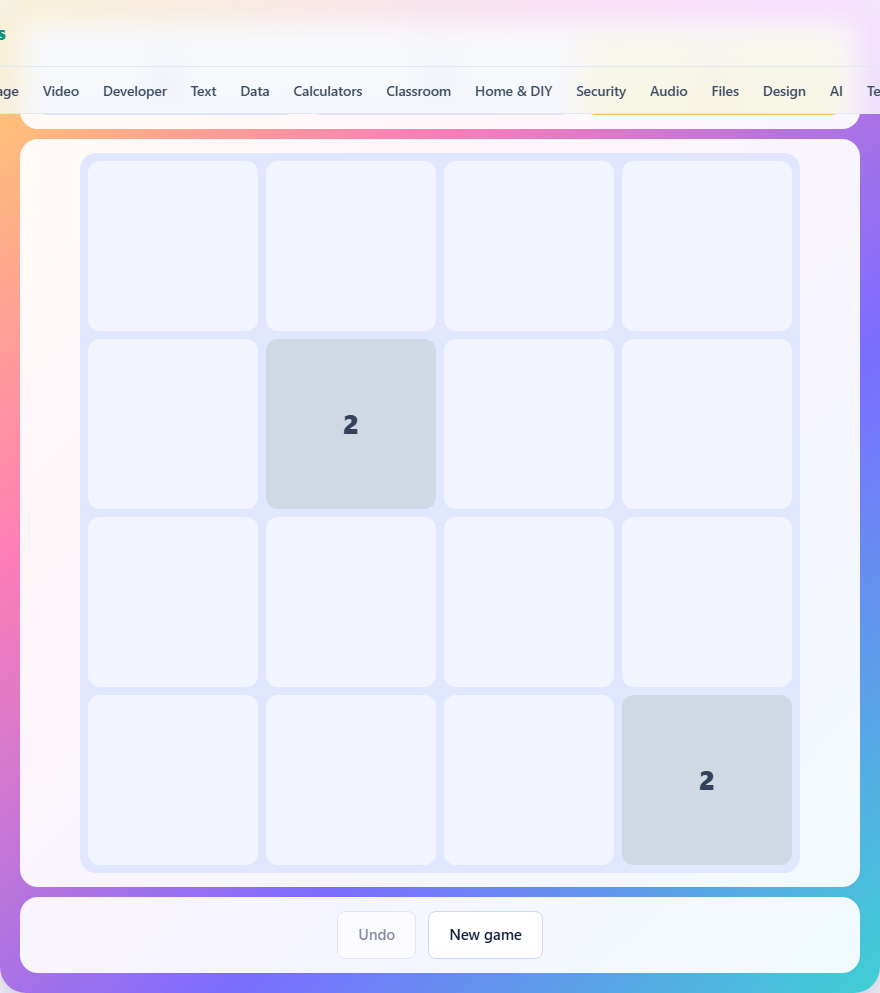
The board is a four-by-four grid. At the start, two tiles sit on random squares, each showing a 2 or occasionally a 4. Every move slides every tile as far as it can go in one direction, up, down, left, or right. Tiles stop when they hit the edge of the grid or another tile. If two tiles with the same number collide during a slide, they merge into a single tile with double the value. After every move that changes the board, a new tile appears on a random empty square. Nine times out of ten the new tile is a 2; one time in ten it is a 4.
A move that would change nothing is ignored. No tile appears, no score changes, and the board stays exactly as it was. This is an important detail because it means you cannot waste a turn. Every move you make does something, or it does not count at all.
Controls on desktop and mobile
On a desktop, the arrow keys control the direction of every slide. Press the up arrow and all tiles slide upward, merging where they meet. The same works for down, left, and right. On a phone or tablet, swipe in any direction on the board. The page also shows four direction buttons under the board, which work on both desktop and mobile for anyone who prefers tapping.
Two more buttons sit below the board. New game clears the grid and starts fresh. Undo takes back exactly one move. That single undo is there for the accidental swipe, not for working backwards through an entire game. Using it is fine when a slip would ruin a strong position, but relying on it as a safety net will not teach you to play better.
How scoring works
Every merge adds the value of the new tile to your score. When two 2s join into a 4, your score goes up by 4. When two 64s join into a 128, your score goes up by 128. Bigger merges are worth more, and since bigger merges only happen later in the game, the score curve climbs steeply toward the end.
Your best score is saved in the browser and shown alongside your current score so you can track your personal record. There is no online leaderboard. The score is stored on your device only, and it stays there between sessions.
When the game ends, and when it does not
The game ends when no move in any direction would change the board. That means every square is full and no two neighbours share a number. Notice that a full board is not automatically a loss. If even one pair of matching tiles sits side by side, you still have a legal move and the game continues.
There is a second way to stop, and it is the happy one. The instant a 2048 tile appears anywhere on the grid, the game declares a win, freezes the board and shows your final score. So the highest tile you will ever see here is 2048 itself. There is no mode that carries the same board on past that point.
The corner strategy and why it works
The single most useful habit is to pick one corner and keep your highest tile there for the entire game. Most players choose the bottom-left or bottom-right corner. Once you have committed to a corner, you restrict yourself to the two or three directions that keep the big tile pinned. For example, if your big tile is in the bottom-right corner, you slide down and right freely, use left when you must, and avoid sliding up as much as possible.
This works because it creates a natural gradient. The highest tile sits in the corner, the next highest sits beside it, and so on along the edge. New small tiles appear away from the corner, and they merge upward through the chain without disrupting the big ones. If you slide the wrong way and pull the big tile out of its corner, the gradient breaks and recovery is hard.
Building the edge chain
Once the big tile is in its corner, your next goal is to fill the bottom row with tiles in decreasing order. Say your corner holds a 256. Ideally the tile beside it is a 128, then a 64, then a 32. When that row is full and ordered, the second row becomes the working area. You build small merges there and eventually push the result down into the main row to continue the chain.
The edge chain gives you a plan for every move. Instead of scanning the whole board and guessing, you ask one question: does this slide help the chain or hurt it? Slides that push tiles toward the filled row are usually safe. Slides that pull tiles away from it are the ones that get you into trouble. Having a clear test like this is what separates a score in the thousands from a score in the tens of thousands.
What to do when the board gets crowded
A crowded board is not the same as a lost board. When empty squares are scarce, look for any pair of matching numbers and merge them. Even a small merge, two 2s joining into a 4, frees a square and might let you slide other tiles into better positions. The goal in a tight spot is not to make progress toward 2048 but simply to survive and create breathing room.
Avoid making random moves in a panic. A desperate slide upward that pulls your big tile out of its corner costs more than the square it freed. If no direction looks good, pick the one that keeps your chain intact even if it does not free a square right away. Patience in a tight spot is usually rewarded a few moves later when the new tile happens to land somewhere useful.
Common mistakes beginners make
The most common mistake is not having a plan at all. Sliding in whichever direction looks good at the moment works until about the 256 tile, and then the board fills up and you lose. Committing to a corner from the very first move avoids this.
The second mistake is chasing merges across the board. A 32 on the left and a 32 on the right look like they should join, but getting them together often means destroying the positions of several other tiles along the way. It is usually better to build a new 32 where you need one rather than dragging an existing one across the grid.
The third mistake is forgetting about the new tile. After every move, a 2 or a 4 appears on a random empty square. If you slide upward and the only empty square is in your corner, the new tile will land there and take your best spot. Keeping a few empty squares in the area away from your corner reduces the chance of a bad spawn.
The role of luck and how to manage it
The random new tile after each move is the only element of luck in the game. Everything else is pure information and pure choice. A 4 appearing instead of a 2 can break a plan. A tile appearing in the one square you needed can end a run. These things happen, and they cannot be prevented.
What you can control is how exposed you are to bad luck. Keeping more empty squares open means the new tile has more places to land that are harmless. Building your chain tightly so that it works regardless of where the new tile falls reduces the number of spawns that actually matter. Good players do not avoid bad luck; they arrange the board so that fewer outcomes count as bad.
Why the run stops at the winning tile
Plenty of versions of this game let you play on after the win. This one does not, and there is a reason behind that. A best score is only written down when a game actually finishes. If a won board simply carried on, every strong run would sit unfinished until it eventually fell apart, and the record you kept would only ever be the score of a loss. Stopping at the win means the number you are proudest of is the one that gets saved.
That puts all the pressure on the climb. Each merge adds the value of the tile it creates, and the merge that finally makes 2048 adds a full 2048 before play stops. Two people can both reach the winning tile and finish thousands of points apart, because one of them kept mopping up small pairs while the other left stray tiles lying around. If you want a bigger number on screen when the message appears, play a tidier game rather than a longer one.
Privacy and how the game runs
The entire game runs inside this page with no server involved. Your current score and your best score are saved in your browser only, and nothing is sent anywhere. The game keeps working if you go offline, and closing the tab forgets the current game state. There is no account, no login, and no tracking of your play beyond what your own browser remembers.