
Training your recall two cards at a time
How the board works at every size, what the move limit means for your approach, and the scanning habits that turn a random guesser into someone who clears the expert grid with moves to spare.
Two cards, one question
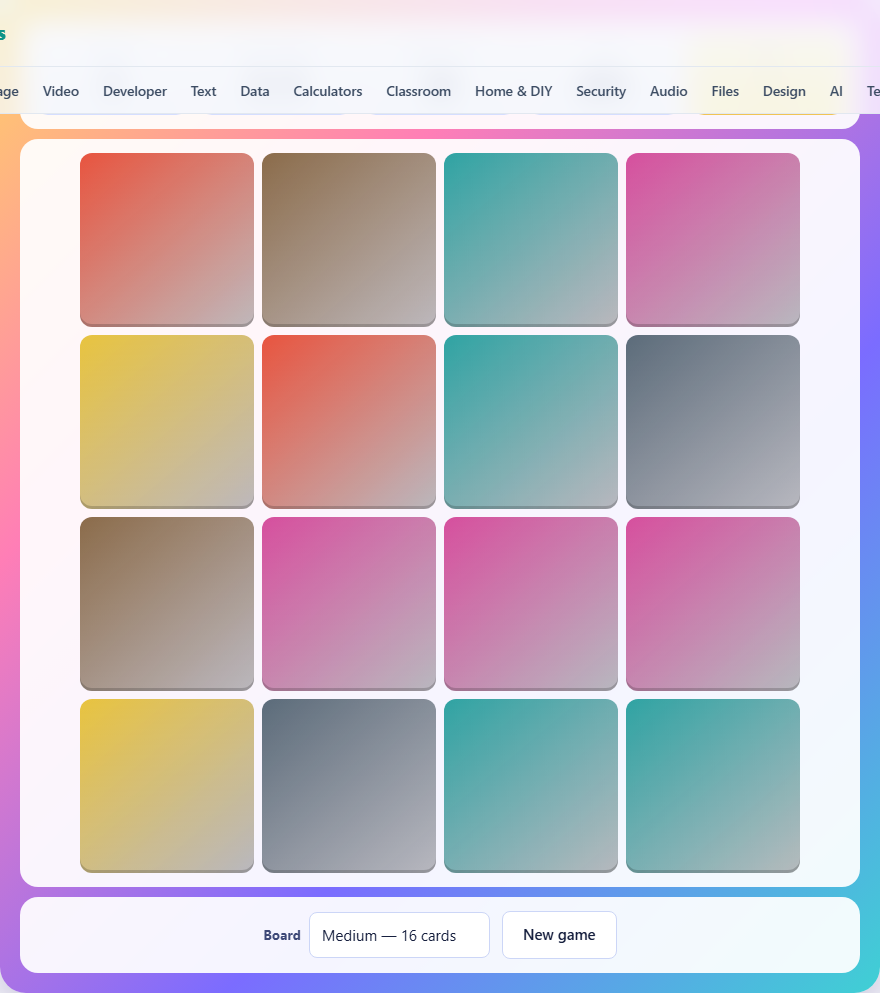
A grid of face-down cards fills the board. Every picture hiding in that grid has exactly one twin somewhere else. Click a card to turn it face up. Click a second card to see if it matches. If the two show the same picture they both stay up and that pair is done. If they show different pictures they flip back down after a short pause.
That pause is the most important moment in the game. Both cards stay visible for about a second. Your job during that second is not to feel disappointed. It is to notice where those two pictures are and file the positions away. Every wrong pair teaches you something. A player who watches during mismatches needs far fewer turns than one who clicks fast and forgets.
Clear every pair on the board and you win. Your score is the number of moves it took, so fewer is better. A move is one attempt at a pair, hit or miss.
The four board sizes
The dropdown below the board offers Easy, Medium, Hard, and Expert. Each one changes how many cards the grid holds and how the grid is shaped.
Easy lays out twelve cards in a four by three grid. That means six pairs. It is gentle enough for a young child and takes under a minute once you have the habit. Medium gives you sixteen cards in a four by four grid, so eight pairs. This is the standard game and the one most people play first.
Hard jumps to twenty-four cards arranged six wide and four tall, twelve pairs. The grid is wide enough that your eyes want to wander, and keeping track of positions becomes a real task. Expert fills a six by six grid with thirty-six cards for eighteen pairs. It is a genuine memory challenge, and the move limit will catch anyone who is not watching their mismatches.
Controls on desktop and phone
On a desktop, click any face-down card to flip it. Click a second face-down card to try for a match. You cannot flip a third card while two mismatched cards are still showing. The board locks during that reveal window to stop a fast click from breaking the pairing.
On a phone or tablet, tap works the same way as a click. The cards resize to fit the screen. On Easy and Medium the cards are big enough to tap with a thumb. On Expert they shrink, but they remain usable on most screens.
Press the New game button under the board to shuffle the deck and start over. Changing the board size in the dropdown also starts a new game. There are no keyboard shortcuts and no settings beyond the size picker.
How your score is counted
One move equals one attempt at a pair, whether it matches or not. Your score is the total number of moves at the end. A perfect game on Medium takes exactly eight moves because there are eight pairs and each can be found in a single try. On Expert, a perfect run is eighteen moves.
That perfect score is not realistic for most players. A realistic good score on Medium is around twelve to fourteen moves. On Expert, finishing under thirty is solid.
A timer runs in the stats bar above the board, but the clock is not the score. It is only there so you can see how long a round took. There is no speed bonus and no penalty for thinking. Take as long as you need on each turn.
The move limit and what it means
Each game allows roughly two and a half moves for every pair on the board. On the Easy board with six pairs, that is fifteen moves. On Medium with eight pairs it is twenty. On Hard it is thirty, and on Expert it is forty-five.
Run out of moves and the game ends, even if pairs remain. The limit is generous for a careful player. If you are watching your mismatches and building a mental map, you will rarely bump into it. But it is tight enough to punish random clicking. Someone who taps cards without trying to remember will run dry before the board is clear.
The limit exists to create a difference between thoughtful play and guessing. Without it, even a random approach would eventually clear the board. With it, paying attention to your wrong turns is not optional.
Scanning in rows instead of jumping around
The strongest habit you can build is a scanning order. Most people find that flipping cards left to right along each row, starting from the top, beats clicking at random. The reason is spatial. When you remember a picture you also remember roughly where it was, and that spatial sense is much stronger when the cards were revealed in a pattern your eyes expect.
Start each game by flipping the first card in the top-left corner, then the one next to it. Whether they match or not, you now know two faces and two positions. Move along the row. By the time you reach the end, you may already recognise a face you saw earlier and know exactly where its twin sits.
On Expert the scanning order matters even more. The grid is six columns wide and six rows tall. Without a system you will waste turns re-flipping cards you already saw but cannot remember.
Making wrong turns work for you
A mismatch reveals two pictures and two positions at the cost of one move. That is not a failure. It is two pieces of information. When you flip a card later and see a picture you recognise from an earlier mismatch, you already know where its twin lives.
This is the main difference between a beginner and a practiced player. A beginner treats a wrong pair as a wasted move. A practiced player sees it as fuel for the next turn. Two early mismatches can save four moves later, because every face you file away is a guaranteed match waiting to happen.
The trade-off is simple. You want to reveal new cards, not re-flip ones you have already seen. If you flip a card you already know does not match the one showing, you have wasted a move and learned nothing new.
Clearing known pairs without delay
When you are certain you know where a pair is, clear it right away. Do not delay a known match to go exploring. Every matched pair leaves the board, which means fewer faces to track. On Expert with eighteen pairs in play, your mental map has room for maybe eight or ten positions at a time. Clearing a pair frees space in that map for the ones still hiding.
There is a rhythm to a good game. Explore for a few turns, spot a match from memory, clear it, explore again. Each cycle shrinks the board. By the halfway point you are working with a much smaller grid and your hit rate climbs.
Mistakes that cost moves
- Clicking too fast during the reveal. The cards stay face up for about a second after a mismatch. If you are already hunting for the next click before they flip back, you are throwing away the one piece of information the game gives you for free.
- Re-flipping a card you already know. Before you tap, ask yourself whether you have seen this face before. If you have, and you know it does not match the card already showing, pick a different card.
- Ignoring the move limit. On Easy and Medium the limit is forgiving. On Expert it is tight. More than a third of your turns wasted on blind guesses will leave you short.
- Jumping around the board. Random clicking kills spatial memory. A consistent scan path gives your brain a grid to pin faces onto.
- Rushing Expert. Eighteen pairs is a lot of information. There is no time penalty, so slowing down costs nothing. Speed only matters after you are already good.
Everything stays on your own machine
The deck is shuffled inside your browser. No cards, no scores, and no move counts leave this device. Your best score for each board size lives in the browser's own storage and is never sent to a server. Close the tab and everything stops. Open it again and your personal best is still there, but nobody else has ever seen it.