
Remembering a growing sequence of colours and sounds
How the memory game works round by round, why listening is more powerful than watching, the chunking trick that gets most people past round seven, and a practical guide to the controls, the mute option, and the keyboard shortcut.
What happens each round
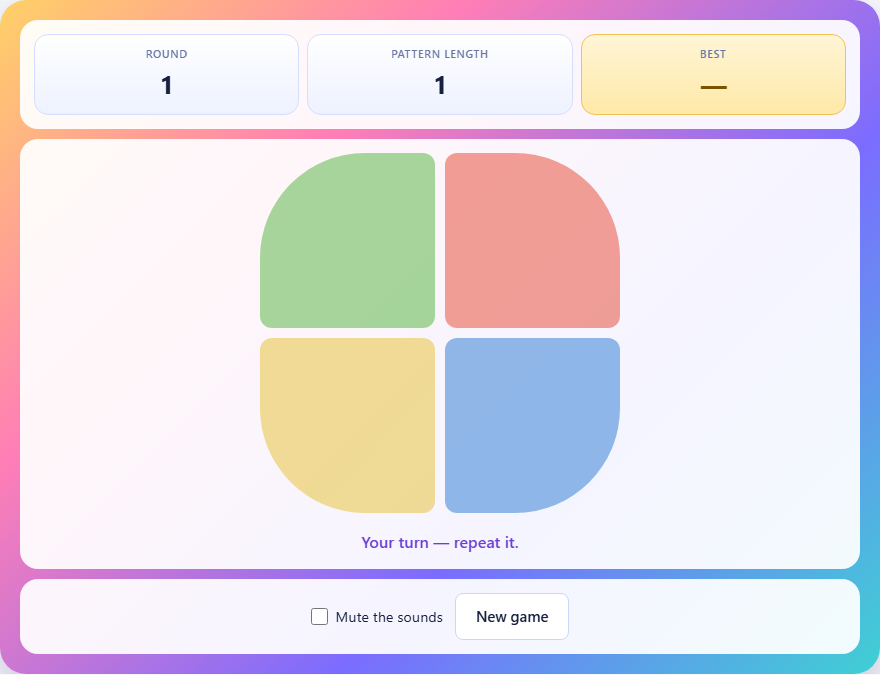
Four coloured pads sit on the screen: green, red, yellow, and blue. The game picks a random pad and lights it up with a matching sound. That is round one. You press the same pad. If you get it right, the game adds one more step to the end of the sequence and plays the whole thing again from the start. You repeat the entire sequence, not just the new step.
Every round the pattern grows by one. Round two has two lights. Round five has five. Round ten has ten. The game always replays the full sequence before your turn, so you hear and see it every time. One wrong press ends the run.
The four pads and their sounds
Each pad has its own musical note. Green is the lowest, then red, then yellow, then blue is the highest. They span roughly an octave, chosen so that a correct sequence sounds like a simple melody rather than a random jumble.
This is not a cosmetic detail. The sound is doing half the work for you. When a pattern lights up green, red, red, blue, it also plays low, middle, middle, high. Most people find it far easier to remember a short tune than a sequence of colours, even when they do not realise they are relying on their ears.
Controls: pads, keyboard, and mute
On a desktop, click a pad with your mouse. On a phone, tap it with your finger. The pads are large and well-spaced, so mistapping one for another is unlikely unless you rush.
There is also a keyboard option. Keys one, two, three, and four map to the four pads in reading order: one is the top-left pad, two is the top-right, three is the bottom-left, and four is the bottom-right. Using the keyboard means your eyes can stay on the pads without moving to aim a cursor.
A mute checkbox sits below the pads. Ticking it turns off all sounds. The game still works, but most people find it noticeably harder without the audio cues. Mute is there for situations where you cannot use sound, not because silent mode is recommended.
What happens when you press wrong
The game stops immediately and plays a low buzzing tone. The message underneath the pads tells you which pad it should have been and how many steps you remembered correctly out of the total. This feedback is deliberate. Being told only that you were wrong teaches you nothing. Knowing it was blue on step six tells you exactly where your memory broke and what part of the sequence tripped you up.
The pattern is generated fresh every game. There is nothing to study between rounds and no set sequence to memorise across sessions. Each run is a clean start with a brand new random sequence.
Scoring and the twelve-round finish line
Your score is the number of rounds you completed. If you make it through round five, your score is five. The game tracks your best score in your browser.
There is a built-in finish line at twelve rounds. If you correctly repeat a twelve-step pattern, the game declares a win with a congratulations message. Most people stop somewhere between five and nine. Reaching twelve means you held a twelve-item sequence in short-term memory, which is well above average.
Past round twelve, the game does not continue. Twelve is the cap, chosen because going further would test patience rather than memory.
Why the playback speeds up
As the pattern grows longer, the playback gets a little faster. Round three plays noticeably slower than round ten. This is intentional. Without the speedup, watching a twelve-step pattern would take uncomfortably long and break your concentration.
The speed does not increase forever. It stops at a floor so the lights are always visible long enough to identify. Past that floor, the playback rate stays constant. The game is testing memory, not reflexes. If the lights flashed faster than you could see them, it would be unfair.
Presses during playback are ignored
While the pattern is playing, the pads do not respond to clicks or taps. This is on purpose. If early taps were counted, an eager player might accidentally submit an answer before the pattern finishes, and the game would mark it wrong for a question that was not yet fully asked.
A message underneath the pads says when it is your turn. Wait for it. The slight pause between the end of playback and the prompt appearing gives your brain a moment to form the sequence before you start tapping.
Listen, do not just watch
The single most effective strategy is to rely on your ears. Each pad plays a distinct note, so a five-step pattern becomes a five-note tune. Human memory for short melodies is remarkably strong. Most people can hum back a five or six note phrase after hearing it once, but ask them to repeat five random colours and they struggle.
If you are playing with sound on, close your eyes during the playback and just listen. You will often find that you can replay the tune in your head and translate it back to pads as you press them. This technique alone can push your score from six or seven to nine or ten.
Saying colours out loud
Another strategy that helps is to name each colour as it lights up. Say the words out loud or mouth them quietly: green, red, red, blue. This engages a different part of your memory from watching. You end up with two copies of the sequence in your head - one visual, one verbal - and they back each other up.
Combining this with listening to the sounds gives you three channels: sight, sound, and speech. They do not compete with each other. They reinforce each other. It sounds like overkill for a four-step pattern, but by round eight, every extra channel matters.
Chunking the sequence into groups
Past about six steps, trying to remember the whole pattern as a single list becomes unreliable. The well-known trick is chunking: break the sequence into groups of three or four. Instead of remembering green red blue yellow green red blue blue, remember green-red-blue, then yellow-green-red, then blue-blue.
This is the same technique that makes phone numbers easier to remember. Nobody memorises 5551234567 as ten separate digits. They remember 555, 123, 4567. Three short groups are easier than one long string.
The groups do not have to correspond to anything. They are just containers. When you are tapping back the pattern, think of each group, tap it out, then move to the next one. The pause between groups is fine. There is no time limit on your turn.
Mistakes that cut your run short
Rushing through your turn is the most common way to lose a step you actually knew. You tap fast, get into a rhythm, and hit the wrong pad not because you forgot the sequence but because your hand moved before your brain finished. Slow down. There is no time limit on your turn.
Another mistake is staring at one pad while the playback runs. The light you are watching is the one you just saw. Meanwhile the next light fires on the other side of the grid and you catch it only from the corner of your eye. Keep your focus in the centre of the four pads so all four are in view at once.
A third error is giving up on sound. Playing muted is much harder. If you are in a quiet room and feel embarrassed by the beeps, use headphones rather than turning the notes off. The sounds carry more information per second than the colours do.
How far most people get
Five to nine rounds is the typical range. People who use sound and chunking together tend to land at the higher end. People who rely on watching alone tend to hit a wall around six.
Past about twelve you are essentially memorising a melody. If you have any musical training, this gives you a clear advantage because you are used to remembering sequences of notes. But even without training, the listen-and-chunk approach gets most people further than they expect.
Your game stays on your machine
The pattern is generated inside your browser using random numbers. No data is sent to any server. There is no account, no login, and no record of your games anywhere except in your browser's storage on this device. The sounds are created on the spot using your browser's audio system, not downloaded from a server.
You can play offline. Once the page has loaded, everything it needs is already on your machine. Turning off the internet changes nothing about how the game works.