
Finding every hidden word on a shaken letter grid
A grid of letter dice, a three-minute clock, and a dictionary of over a hundred thousand words. Your job is to trace paths through neighbouring tiles and build as many words as you can before time runs out. This guide explains exactly how the board works, how the scoring rewards long words far more than short ones, and the habits that separate a quick scan from a thorough sweep.
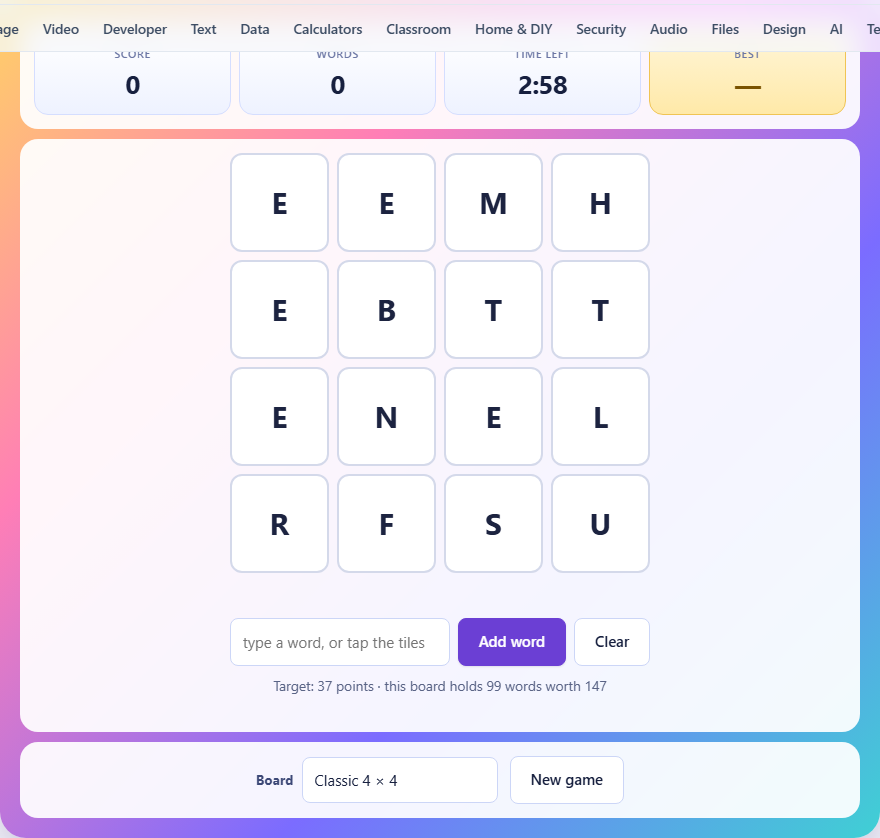
The grid, the dice, and what makes each shake different
The classic board is four tiles wide and four tiles tall. Each tile is one die from a set of sixteen, and each die has six printed faces with specific letter distributions. The game shakes these dice and drops them into the grid, one per cell. Because the faces are not random letters but a carefully balanced set, almost every shake produces a board with enough vowels and consonants to hold dozens of playable words.
The balance matters. Purely random letters would give you boards full of consonants with no vowels, or clusters of rare letters with nothing to spell. The real dice solve that problem. A shake might still come out thin, and when it does the game quietly shakes again until the board holds at least fifteen words. You never see a board that was born empty.
Tracing a path through the tiles
A word is valid when every letter in it can be reached by stepping from one tile to a neighbouring tile. Neighbours include the tiles directly above, below, left, right, and all four diagonals. Each tile may only be used once per word, so you cannot bounce back and forth through the same cell to repeat a letter. The path does not have to be a straight line. It can wind, turn corners, and double back as long as each step lands on a tile next to the one before it and no tile is reused.
Two ways to enter a word
You can tap tiles on the grid one by one. Each tap highlights the tile and adds its letter to the word you are building. The display above the grid shows the word growing as you tap. When you are satisfied, press the Add word button and the word is checked. If you tap the wrong tile, tapping the last tile again removes it, letting you step back without clearing the whole path. The Clear button wipes the path entirely.
Typing is the other option. Click or tap the text field, type a word, and press Enter. The game checks whether the word exists in the dictionary and whether a valid path through the board can spell it. If both checks pass, the word counts. Typing is faster when you spot a word by eye and do not want to trace each letter. The board does the tracing for you behind the scenes.
How scoring rewards length
Short words earn modest points. A three-letter or four-letter word is worth one point each. Five letters earn two points, six letters earn three, seven letters earn five, and anything of eight letters or longer earns eleven points. That steep curve is the heart of the game. Ten three-letter words give you ten points. A single eight-letter word gives you eleven. Chasing long words is risky because the clock is ticking, but landing one can jump you past the target in a single move.
The target itself is not a fixed number. When the board is shaken, the game solves every word the grid contains, adds up all their points, and sets the target at a quarter of that total. A rich board with many long words asks for more. A difficult board with fewer options asks for less. The target is always fair for that exact shake, which means you can never blame the board for an impossible goal.
The Qu tile and how it behaves
One die in the classic set has a face printed with the letters Qu together. On the grid it appears as a single tile showing Qu, but when you trace through it or type a word containing qu, both letters are counted from that one cell. You do not need to find a separate U after a Q. This mirrors the physical dice in the boxed game, where the Q face always carries its U.
Words that use the Qu tile follow all the same adjacency rules. The tile itself is one step in the path, and the tiles around it are its neighbours. Because qu gives you two letters for one step, words passing through it can be longer than you expect for the number of tiles they touch.
Start with the short words and build outward
The temptation is to hunt for the longest word on the board right away. Resist it, at least for the first minute. Scanning the board for three-letter and four-letter words fills your list quickly and builds a base of points while your eyes learn the layout. Once you have banked fifteen or twenty small words, your brain has quietly mapped the board, and the longer words start to appear on their own.
A useful habit is to pick a tile and read every neighbour around it, asking whether any combination of two or three tiles spells something. Then move to the next tile and do the same. This systematic sweep catches words that a roaming eye misses. It is slower per word, but it finds more of them.
Suffixes and prefixes are your fastest multipliers
When you find a word, look immediately at the tiles around its last letter. Is there an S nearby? Then the plural probably exists in the dictionary and counts as a separate word. Is there an ED or an ER within reach? Those are new words too, each scored on their own total length. A four-letter word that becomes a six-letter word with an ED suffix jumps from one point to three.
Prefixes work the same way in reverse. Common starts like RE, UN, and DE open up dozens of possibilities. If you spot an R next to an E in a useful part of the board, run through every word you can think of that begins with RE and check whether the rest of the letters happen to sit nearby. This is not guessing. It is narrowing the search to the most productive part of the dictionary.
Scan from the rare letters
Most of the board is made of common letters. The rare ones, like X, Z, J, and K, appear on fewer dice faces and show up less often. When one does appear, it anchors a smaller set of possible words, which makes them easier to find. A tile showing X probably leads to words like AXE, OX, or WAX if the right vowels sit beside it. Checking the rare letters first gives you a quick harvest before you start the slower sweep through the common ones.
This also helps with the Qu tile. Because Q is unusual, the words it participates in are a shorter list. QUIZ, QUAKE, QUEST, and QUIET are all common. If the Qu tile has the right neighbours, those words are findable in seconds.
Mistakes that cost time and points
The most common mistake is entering a word you already found. The game rejects duplicates with a message, but the seconds you spent typing it are gone. Keep half an eye on your word list as it grows so you do not retrace the same ground.
Another frequent error is attempting a word that cannot be traced on the board. You might see the right letters scattered across the grid, but if they are not connected by a chain of adjacent tiles, the word does not count. Typing is where this bites hardest, because you cannot see whether a path exists until you submit. If you are unsure, tap the tiles instead. The game only lets you tap valid neighbours, so if you finish the word by tapping, the path is guaranteed.
Spending too long on one promising cluster is a subtler mistake. You spot five letters that almost spell something great, and you rotate them in your head for thirty seconds trying to make it work. Meanwhile the rest of the board sits untouched. Set a mental limit: if a word does not appear in five seconds, move on and come back later.
The big board and its higher minimum
The Board selector offers a second option labelled Big Word Shaker 5 x 5. This uses twenty-five dice instead of sixteen, giving you a larger grid with more tiles and more possible paths. The important difference is that three-letter words do not count on the big board. The minimum length rises to four letters, matching the rules of the larger boxed set. This changes the pace. You lose the quick harvest of tiny words and have to think in longer chains from the start.
The big board also sets its own target based on the words it actually contains. Because there are more tiles and more paths, the total score available is higher, but so is the target. The difficulty is roughly the same, just shifted toward longer thinking rather than rapid scanning.
Where the words come from and where your guesses go
The word list is the ENABLE dictionary, a public-domain collection of over a hundred thousand English words that has been the standard for word games for decades. It loads once with the page and every lookup happens on your own device. No word you try is sent to a server, and no record of your game leaves your browser. The board-solving step that finds every possible word also runs locally, which is how the game can set a fair target and tell you afterwards exactly how many words you missed.