
Climbing the word ladder in fewer steps
Word Ladder gives you a start word and a target word of the same length. Change one letter at a time, making sure every step is a real English word, until you reach the target. The challenge is doing it within the step limit. This guide walks through the rules, shows how to plan a route from both ends at once, and covers the traps that send beginners on long detours.
How the puzzle is set up
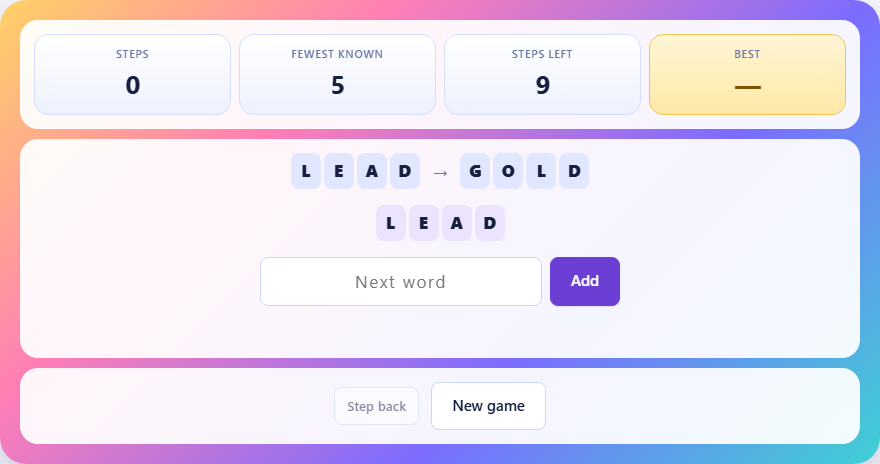
When you start a game, two words appear at the top of the board with an arrow between them. The word on the left is your starting point, and the word on the right is the target. Below them sits your chain, which begins with just the start word. Your job is to extend that chain, one word at a time, until the target word sits at the bottom.
Each puzzle is built around a known shortest path. The stats bar shows this as the fewest known number of steps. Your step limit is that shortest path plus four extra steps, which gives you room for detours without making the puzzle trivial. The Steps counter tracks how many words you have added, and Steps left shows how many you can still use.
Rules for each step
Every word you add must follow three rules. First, it must be exactly one letter different from the last word in your chain. You can change any single position, but you cannot swap two letters at once or change more than one. Second, the word must appear in the puzzle's own word list. Not every English word is in every puzzle, so a perfectly real word may be rejected if it was not included. Third, you cannot reuse a word that is already in your chain.
Type your next word into the input field below the chain and press Add or hit Enter. If the word is valid, it appears at the bottom of the chain with a downward arrow connecting it to the previous word. If it breaks any of the three rules, you get a feedback message explaining why.
The Step back button and why it is free
If you take a wrong turn and end up stuck, press Step back. It removes the last word from your chain and does not count against your step limit. You can step back as many times as you like, all the way to the start word if needed. This means exploration is cheap. You can try a side path, decide it leads nowhere, undo it, and go a different way without any penalty.
The step counter goes down when you step back, and the steps-left counter goes up. So stepping back genuinely restores your budget rather than just hiding the word.
Working from both ends at once
The strongest technique in word ladders is thinking about the target at the same time as the start. Before you type your first word, look at the target and ask which words are one letter away from it. Then look at the start and ask the same question. If both lists share a word or a similar group of words, you have a rough map of the middle section.
For example, in the puzzle COLD to WARM, the target WARM is one letter from WARD, WORM, and WART. The start COLD is one letter from CORD, BOLD, and WOLD. If you can see a path from CORD through CARD to WARD, you have found a route through the middle. Players who only work forward from the start often wander into dead ends because they never checked whether their direction leads anywhere useful.
Vowels as escape routes
When you are stuck and no consonant change produces a valid word, try changing a vowel. Vowels connect to far more real words than consonants do, because English spelling allows many vowel swaps. Changing the A in BAND to every other vowel gives BEND, BIND, BOND, and BUND. Changing the B gives fewer results.
This pattern makes vowels the most flexible letters in any ladder. If your chain has reached a dead end where every consonant swap leads to something outside the puzzle's word list, swapping a vowel often opens a new branch. Keep this in mind especially in the middle of a long ladder, where the path between start and target may pass through an unexpected vowel shift.
Choosing which letter to change at each step
At every step you can change any one of the four letters. A natural approach is to change the letter that is furthest from the target first, but that is not always the best order. Sometimes the easiest letter to change is the one that opens the most valid words, even if it does not match the target immediately.
Look at your current word and the target, and count how many letters already match. If two letters match, you need two changes. The question is which to change first. Try the position where the current letter produces the fewest real words. If that position is inflexible, locking it in early avoids getting stuck later. Leave the most flexible position for last, because you will have more options when it is the only letter left to change.
Another useful habit is to look for stepping-stone words that share three letters with both your current word and the target. A word like that acts as a bridge and usually means you are one step away from either side.
How scoring works
Your score for a completed puzzle is the number of steps you used. Lower is better. If you match the fewest-known count, you have found the shortest route, and the finish message tells you so. If your route is longer, the message shows both your count and the shortest known, so you can see how much room there was to improve.
Your best score across all games is saved in your browser on this device. It is the fewest steps you have ever used to complete any puzzle. Because different puzzles have different shortest paths, your best score reflects your most efficient solve overall rather than the easiest puzzle you happened to get.
Common mistakes that eat steps
The most frequent mistake is drifting sideways. You change a letter that feels productive but does not bring you closer to the target. After three or four sideways steps your budget is half gone and you are no closer than when you started. Before every step, check whether the word you are about to add shares at least one more letter with the target than the word you are leaving.
Another mistake is forgetting that the word list is limited. A word can be a perfectly real English word and still be rejected because the puzzle was built around a specific set of words. When this happens, do not keep trying variations of the same root. Step back and try a completely different letter change.
Finally, beginners sometimes avoid stepping back because it feels like losing progress. In reality, stepping back is the fastest way to recover from a bad path. Two steps forward and two steps back costs nothing from your budget. Two steps forward into a dead end followed by three more steps trying to escape costs three turns you cannot get back.
A worked example from COLD to WARM
Start with COLD. Change the L to an R and you get CORD. Change the C to a W and you get WORD. Change the O to an A and you get WARD. Change the D to an M and you get WARM. That is four steps, which matches the shortest known path for this puzzle.
Notice how each step changed a different letter, and at every point the chain moved towards the target by getting one more letter right. After CORD, the word already shares the R with WARM. After WORD, it shares both the W and R. After WARD, three of four letters match. The final step finishes the job.
When alternative routes help
The game accepts any valid word in its list, not just the words on the intended shortest path. This means you can find routes the puzzle designer did not plan. If the shortest path goes through an obscure word you cannot think of, a longer route through common words is perfectly valid, as long as you stay within the step limit.
Sometimes the intended path is not the most obvious one. If you find a natural-sounding route that takes one extra step, it is often better to use it and finish than to spend three extra steps searching for the shorter path you cannot see. The step limit has slack built in for exactly this reason.
Privacy and how the game runs
The whole game runs inside your browser. Nothing is uploaded, there is no account, and your best score is stored in this browser on this device only. Once the page has loaded, it works offline.