
Winning the five-letter word guessing game in fewer tries
Word Guess gives you six attempts to find a hidden five-letter word. After each guess the letters turn green, yellow, or grey to tell you how close you are. Unlike the well-known daily version that limits you to one puzzle a day, this one lets you play as many rounds as you want. This guide covers the rules, explains how the colour system works with repeated letters, and shares the thinking that consistently finds the answer in three or four guesses.
How a round works
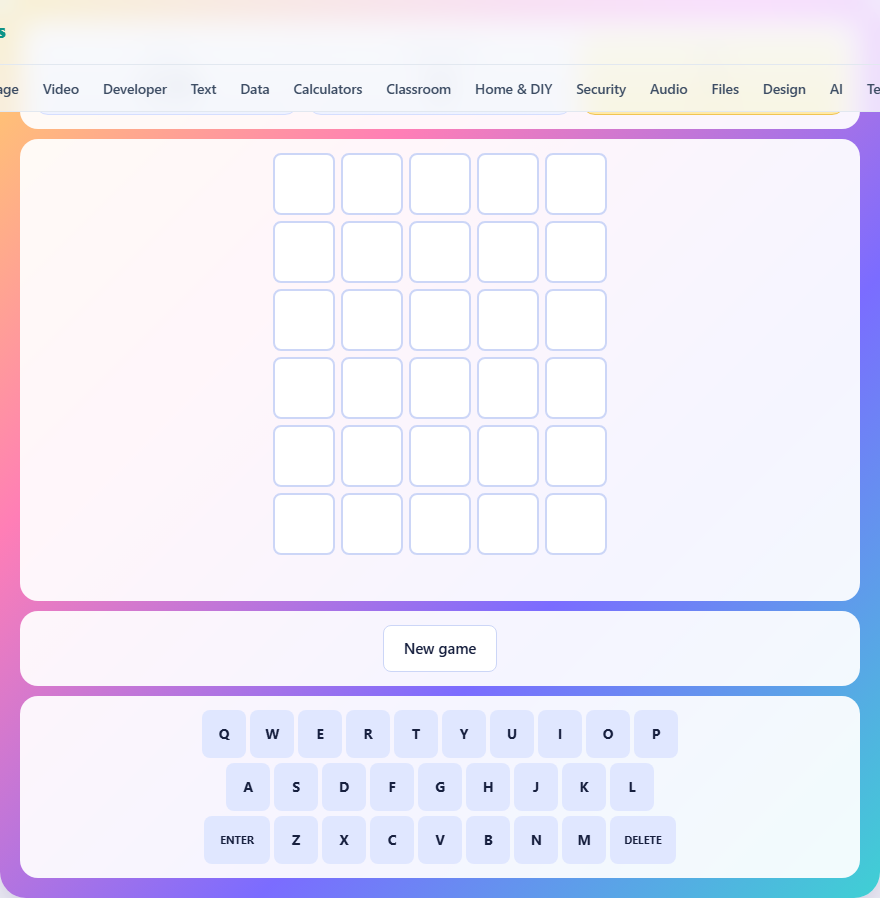
When you open the page or press New game, the game picks a random five-letter word from its answer list. You do not see the word. Type any five-letter English word using your physical keyboard or the on-screen letter buttons, then press Enter. The game checks your guess against the hidden answer and colours each tile.
Green means that letter is correct and in the right position. Yellow means the letter appears in the answer but not at that spot. Grey means the letter is not in the answer at all. You get six guesses. If you find the word within those six tries, you win. If not, the answer is revealed.
The on-screen keyboard and its colours
Below the guess grid sits a three-row keyboard. Every time you submit a guess, the keyboard updates its letter colours to match. A key turns green if that letter has been found in the right place, yellow if it is in the word but not yet placed, and grey if it has been ruled out. This running summary saves you from scrolling back through your guesses to remember which letters are still alive.
The keyboard always shows the best result each letter has ever achieved. If you guess a letter in the wrong spot on try two and then place it correctly on try three, the key stays green from that point on. This means a quick glance at the keyboard tells you which letters to keep, which to reposition, and which to forget.
How repeated letters are coloured
This is the detail that trips up most players. When your guess contains a letter more than once but the answer has it fewer times, only some of those tiles will light up. The game first marks exact matches as green, consuming one instance of that letter from the answer. Then it goes through the remaining tiles and marks yellow only if the answer still has an unused instance of that letter.
For example, suppose the answer is THESE and you guess GEESE. Both words have three Es, but only the Es in positions three and five match exactly, so those go green. The E in position two is not in that spot in the answer, but there is still one unused E, so it goes yellow. The E in position one has nothing left to match, so it goes grey. Understanding this system lets you reason about exactly how many times a letter appears, which is powerful information.
Choosing a strong opening guess
Your first guess should collect information, not chase a win. Pick a word with common letters spread across different positions and include at least two vowels. Words like RAISE, SLATE, and AUDIO each test five different frequent letters in a single guess. After one of these, you typically know two or three letters that belong in the answer and several that do not.
Avoid opening with words that repeat a letter. Guessing GEESE on turn one tests only three distinct letters instead of five, which wastes almost half your information budget. Also avoid words loaded with uncommon letters like X, Z, or Q on the first try. Those letters appear in very few answers, so testing them early is usually a blank.
Making the most of yellow tiles
A yellow tile tells you two facts at once. First, the letter is somewhere in the answer. Second, it is not in the position where you just placed it. Both facts are useful. On your next guess, put that letter in a different spot. If the new spot turns green, you have locked it. If it turns yellow again, you have ruled out two positions and the letter must be in one of the remaining three.
Beginners often waste a guess by leaving a yellow letter in the same position it was before. The tile will go yellow again, confirming what you already knew but teaching nothing new. Move every yellow letter to a new position on every guess, and you learn something with every single tile.
When you get two yellow tiles in the same guess, consider whether the answer might have those letters in swapped positions. If you guessed TRAIL and the T and R are both yellow, ask whether RATIO or RETRO might put them where they belong. Two yellows swapping to two greens in a single guess is one of the most satisfying jumps you can make.
Narrowing from four known letters to the answer
By guess three or four you often know four of the five letters and their positions. The puzzle then becomes finding the one missing letter. Mentally walk through the alphabet for that open slot and check which real words the candidates produce. Most of the time only one or two possibilities exist.
If more than two words fit, pick the guess that tests the most remaining candidates at once. Suppose the open slot could be B, L, or T. If a word outside the answer list uses two of those letters, guessing it can rule out two candidates in one try, even if the guess itself is not the answer. This kind of sacrificial guess is what separates a four-try solve from a six-try scramble.
A worked example from opener to answer
Suppose you open with RAISE. The R and A are grey, the I turns yellow, the S turns green in position four, and the E turns yellow. You now know the answer has no R or A, has an I somewhere other than position three, has an S in position four, and has an E somewhere other than position five.
For your second guess, pick a word that uses the I and E in new positions while testing fresh consonants. UNITE would test U, N, and T while placing the I in position three and the E in position five. If the N turns green in position two and the I turns green in position three, you have locked three of five letters: something-N-I-S-something. A quick mental scan finds ONSET does not fit, but maybe UNIST is not a word. Keep thinking, and INSECT is too long. You land on a word, type it, and the board lights up green.
This step-by-step process of locking greens and shuffling yellows is how nearly every strong solve unfolds. Each guess narrows the search space until only one word fits.
Scoring and tracking your results
The game tracks two things. The Games won counter increases each time you find the answer within six guesses. Your best score is the fewest guesses you have ever needed. Both numbers are stored in your browser on this device only. There is no leaderboard and no account.
The ideal result is a one-guess solve, which is pure luck. A two-guess solve is rare but possible with a very lucky opener. Consistently finishing in three is expert-level play. Four guesses is a strong average for an attentive player, and five is perfectly normal when the answer has unusual letter patterns.
Common mistakes that waste guesses
The single biggest waste is reusing a grey letter. Under time pressure it is easy to type a familiar word without checking whether every letter in it is still alive. A quick look at the keyboard before pressing Enter catches this every time.
Another mistake is guessing a word that does not test any new letters. If your first two guesses have already tested ten distinct letters, your third guess should test five new ones whenever possible. Repeating letters you have already confirmed yellow or green is only worthwhile when you are placing them in their final positions.
Finally, some players hesitate to guess a word they think is too unusual. The game accepts any five-letter combination that passes a generous word check, so even a less common word will be accepted as a guess if it looks like real English. Do not hold back a useful guess just because it feels obscure.
Privacy and how the game runs
The word is chosen entirely inside your browser each time you press New game. Nothing is sent to a server. There is no account, no daily limit, and no waiting. Your win count and best score live in your browser's local storage on this device only, so they stay private and will not follow you to another machine.