
Solving pulley-and-winch logic puzzles step by step
Windlass is an original logic puzzle that replaces the usual grid with a mechanical rig. Platforms hang on ropes threaded through pulleys, and every winch you turn moves several platforms at once. Some go up, some go down, and finding the combination whose side effects cancel each other out is the whole challenge. This guide explains the rules, the controls, and the thinking that helps you solve each rig without running out of turns.
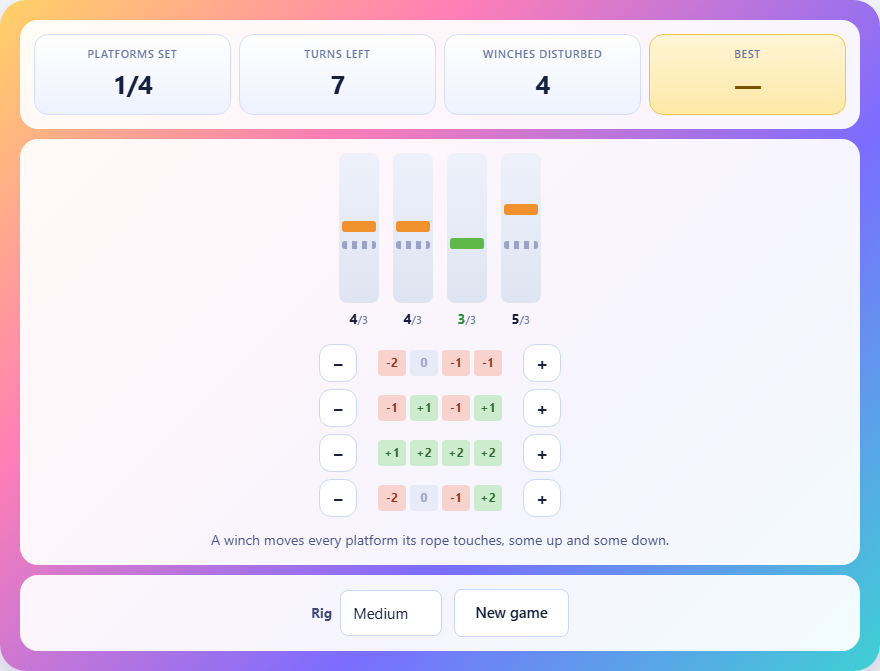
What the board shows you
The top half of the board is a row of vertical shafts, one per platform. Each platform sits at some height within its shaft, shown as a solid block. A dashed mark in the same shaft shows the target height. The number below each shaft reads the current height and the target side by side, so you can see the gap at a glance.
The bottom half is a row of winches. Each winch has a minus button on its left, a plus button on its right, and a strip of coloured numbers in between. Those numbers describe what one forward turn of that winch does to each platform. Green means the platform goes up by that amount. Red means it goes down. Grey with a zero means that platform is not connected to this winch at all. This strip never changes during a game. Only the platforms move.
Rules of the puzzle
Your goal is to bring every platform onto its dashed mark at the same time. You do this by pressing the plus or minus buttons on the winches. Each press counts as one turn. Plus applies the winch's effects as printed. Minus applies the exact opposite, so a winch that lifts platform A by two and drops platform B by one will, when turned backwards, drop A by two and lift B by one.
You have a limited budget of turns. The budget is the number of winches that were turned to scramble the rig, called the par, plus a few extra turns of slack. If you run out of turns before all platforms are set, the game ends. There is no undo button, but because minus exactly reverses plus, you can always undo a turn by pressing the opposite button, though that costs you one more turn from your budget.
How the rig is built and why it is always solvable
Every puzzle starts from a solved position where all platforms sit on their marks. The game then turns a known number of winches in random directions to scramble the machine. Because turning a winch backwards undoes exactly what turning it forwards did, the marks can always be reached again by reversing those scramble moves. Any scramble that would push a platform past the top or bottom of its shaft is thrown away and tried again, because a platform held against a stop loses track of how far it really moved.
The par displayed in the stats is the number of scramble turns, so matching it means you found the most direct path back. Beating it is sometimes possible when two scramble turns partially cancel each other, but matching it is a strong result.
Controls and difficulty levels
The Rig dropdown offers three sizes. Small gives you three platforms and three winches with a scramble of three turns. Medium raises everything to four of each. Large goes to five platforms, five winches, and five scramble turns. The shaft heights also increase on harder levels, which widens the range each platform can travel and makes the arithmetic more demanding.
Press New game at any time to generate a fresh rig at the current difficulty. The game tracks your best score, measured in total turns used. Lower is better. Your best is stored in your browser on this device only.
Start with the platform that has the fewest options
Look at the strips on every winch and find any platform that appears as grey on most of them. A platform connected to only one or two winches can only be moved by those winches, so its solution is tightly constrained. Solve that platform first.
For example, suppose platform C is only affected by winch 2 (which lifts it by one) and winch 4 (which drops it by two). If C needs to go up by three, you know winch 2 must be turned forward at least three times, and you know exactly what side effects those three turns will have on every other platform. Write those side effects down mentally and then look for other winches that can fix them.
Think in differences, not positions
The absolute height of each platform matters less than how far it is from its mark. Before you touch anything, scan the numbers and note each gap. Platform A is two above its mark, platform B is one below, platform C is right on target. Now look for a winch whose strip matches those gaps. A winch that drops by two and lifts by one would fix A and B in a single turn without disturbing C if C shows grey on that winch.
This approach turns a spatial puzzle into simple subtraction. When you frame the puzzle as a list of differences, the winch strips become a menu of corrections, and the question becomes which corrections to combine so the final list is all zeros.
Using a winch more than once
Nothing stops you from turning the same winch two or three times. Each extra turn multiplies its effect. If a winch lifts platform A by one and drops platform B by one, turning it twice lifts A by two and drops B by two. This is especially useful when a single winch almost fixes the board but falls short by one step. Before searching for a second winch to make up the gap, check whether doubling the first one gets you closer.
Be careful with the budget though. Every press costs a turn, so two presses of one winch cost two turns, not one. When your slack is thin, doubling a winch can eat through your reserve quickly. On the Large rig the slack is only three turns beyond the par of five, so there is very little room for exploration. Every turn you spend on a double must pay for itself by fixing at least one platform.
Looking for cancelling pairs of winches
The deepest idea in Windlass is that side effects can cancel. Suppose winch 1 lifts platform A by two and drops platform B by one. That is useful if A needs to go up, but the drop on B is a side effect you do not want. Now suppose winch 3 lifts platform B by one and does nothing to A. Turning winch 1 once and winch 3 once gives you a net lift of two on A and zero change on B. The unwanted side effect disappears.
This kind of pairing is the core of every solution. When you cannot find a single winch that fixes the board, search for two winches whose side effects are equal and opposite. The more platforms there are, the harder it is to find a clean pair, which is why the Large rig is so much trickier than the Small one.
Avoiding the stops at top and bottom
Each shaft has a floor and a ceiling. A platform pushed below zero stays at zero, and one pushed above the top stays at the top. The problem is that the clamp destroys information. If a platform is at height three and you turn a winch that drops it by five, it sits at zero, but the rig remembers a drop of three, not five. Turning the winch back will only lift it by five, overshooting where it started.
The practical rule is to avoid hitting the stops. If a move would send any platform into the floor or ceiling, look for a different order. Solve the middle of the range first, so no platform is near an edge when a big correction comes through.
Common mistakes and how to recover
The most frequent error is solving platforms one at a time without noticing the side effects on the others. You set platform A, then turn a different winch to fix B, and that winch moves A off its mark again. The fix is to plan at least two moves ahead. Before pressing a button, scan the strip and confirm that every platform either improves or stays put.
Another mistake is spending too many turns exploring. Because minus undoes plus, some players toggle a winch back and forth to see what it does. Each toggle costs two turns. If your slack is only two or three, a single round trip spends most of it. Instead, read the strip carefully. The numbers tell you everything a press will do, so there is no need to try it and undo it.
If you do run low on turns, focus on the platforms that are closest to their marks. One accurate turn that finishes two platforms at once is worth more than a turn that moves three platforms in the right direction but finishes none.
Privacy and how it runs
The entire puzzle runs inside your browser. No data is sent to any server, and there is no account to create. Your best score is saved in your browser's local storage on this device only, so it stays private and will not follow you to a different computer.