
Thirty Seconds of Reflexes and Accuracy
This article covers the rules, scoring, and techniques for the mole-tapping game, a thirty-second reflex challenge where moles appear faster and vanish sooner as the clock runs down. Hitting empty holes costs you, so raw speed alone is not enough.
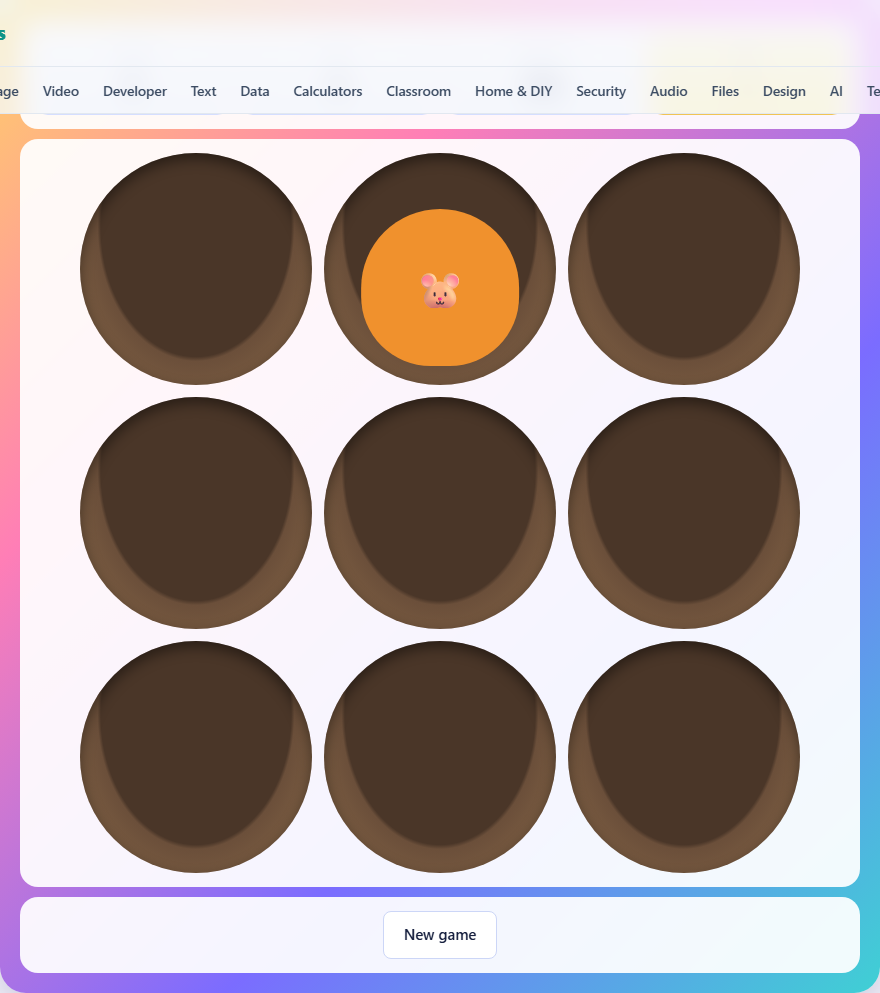
What the game is about
Nine holes sit in a three-by-three grid. Press New game and the thirty-second clock starts immediately. Moles pop up in random holes, and because each one stays up for longer than the gap before the next appears, two are often showing at the same time. Each mole stays visible for a short window, then ducks back down. Tap or click a mole while it is showing to score five points. Tap an empty hole and you lose a point. When the clock reaches zero, the round ends and you see your total score, the number of moles you hit, the number of empty holes you tapped, and your accuracy percentage.
The game gets harder as it goes. At the start of the round, moles appear roughly every eight hundred milliseconds and stay up for just over a second. By the final seconds, they spawn every three hundred and thirty milliseconds and stay up for about half a second. This ramp means the last ten seconds of the round are significantly harder than the first ten.
Scoring rules
Each successful hit earns five points. Each miss, meaning a tap on a hole that has no mole, costs one point. Your score cannot drop below zero. The penalty exists to stop a strategy of hammering all nine holes as fast as possible, which would guarantee every mole is hit but would also rack up dozens of misses. With the penalty in place, accuracy matters.
The target score is one hundred and fifty points. Reaching it or higher counts as a win. One hundred and fifty points means at least thirty clean hits in thirty seconds, which requires roughly one hit per second with very few misses. A player who hits every mole but also taps five empty holes still finishes well above the target. A player who misses frequently will struggle to break one hundred.
Controls
On a phone or tablet, tap the hole where you see a mole. On a desktop, click it with the mouse. The game uses pointer events, so both touch and mouse input work on devices that support both. There is no keyboard control for hitting moles. The only button on the page is New game, which starts a fresh round. There is no difficulty selector. The difficulty is built into the round itself through the speed ramp.
The speed ramp explained
The gap between mole spawns starts at eight hundred milliseconds and shrinks linearly to three hundred and thirty milliseconds by the end of the round. That means the first mole appears after roughly a second, and by the end of the round a new mole is appearing roughly three times per second.
At the same time, the window you have to hit each mole shrinks. It starts at just over one second and falls to about half a second. Early in the round, you have plenty of time to see a mole, move your cursor or thumb, and tap. Late in the round, a mole can appear and vanish before you react if you are looking at the wrong part of the board. Two moles are frequently up at once, and not only late on: at the start a mole lasts about 1.1 seconds while a fresh one arrives every 0.8 seconds, so they overlap from the opening moments. A new mole is always placed in a hole that is currently empty, so two never share one.
Using peripheral vision
The strongest technique for this game is to let your eyes rest near the centre of the board and use peripheral vision to spot moles in any of the nine holes. If you stare directly at one hole, you will catch moles there quickly but miss ones that pop up on the far side of the board. The nine holes are arranged in a tight three-by-three grid, which is small enough for your peripheral vision to cover all of them at once.
This is the same skill used in many reaction-based activities. The key is to resist the urge to chase. When a mole appears in the top-left, you do not need to move your eyes there first. Move your finger or cursor directly. Your peripheral vision saw the mole, so your hand knows where to go. Moving your eyes there wastes a fraction of a second, which adds up over thirty seconds.
Accuracy over speed
Because misses cost a point and hits earn five, the penalty ratio is five to one. That means five misses wipe out one hit. A player who hits twenty moles and misses zero finishes with one hundred points. A player who hits twenty-five moles but also misses twenty-five holes finishes with one hundred. The second player did more work for the same score.
In practice, a few misses are unavoidable, especially late in the round when the speed ramp is at its highest. But deliberately tapping in the area of a mole you only half-saw is usually not worth it. If you are not confident a mole is up in that hole, wait for the next one. The cost of a miss is small, but it adds up when you do it ten or fifteen times.
Two-thumb technique on mobile
On a phone, holding the device with both hands and using both thumbs gives you much better board coverage than one finger. Your left thumb covers the three left-column holes and your right thumb covers the right three. The centre column is reachable by either. This splits the board in half and roughly halves your reaction distance for any mole.
If you use one finger, you spend a lot of time chasing moles across the board. A mole appears top-left, you reach up to tap it, and by the time you get back another mole has appeared bottom-right. With two thumbs, one of them is always close.
Pacing yourself through the round
Although the round is only thirty seconds, the speed ramp divides it into two phases. The first fifteen seconds are relatively relaxed. Moles appear every eight hundred milliseconds at the start, tightening to a little under six hundred by the halfway mark, and stay up for nearly a second. Use this phase to build your score with clean hits and zero misses. Each clean hit adds five points, and there is plenty of time to be precise.
The second fifteen seconds are frantic. Spawns accelerate, the visible window shrinks, and two moles may be up at once. Accuracy inevitably drops here. Accept that and focus on hitting as many moles as you can rather than avoiding all misses. If you built a strong lead in the first half, a few misses in the second half will not matter.
Common beginner mistakes
The most common mistake is tapping too fast and hitting empty holes repeatedly. The penalty is mild per miss, but ten or fifteen empty taps can drop your score by a full mole's worth.
- Staring at a single hole and waiting for a mole to appear there. The moles are random, so fixating on one spot means missing everything elsewhere.
- Holding the phone with one hand. One thumb has to travel across the entire board, which is too slow for the late-round speed.
- Panicking in the final ten seconds. The speed ramp is steep, but the moles are never more than two at a time. Stay calm, tap what you see, and skip what you are not sure about.
- Not pressing New game quickly enough. The clock starts the moment you tap the button, so be ready. A wasted second at the start is one less second of scoring at the end.
What the end-of-round summary tells you
When the timer reaches zero, the game shows your final score, the number of moles hit, the number of empty holes tapped, and your accuracy as a percentage. Accuracy is calculated as hits divided by total taps (hits plus misses). A score above one hundred and fifty counts as a win. Below that, the game tells you the target.
Tracking your accuracy over several rounds is the fastest way to improve. If your accuracy is below seventy percent, focus on precision before speed. If it is above ninety percent and your score is still low, focus on reacting faster. The balance point for most players is around eighty-five to ninety percent accuracy with twenty-five to thirty-five hits.
Privacy and your device
The whole game runs inside your browser. No data is sent to a server, no account is needed, and your best score is stored locally on this device. It will not appear on another device or in another browser. Once the page has loaded, the game works without a network connection.