
Sorting Coloured Tubes with Careful Pours
This article covers the rules, controls, and strategies for Colour Sort, a liquid-pouring puzzle where every tube must end up holding a single colour. Every puzzle has a solution, and the difference between solving and getting stuck usually comes down to how you manage your empty tubes.
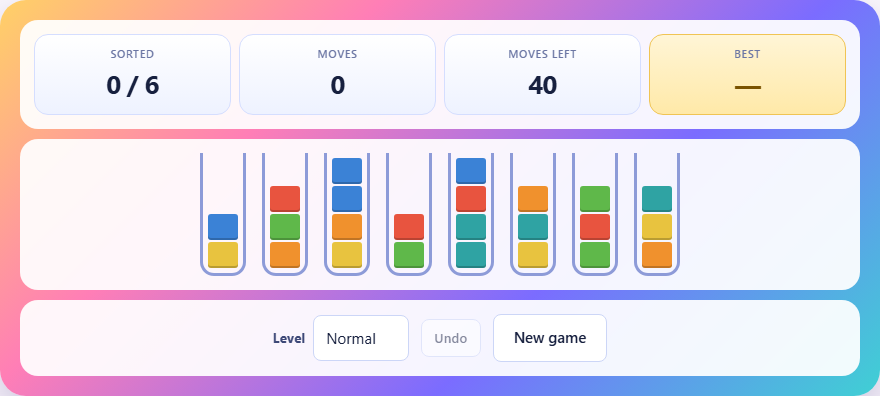
What the game is about
You start with a row of tubes, each filled with four units of colour in a scrambled order, plus a couple of empty tubes. Your job is to sort the colours so that each tube holds only one colour. You do this by pouring from one tube to another, following strict rules about what can go where. The puzzle is finished when every tube that contains anything holds four units of the same colour.
Each puzzle is built by starting from a solved state and pouring backwards at random. Because every step is reversible, a solution always exists. You will never face a board that cannot be completed. The challenge is finding a route through the puzzle within the move limit.
Pouring rules
You may pour from one tube to another only if the colour on top of the source matches the colour on top of the destination, or if the destination tube is completely empty. The destination must also have room. A full tube cannot receive anything.
When the top of a tube has a run of the same colour, the entire run pours at once. If the top three slots of a tube are all blue, tapping that tube and then tapping a tube with blue on top will pour all three at once, provided the destination has enough space. If the destination has room for only two, only two will pour. This run-pouring rule is important because it means a single pour can move several units, which saves moves.
Controls
Tap or click a tube to pick it up. It lifts slightly to show it is selected. Then tap another tube to pour into it. If the pour is not valid, the game shows a message explaining why and deselects the tube. Tap the same tube again to put it back down without pouring.
The Undo button reverses your last pour, but it costs one move from your budget. You can undo multiple times in a row, each costing one move. The Level dropdown offers Easy, Normal, and Hard. The New game button generates a fresh puzzle at the selected level.
How scoring works
Your score is the number of moves you use, including any undos. Lower is better. The scoreboard shows three things: Sorted tells you how many tubes are completely sorted out of the total number of colours, Moves shows how many pours and undos you have made, and Moves left counts down from your budget.
Easy gives you thirty moves to sort four colours. Normal gives you forty moves for six colours. Hard gives you fifty moves for eight colours. All levels include two empty spare tubes. If you run out of moves, the game ends. Your personal best is tracked in the browser across sessions.
Protecting your empty tubes
The single most important strategy is to keep at least one tube empty for as long as possible. An empty tube is the only place you can put a colour that has nowhere else to go. If you fill both spares early with partial colours, you lose your escape route and the puzzle locks up.
Think of empty tubes as breathing room. Every pour into a spare tube should be done with a plan for how to empty it again. If you pour red into a spare and then pour blue on top of it, you now need a third place to put the blue before you can get the red back out. That cascading problem is how most puzzles become unsolvable within the move limit.
A good rule of thumb is to use one spare tube freely and try to keep the other empty until you are sure the puzzle is nearly finished.
Finishing tubes early
A tube with three units of the same colour on the bottom needs only one more to be complete. Finding that fourth unit and pouring it in locks the tube away and frees up space across the board. Scan the tubes at the start for any that are almost done. Completing one tube early often creates a chain reaction where the space freed up lets you finish a second tube, which frees up more space, and so on.
The opposite is also true. A tube with one unit of a colour buried under three different colours is going to be expensive to fix. You need three pours just to uncover it. Prioritise the easy completions first, and deal with the deeply buried colours once you have more room to work with.
Thinking two pours ahead
Before you pour, ask yourself what the colour underneath the run you are about to move will need. If you pour three blue units off a tube and expose a yellow unit, where is the yellow going to go next? If there is no tube with yellow on top and no empty tube, that yellow unit is now stranded and will block you later.
This two-step look-ahead is the habit that separates quick solves from stuck puzzles. It does not require deep calculation. You only need to check one layer down. Is the colour that will be exposed after this pour going to have somewhere to go? If the answer is no, look for a different pour.
When to use undo
Undo is powerful but not free. It costs one move from your budget, and the budget is not infinite. Use undo when you realise a pour has locked you in, not as a way to explore random possibilities. If you poured blue into a spare tube and immediately see that it blocks a yellow you needed to move next, undo right away. The sooner you undo, the fewer wasted moves you accumulate.
On Hard puzzles, where eight colours share the board and only two tubes are spare, a single wrong pour can cascade into three or four undos. That is four moves lost to recover from one mistake. At that cost, it is often better to pause and think for a few seconds before pouring than to rely on undo afterwards.
Common beginner mistakes
The most common error is filling both spare tubes within the first few moves. Once both spares hold mixed colours, you have no room to manoeuvre and the puzzle stalls.
- Pouring without checking what colour is underneath. The exposed colour needs somewhere to go, or you have just created a new problem.
- Ignoring almost-complete tubes. A tube with three of the same colour is one pour from being done and freeing up four slots of space.
- Using undo repeatedly to fish for lucky sequences. Each undo costs a move, and on Hard puzzles the budget is tight enough that five undos can end your game.
- Trying to sort every colour at once. Focus on finishing one or two tubes first. The freed space makes the rest of the puzzle much easier.
- Pouring a single unit into an empty spare when the source tube has a longer run of that colour underneath. The run-pour rule moves the entire matching top at once, so waiting until the run is exposed can save you several moves.
Difficulty levels
Easy has four colours, six tubes total, and thirty moves. This is generous enough to allow plenty of mistakes and undos. Normal has six colours, eight tubes, and forty moves. The board is busier and the budget per colour is lower. Hard has eight colours, ten tubes, and fifty moves. Eight colours means more collisions and more deeply buried units. The two spare tubes feel much tighter at this level.
All three levels use tubes that hold four units each and provide exactly two spare tubes. The spare count does not increase with difficulty, which is the main reason Hard puzzles feel so much harder than Easy ones. On Easy, two spares for four colours means you have one spare for every two colours. On Hard, two spares for eight colours means one spare for every four. That ratio is what tightens the puzzle.
Privacy and your device
The whole game runs inside your browser. Nothing is uploaded, no account is needed, and your best score is stored on this device only. Once the page has loaded, the game works offline.