
Mastering Ultimate Tic Tac Toe Against the Computer
This guide explains the rules, the send mechanic that makes the game deep, and the tactics that separate a first attempt from a consistent win on hard mode.
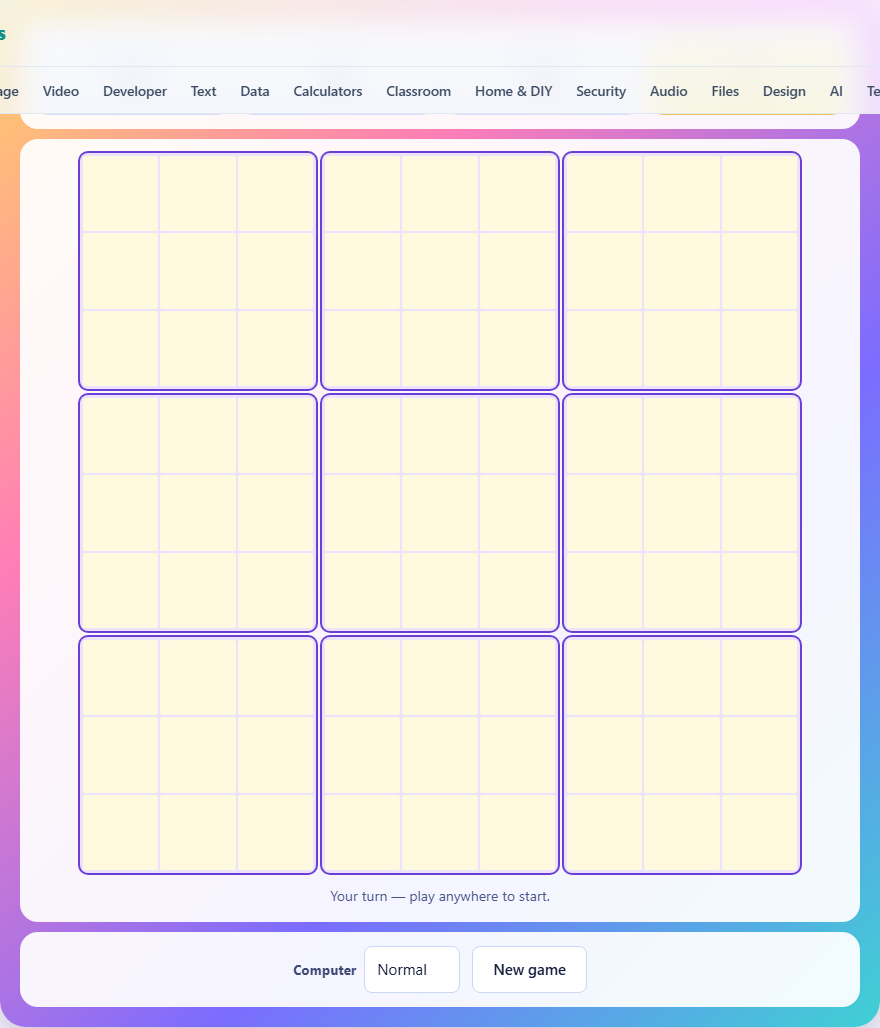
How the two layers work
The board is a three-by-three grid of smaller three-by-three grids, giving eighty-one squares in total. You win a small board the usual way: three of your marks in a row, column, or diagonal. You win the big board by winning three small boards in a line. That part is easy to grasp. The part that changes everything is what happens between turns.
The square you choose inside a small board decides which small board your opponent must play in next. If you play in the top-left cell of any small board, your opponent is sent to the top-left board. If you play in the centre cell, they are sent to the centre board. This link between position and destination means every move is really two decisions at once: where you want to build, and where you want to send them.
The finished-board exception
When the small board you are sent to is already won or completely full, the rule relaxes. You may play in any small board that still has open squares. The board you need to play in is always highlighted, so you never have to guess. This exception is a core part of tactics, because sending your opponent to a finished board gives them a free choice. A free choice is almost always a gift.
Controls and difficulty levels
Click or tap any highlighted cell to place your mark. You play as the cross and the computer plays as the circle. After you move, the computer takes a short pause to think, then plays its reply. The note below the board tells you whose turn it is and whether you are locked to a specific board or free to choose.
The Computer dropdown offers three levels. Easy looks only one move ahead and will miss most traps. Normal searches three moves deep and plays a respectable game. Hard searches four moves deep, uses alpha-beta pruning to skip hopeless branches, and is quite difficult to beat. Changing the level starts a new game immediately.
Scoring and what counts as a win
The stats panel tracks three numbers: boards you have won, boards the computer has won, and your total moves. Winning the big board ends the game with a victory. If all nine small boards fill or get claimed without anyone completing a big line, the game is a draw. Your best score is the fewest moves you needed to win, saved in this browser only.
A draw counts as neither a win nor a loss. The game simply reports the small-board tally and ends. Draws become more common on hard mode, where the computer defends well enough that neither side can complete a big line.
A walkthrough of the first few moves
Your first move is free because no one has sent you anywhere yet. Suppose you play in the centre cell of the centre board. That is a strong opening because the centre cell sits on all four lines of the small board, and the centre board sits on all four lines of the big board. The computer is now sent to the centre board as well, which is already partly occupied by your mark.
The computer plays somewhere in the centre board and sends you to whatever board its cell position maps to. Say it plays in the top-right cell, sending you to the top-right board. You look at the top-right board, find it empty, and play in its centre cell. That sends the computer back to the centre board again. In just three moves you have built in two different boards while keeping the computer locked to the same crowded one.
This kind of cycle, where your moves keep sending the opponent back to the same place while you spread out, is the pattern that wins games. The details change every time, but the shape stays the same.
Strategy: control where you send them
Beginners focus on where they want to play and ignore where the move sends the opponent. Strong play does the opposite. A cell that completes a threat inside its small board is often a bad move if it sends the opponent to a board where they can do the same thing.
The ideal move builds something useful for you and sends the opponent somewhere cramped, where every reply is either wasted or sends you somewhere you want to be. This is the main skill of the game. Practice reading each candidate cell in two parts: what does it do locally, and where does it send them next.
Strategy: value the centre board
In ordinary three-in-a-row the centre square sits on four lines: both diagonals, the middle row, and the middle column. The same is true at the big-board level. The centre small board feeds four big lines, while a corner feeds only three and an edge feeds only two. Claiming the centre board early narrows the paths the opponent can use to win.
The same logic works inside each small board. Taking the centre cell of a small board gives you the most options for completing that board. If you can play in the centre of the centre board on your first move, you are off to a good start on both layers at once.
Strategy: sacrifice a board on purpose
Losing a small board is not the same as losing the game. You only need three boards in a line, and the opponent only has three lines that include any given board. If giving up a corner board sends the opponent into a dead zone for three turns in a row, the trade is worth it.
Think of small boards the way chess players think of pieces. A sacrifice that gains tempo or position is good play, not a mistake. The strongest lines often come from ignoring a board the opponent is about to claim and building somewhere they have not been watching.
How the difficulty levels think
Easy mode only looks one step into the future. It will take an obvious win inside a small board and block an obvious threat, but it does not plan ahead. It is good for learning the send mechanic without being punished for every mistake.
Normal mode searches three moves deep. It sees simple traps and avoids sending you to boards where you have a two-in-a-row already. It gives a genuine challenge once you understand the rules but can be beaten by consistent positional play.
Hard mode goes four moves deep and uses a technique called alpha-beta pruning, which lets it skip branches it already knows are worse than what it has found so far. It also weighs the centre board and corner boards more heavily than edge boards. Beating it usually requires controlling where it gets sent for several turns in a row, not just winning individual small boards.
Common beginner mistakes
The most common error is handing over a free choice. Sending the opponent to a board that is already won or drawn lets them play wherever they like. That usually means they pick the board that hurts you most. Before you click, check whether the target board is still open.
The second mistake is chasing a single small board too hard. Winning one board does nothing unless it contributes to a big line. Three turns spent finishing a corner board that sits on no useful big line is three turns the opponent spent building elsewhere.
The third is ignoring the opponent's big-board threats. Small-board play is absorbing, and it is easy to forget that the opponent only needs three small boards in a row. Glance at the big picture every few moves. If they have two in a line, the third board on that line is your top defensive priority.
Privacy and saved data
The game runs entirely in your browser. Nothing is uploaded, there is no account, and no data leaves your device. Your best score is stored in this browser's local storage and will not follow you to a different computer or a different browser on the same machine. Once the page has loaded, the game works offline.