
Turmite: guiding a beetle that cannot be steered
Turmite is a puzzle built on top of a famously simple machine. A beetle sits on a grid and follows two rules without exception: on a pale square it turns right, darkens the square and steps forward, and on a dark square it turns left, lightens the square and steps forward. You cannot steer the beetle. All you can do is darken a few squares before it sets off, then release it and see whether its path crosses the green gate. This guide covers the rules in detail, explains every control, and offers strategies for solving these puzzles with fewer wasted runs.
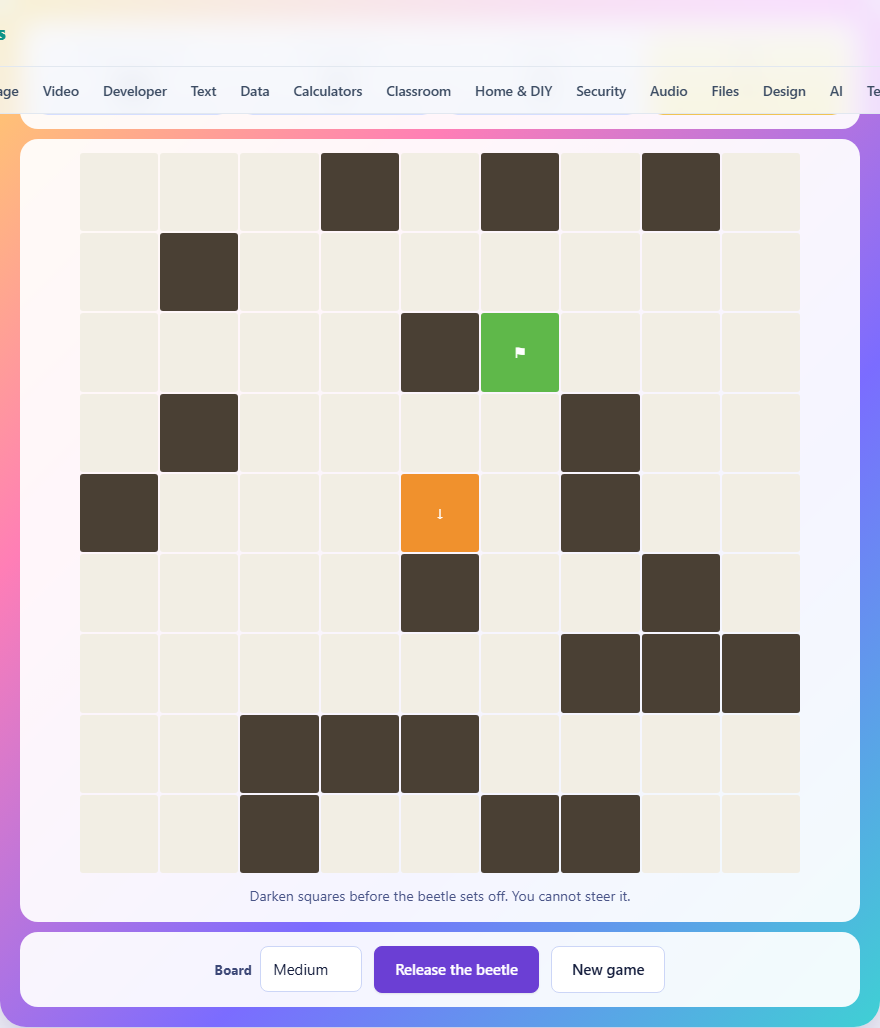
The two rules the beetle follows
The beetle has no memory and no plan. On each step it checks the square beneath it and does one of two things. If the square is pale, it turns ninety degrees to the right, darkens the square, and moves one space forward. If the square is dark, it turns ninety degrees to the left, lightens the square, and moves one space forward. That is the entire program.
Because the beetle flips the colour of every square it leaves, its own trail changes the board. A square it darkened on its third step may steer it a completely different way when it crosses that same square on its twentieth step, because by then the square is dark and triggers a left turn instead of a right. This compounding effect is what makes the path so hard to predict by eye.
What you control and what you do not
You cannot move the beetle, change its direction, or pause it mid-walk. The only thing you can do is darken squares on the grid before the beetle starts walking. Tap any square to darken it, and tap it again to undo. The orange square with an arrow shows where the beetle starts and which way it faces. You cannot change those either. The green flag marks the gate the beetle needs to reach.
Once you are satisfied with your darkened squares, press Release the beetle. The beetle walks according to its two rules until one of three things happens: it steps onto the gate and you win, it steps off the edge of the board and the run fails, or it runs out of its allotted steps and the run fails. After each run the track it walked is drawn onto the board so you can study where it went.
Board sizes and flip budgets
The Board dropdown offers three sizes. Small gives you a seven-by-seven grid with a budget of two darkened squares and a walk limit of forty steps. Medium uses a nine-by-nine grid with three darkened squares and seventy steps. Large is an eleven-by-eleven grid with four squares and one hundred and ten steps.
The budget is the maximum number of squares you may darken before releasing the beetle. It is shown in the stat bar as Flips left. You can use fewer than your budget if you like, but you cannot exceed it. To free up a flip, tap one of your already-darkened squares to undo it.
Why every puzzle is solvable
Each board is built by actually running the beetle. The generator darkens a set of squares at random, lets the beetle walk, and then places the gate somewhere along the path the beetle took. Because the gate sits on a square the beetle really did reach, the puzzle is solvable by construction. Boards where the beetle reaches the gate without any darkened squares at all are thrown away, so there is always work for you to do.
This also means the solution might not be the same set of squares the generator used. There could be other combinations of darkened squares that also guide the beetle to the gate. Finding any one of them is enough to win.
Strategy: read the failed track
A failed run is the most useful thing the game gives you. After you release the beetle and it misses the gate, the path it took is drawn on the board in a contrasting colour. Study that track. Where did it veer away from the gate? Which square was the turning point?
The answer to that second question tells you where to focus your next flip. A square early in the path that sent the beetle north when it needed to go east is a strong candidate for darkening, because flipping that one square changes every crossing after it. A square late in the path is a weaker target, because fewer steps remain to be affected and the beetle may never even reach it on the next walk.
Strategy: change one square at a time
The temptation after a failed run is to darken several new squares at once. Resist it. The beetle's path is so sensitive to small changes that flipping two squares together makes it nearly impossible to tell which one helped and which one hurt. Change one square, release the beetle, and compare the new track to the old one.
If the new path is closer to the gate, that square was a good choice. Keep it and change another. If the new path is worse, undo that square and try a different one. This patient one-at-a-time approach converges on the answer much faster than scattershot guessing, especially on the larger boards where your budget gives you three or four flips.
Strategy: focus on the first few steps
Squares near the beetle's starting position matter more than squares far away. The beetle rewrites the board as it goes, so a darkened square near the start gets crossed early, and that early crossing changes the direction of every step that comes after. A darkened square on the far edge of the board might never be reached at all if the beetle's new path takes it somewhere else.
On the small board, the beetle only takes up to forty steps. In forty steps on a seven-by-seven grid, most paths stay near the centre. Darkening a corner square on a small board is almost always a waste of a flip. Focus your attention on the squares within a few steps of the starting position and within a few steps of where the failed track began to go wrong.
The machine behind the puzzle
The two rules the beetle follows are known as Langton's ant, first described in 1986. On an infinite blank grid, the ant does something remarkable. For the first few hundred steps the path looks chaotic and random. Then, without warning, it settles into a repeating diagonal corridor and marches off in a straight line forever. This highway appears from every starting arrangement anyone has tested, yet nobody has proved it must always happen.
The puzzles here stay well inside the chaotic part, before any highway forms. That chaos is what makes the puzzle interesting: the path genuinely cannot be predicted without running the beetle, so trial and observation are the only tools that work.
Common mistakes and how to avoid them
The most common mistake is using all your flips at once on the first attempt. With no failed track to study, you are guessing blind. Release the beetle with zero flips first, watch where it goes, and use that information to place your first flip wisely.
Another mistake is darkening the beetle's starting square, which the game does not allow, or darkening a square the beetle will never reach. Check each candidate against the failed track. If the beetle never passed through or near that square, flipping it is unlikely to change anything.
Finally, players sometimes forget that undoing a flip is free. If you have used all three flips and the run fails, you do not need to start a new game. Tap one of your darkened squares to remove it, darken a different square instead, and release the beetle again. The budget limits how many squares can be dark at once, not how many times you can rearrange them.
Privacy and how the game runs
Turmite runs entirely inside your browser. No data is sent to a server, there is no account, and your results are stored in local storage on this device only. Once the page has loaded, the game works offline without any change. The board scales to fit your screen and the tap controls work on both desktop and phone.