
Mastering Triple Match: see patterns faster
Triple Match is a timed pattern-spotting game played with a set of cards that each carry four visible properties. Three cards form a valid match when every one of those four properties is either the same across all three cards or different across all three. Two sharing a property while the third differs is the one case the rule forbids. This guide explains the matching rule in detail, walks through the controls, and shares techniques that help you spot matches faster under the clock.
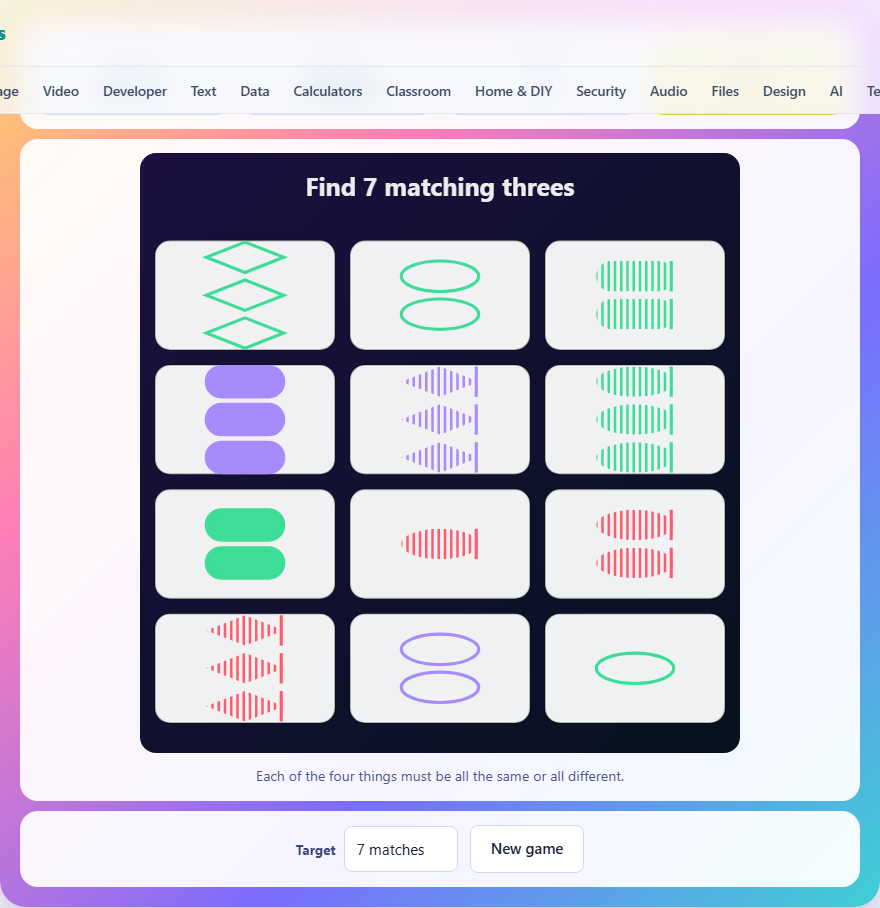
The four properties on every card
Each card shows a set of symbols. Four things vary from card to card. Count is how many symbols appear: one, two or three. Shape is the outline of those symbols: oval, diamond or bar. Colour is the fill colour: red, green or purple. Fill is how the shape is rendered: solid, striped with horizontal lines, or hollow with just an outline.
Because every property has exactly three possible values and the deck contains one card for every combination, the full deck holds eighty-one cards. Twelve of those are dealt face up at any time, arranged in a grid of three columns and four rows, and the game guarantees that at least one valid match exists among them.
The matching rule explained
Three cards match when each of the four properties passes one test: it must be all the same on the three cards, or all different on the three cards. There is no middle ground. Two reds and a green fails the colour test even if the other three properties are perfect. Two solids and one striped fails the fill test. Every property must independently be all-alike or all-unlike.
A useful shortcut is to number each value zero, one and two. For any trio that matches, the three values of each property add up to a multiple of three. All the same gives zero, three or six. All different always gives three. If any property sums to one, two, four or five, the trio is not a match. This arithmetic check is fast once it becomes second nature and it is exactly how the game checks your answers internally.
Controls and how the clock works
Tap three cards to claim a match. If the match is valid, the three cards flash green, are removed, and three new cards are dealt from the deck in their place. If the match is invalid, the cards flash red and the game tells you which property failed. A wrong guess does not end the game, but it costs you time.
The Target dropdown sets how many matches you need to find. Easy asks for five matches and gives you one hundred and fifty seconds. Normal asks for seven in one hundred and thirty-five seconds. Hard asks for nine in one hundred and twenty seconds. A wrong guess costs four seconds on Easy, six on Normal and eight on Hard. The clock runs constantly, so speed matters as much as accuracy.
How scoring works
Your score is the number of seconds left on the clock when you find the last match. A fast finish on Normal might leave forty seconds, while a slow finish might scrape in with two. Wrong guesses drain the clock, so guessing wildly can cost more than pausing to think. The game tells you which property failed after a wrong answer, so each mistake at least teaches you something.
The stat bar also shows how many valid matches currently exist among the twelve displayed cards. This number updates every time the board changes. If it shows one, there is exactly one match to find and the search should be methodical. If it shows four or five, several matches overlap and the quickest one to spot wins. Use that number to set your pace.
Strategy: pick two, then hunt for the third
Scanning all possible combinations of three among twelve cards means checking over two hundred trios. Nobody does that consciously. The fastest approach is to pick any two cards and work out exactly what the third card must look like. For each property, if the two cards match, the third must also match. If the two cards differ, the third must carry the remaining value.
Once you know all four properties of the missing card, scan the board for that one specific card. You are looking for a single target, not evaluating every card against every other. If the card is not there, move on to a different pair. This method narrows a two-hundred-way search into a quick scan of twelve cards, and with practice it takes only a few seconds per pair.
Strategy: start with counts
Count is the easiest property to see at a glance. Sort the twelve cards mentally into three groups: those with one symbol, those with two, and those with three. Any valid match is either three cards with the same count or one from each group. This single observation eliminates a large number of wrong combinations before you look at shape, colour or fill.
If the board has five cards showing two symbols, three showing one, and four showing three, there are ten possible all-twos trios just within the group of five. Start there, because those ten trios share count already and you only need to check three properties instead of four. Reducing the search space like this is what lets experienced players find matches within seconds.
Strategy: spotting matches by colour groups
After count, colour is the next easiest property to group visually. If three cards share both count and colour, you only need shape and fill to both be all-same or all-different. Two checks instead of four is fast.
Alternatively, look for a card of each colour among cards of the same count. Three cards that are all-different in colour and all-same in count need shape and fill checked, and those two tests are quick. Training your eye to jump between count groups and colour groups gives you two parallel search paths, and whichever one finds a match first wins.
The board always has a match
Every deal is checked before it is shown. If the twelve cards drawn from the deck contain no valid match, the deck is reshuffled and a new set of twelve is dealt. The same check runs after every successful match: when the three replacement cards arrive, the game verifies that at least one match still exists. If it does not, a fresh board is dealt.
This guarantee means you can never be stuck. If you have been staring at the board for a while and see nothing, the match is there and you are missing it. Try switching your search strategy. If you were grouping by count, switch to colour. If you were grouping by colour, try shape. A different lens often reveals what the first one hid.
Common mistakes and how to fix them
The single most common mistake is checking only two or three properties and assuming the fourth is fine. You spot three cards that are all red, all different shapes, and all different counts, and you tap them without noticing that two are solid and one is hollow. That two-plus-one pattern on fill kills the match. Always check all four properties before tapping.
Another mistake is guessing under pressure. When the clock drops below twenty seconds, the temptation is to tap any three cards that look plausible. Each wrong guess costs several more seconds, and two bad guesses in a row can drain the remaining time entirely. Even under pressure, the pick-two-and-hunt method is faster than random guessing.
Finally, beginners often ignore the matches-on-board counter. If the counter shows one, you know the match is unique and your search must be thorough. If it shows five, you can afford a quick scan because several answers exist. Letting the counter guide your pace saves time over treating every board the same way.
Privacy and how the game runs
Triple Match runs entirely inside your browser. Nothing is uploaded, there is no account to create, and your best score is saved in local storage on this device only. The layout scales to fit your screen and works well on both a wide monitor and a phone held upright. Once the page has finished loading, the game works offline without any change.