
TriPeaks solitaire: chasing the long run
TriPeaks is a solitaire card game built around three overlapping pyramids. Twenty-eight cards sit face down in a layered formation, and a waste pile at the bottom sets the rank you can take next. The interesting part is the run: cards taken in an unbroken chain score more and more, so the game rewards planning ahead rather than grabbing the first card you see. This guide walks through every rule, explains the controls, and shares the thinking that turns average scores into great ones.
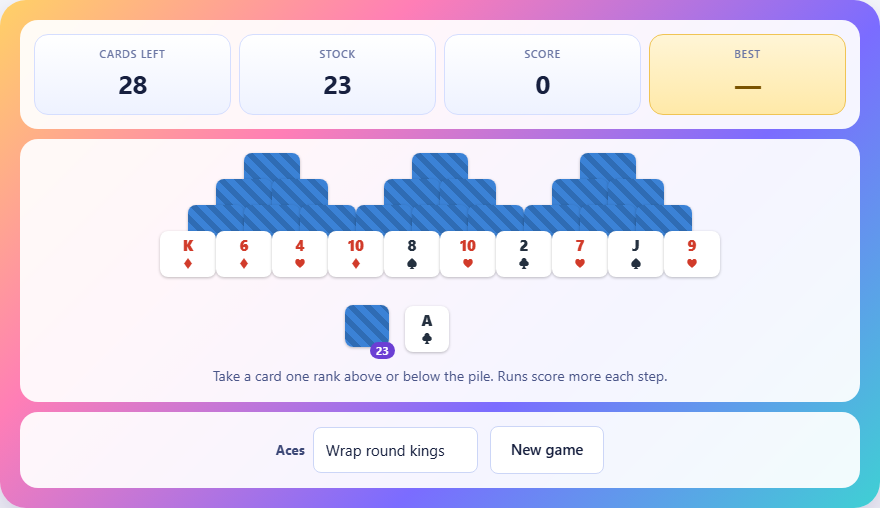
The half-column test that decides which cards are free
Every slot in the layout is stored as a row number and a column position, and the column positions carry the halves that make the shape work. Row 0 is the three peaks, at columns 1.5, 4.5 and 7.5. Row 1 has six cards, at 1, 2, 4, 5, 7 and 8. Row 2 has nine, at 0.5, 1.5, 2.5 and on up to 8.5. Row 3 is the base of ten, at 0 through 9. That adds up to 28. A card always sits half a step to the side of the two cards under it.
The freedom test reads straight off those numbers. Row 3 is free from the first move, since nothing sits under it. For any card higher up, the game looks at the row below and keeps the cards whose column is exactly 0.5 away. That picks out two cards every time, for all 18 cards above the base. The card is free once both of them are gone. No list of card numbers is written down anywhere, so the picture and the rule can never drift apart. On screen each column is 10 percent of the board width, which makes a half step 5 percent, and that is the small offset you see between rows.
Follow one peak down and you can see the size of the job. The left peak at column 1.5 waits on the row 1 cards at 1 and 2. Those two wait on the row 2 cards at 0.5, 1.5 and 2.5. Those three wait on the base cards at 0, 1, 2 and 3. So 2 plus 3 plus 4 is 9 cards under one peak, and 10 cards for that pyramid as a whole. Three pyramids of ten would be 30 cards. The deal is 28 because base cards 3 and 6 each serve two pyramids at once. Base card 3 is a coverer for the row 2 card at 2.5 on the left and the one at 3.5 in the middle. Those two shared cards are the whole of the overlap.
Whether you may take a free card is a second, plainer test. Ranks are numbered 0 for the ace up to 12 for the king. The game takes the gap between the free card and the card on top of the waste pile. A gap of 1 always passes. A gap of 12 passes only while the Aces box is set to wrap, and a gap of 12 can only mean an ace and a king. Nothing else is looked at. Suit and colour play no part, so the strict setting cuts exactly one link out of the ring of ranks: the one joining ace to king.
- Row 0, the peaks: 3 cards, at columns 1.5, 4.5 and 7.5.
- Row 1: 6 cards, at 1, 2, 4, 5, 7 and 8.
- Row 2: 9 cards, at 0.5 up to 8.5 in steps of 1.
- Row 3, the base: 10 cards, at 0 up to 9, all free at the start.
- Coverers of a card: the cards one row down whose column is 0.5 away, and there are always two.
Two ways to clear the same 28 cards, and the 42 points between them
The score is built from one small step. Each time you take a card the run counter goes up by one, and that new number is then added to the score. The first card of a chain pays 1, the second pays 2, the third pays 3. A chain of n cards pays n times n plus 1, all divided by 2. Drawing from the stock puts the counter back to zero. Clearing the board adds 25 points, plus 2 more for every card still sitting in the stock.
One number catches people out. The stat bar shows 23 stock cards at the start, not 24. The deal hands 28 of the 52 cards to the pyramids, which leaves 24, and the game then turns one of those face up on the waste pile so you have a rank to match. The other 23 are your draws. There is no second pass through the stock.
Now take two players who both clear the board. Player A wins in seven chains of four. Each chain pays 1 plus 2 plus 3 plus 4, which is 10, so the cards pay 70. Six draws sit between the seven chains, leaving 17 in the stock, so the bonus is 25 plus 2 times 17, which is 59. Final score 129. Player B clears the same 28 cards in fourteen chains of two. Each chain pays 1 plus 2, which is 3, so the cards pay 42. Thirteen draws leave 10 in the stock, and the bonus is 25 plus 20, which is 45. Final score 87. Same win, 42 points apart. Both halves of the score pull the same way, because fewer draws mean longer chains and a fatter bonus.
Those two totals assume each draw is used at once. A draw you cannot use still costs you 2 points off the end bonus. The highest total the rule can reach is 477: all 28 cards in one unbroken chain, which is 28 times 29 divided by 2, or 406, with no draw at all and a bonus of 25 plus 46. No real deal will hand you that. The sound tracks the chain as well. Each card you take beeps at 420 plus 45 times the run, in hertz, so the first card of a chain sounds at 465 and the second at 510. A rising pitch means the chain is still going.
- A loss is only tested once the stock is empty. Until then you can always draw, so the game will never tell you that you are stuck.
- That test only compares free cards with the card now on the waste pile. It looks no further ahead, and there is no solver behind it.
- Nothing checks that a deal can be cleared. The cards are shuffled and dealt as they fall, so some deals cannot be won by anyone.
- Your best score is written down only when a game ends in a win or in the no-moves ending. Starting a new game throws the score away.
- Changing the Aces box deals again at once, so switching it mid-game costs you the deal you were playing.
- There is no undo, and the waste pile is never turned back into stock.
- Only a draw resets the run counter. Nothing else breaks a chain.
- The run label on the board appears only once the run reaches 2.
- Deals come from the browser random number generator and carry no deal number, so a good layout cannot be played again.
How the pyramids are laid out
The layout has four rows. The top row holds three single cards, one at the peak of each pyramid. Below that sit six cards, then nine, and then a base row of ten. Every card except those on the base row sits between and slightly above two cards on the row beneath it. Those two lower cards are its coverers.
A card is face down and locked as long as either of its two coverers is still on the board. Once both coverers have been taken, the card flips face up and becomes free. The base row of ten is always free from the start because nothing sits below it. This means you usually begin the game with ten face-up cards to choose from, plus the single card turned from the stock onto the waste pile.
Taking cards and building a run
The waste pile shows one card face up. You may take any free card from the pyramids if its rank is exactly one above or one below the waste pile card. Suits do not matter. A seven can take a six or an eight regardless of whether they are hearts, spades, diamonds or clubs.
When you take a card, it moves to the waste pile and becomes the new rank to match against. If you take a six onto a seven, the pile now shows a six, and any free five or seven can follow. Each card taken this way without touching the stock extends your current run. The first card in a run scores one point, the second scores two, the third scores three, and so on. A five-card run scores fifteen points total. Turning a card from the stock resets the run counter to zero.
The stock and when to use it
Twenty-four cards remain in the stock after the pyramids are dealt. Tapping the stock turns one card face up onto the waste pile, giving you a new rank to work from. You can only go through the stock once, from top to bottom, with no reshuffling.
Using the stock always breaks your current run, so it should be a last resort when no free card on the board matches the pile. Before you tap the stock, scan every face-up card carefully. A match you missed costs the run bonus and wastes a stock card that might have been more useful later. The stock count is shown in the stat bar so you always know how many draws you have left.
Winning, losing and the final score
You win by clearing all twenty-eight cards from the pyramids. When you do, the game awards a bonus of twenty-five points plus two points for every card still left in the stock. A fast clear with stock to spare can push the score well above a hundred. Running out of stock while cards remain on the board, with no free card matching the pile, ends the game in a loss.
Not every deal is winnable. Roughly nine deals out of ten can be cleared with good play, so losing a hand is normal and nothing to worry about. The best approach after a loss is to tap New game and try a fresh deal rather than looking for a mistake that may not exist. Some layouts are simply unsolvable no matter what you try.
The aces setting
The Aces dropdown beneath the board has two options. The default, Wrap round kings, lets an ace sit on top of a king and a king on top of an ace. This makes runs longer because the sequence can go queen, king, ace, two without stopping. The strict setting, Do not wrap, treats ace as the bottom and king as the top, so no card can follow a king going up or an ace going down.
Wrapping round makes the game noticeably easier. Long runs become more likely because you never hit a dead end at the top or bottom of the rank order. Turning wrapping off is a good challenge once you are comfortable clearing most deals with it on.
Strategy: clearing peaks early
Each pyramid has one card at its peak. That card sits on top of two cards, which sit on top of three, which share a base with the other pyramids. Taking the peak card frees the two below it, and clearing both of those frees three more. A single card removed from a peak can cascade into half a dozen newly available cards.
Because of this, clearing a peak early is often worth breaking a short run. A two-card run scores three points, but freeing five or six new cards opens up the chance for a much longer run later. Whenever you have a choice between extending a short chain and removing a peak card, the peak is usually the better move.
Strategy: choosing between two matching cards
When two free cards both match the waste pile, they are rarely equal. The one that uncovers more hidden cards is almost always the right pick. Look at the row above each candidate. If taking card A would leave both of its upper neighbours still locked because their other coverer is in place, but taking card B would free one of its upper neighbours immediately, card B gives you more options on the very next step.
As a tie-breaker, prefer cards from whichever pyramid has the most cards remaining. Evening out the three pyramids keeps the board flexible. A pyramid with only its peak left is about to give you a cascade, while a pyramid that is barely touched will clog the board until late in the game.
Strategy: saving the stock for the right moment
Every stock card you burn is a rank you cannot choose. Think of the stock as a lifeline, not a pace-setter. Before drawing, ask whether any face-down card on the board could be the rank you need. If two coverers of a hidden card are about to come free, waiting one more move before drawing might let you keep the run alive.
In the endgame, when only a handful of cards remain on the peaks, a single stock draw can connect two otherwise separate runs into one long chain. Holding a draw in reserve for that moment is often worth sitting through a turn where no free card seems to help. The longer you keep the stock intact, the more options you have when the board narrows down to its final cards.
Common mistakes beginners make
The most frequent mistake is grabbing the first matching card without checking for a longer chain. Suppose the pile shows a five and you see a free four. Before taking the four, look for a three that would become free after the four is gone. If the three is there, look for a two after that. Planning two or three steps ahead is what turns a two-card run into a six-card run.
Another mistake is ignoring the peaks until late in the game. The deeper a card is buried, the more moves it takes to reach it. If you focus only on the base row, the peaks stay locked and you run out of stock before you get near them.
Finally, players sometimes switch to the strict aces setting without adjusting their expectations. Without wrapping, kings and aces become dead ends. Any run that reaches a king going up has nowhere to go. Accept that runs will be shorter and plan around the ceiling and floor of the rank order.
Privacy and how the game runs
The entire game runs inside your browser. No cards or scores are sent to a server, there is no account, and your best score is kept in local storage on this device only. The board scales to your screen and works well on both desktop and mobile. Once the page has loaded, TriPeaks works offline without any change in how the game plays.