
Solving Trawl: the set cover puzzle behind the nets
Trawl is a logic puzzle dressed as a fishing trip. A survey lists every species in the area, and a yard full of nets each catch a different combination of those species. Your job is to bring back at least one of every species using as few nets as possible. The obvious method of always taking the biggest net usually works, but the puzzles here are designed to show exactly where that thinking falls short. This guide explains the rules, walks through the controls, and offers concrete strategies for beating the par figure shown at the top of each board.
What the board shows you
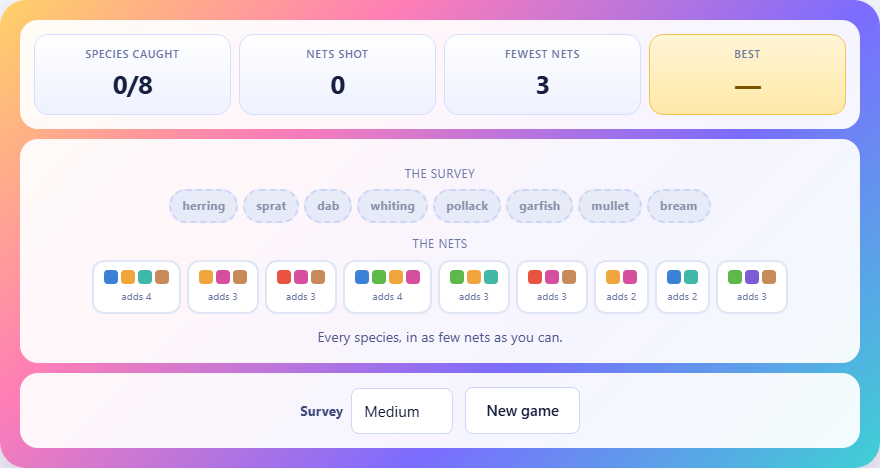
The board is split into two areas. At the top is the survey: a row of species names, each with its own colour. Species you have already caught are highlighted. Below the survey sit the net cards. Each card displays a set of coloured marks that match the species that particular net catches, plus a short label that tells you how many new species it would add to what you already have.
When you tap a net it is shot, and its label changes to show that it is active. Tap the same net again and it is hauled back in, freeing it for a different choice. Only the nets that are shot at the moment you finish count toward your total. This means you can rearrange your selection as many times as you like at no cost.
The goal and how scoring works
The stat bar shows three numbers. Species caught tracks how many of the total species you have collected so far. Nets shot is your current count. Fewest nets is the par: the smallest number of nets that can cover every species. This figure is calculated exactly by trying every combination of nets from smallest to largest, so it is always correct.
You win when every species is caught and your net count matches or beats the par. If you catch everything but used more nets than the par, the game tells you how many were needed and lets you keep trying. Fewer nets is always better, and the score that gets recorded is the number of nets in your solution.
Difficulty levels and board sizes
The Survey dropdown offers three sizes. Small gives you six species and seven nets. Medium raises that to eight species and nine nets. Large has ten species and eleven nets. On every size the par is always three or four nets, so the puzzle is always tight: you have just enough nets available to make the job interesting without making it feel impossible.
Larger boards are harder not because the par grows, but because the number of possible combinations grows much faster. With eleven nets and a par of four, there are 330 ways to choose four nets, and most of them miss at least one species. Thinking through those combinations by eye is the real challenge. Changing the level and pressing New game deals a fresh board immediately.
Start from the rarest species
The most powerful first move is to look for a species that appears on only one net card. If only one net catches mackerel, then that net must be part of every valid solution, no matter what else you choose. Picking those forced nets first narrows the field instantly.
After the forced choices, look for species that appear on just two cards. You know one of those two nets must be used. Try each one mentally and see which covers more of the remaining uncaught species. The rarest species constrain your choices the most, so working from rare to common keeps the search manageable.
Why the biggest net is not always right
The greedy rule says to always take whichever net adds the most new species. This method is fast and often correct, but on some boards it leads to a solution that uses one more net than necessary. The problem is overlap. Two large nets may each catch six species, but if five of those six are the same, using both wastes most of their coverage.
The par-beating answer in those cases is often two medium nets that overlap hardly at all. Together they cover nearly everything the two big nets covered, but they do it in two nets instead of three. When the greedy approach lands above par, shift your attention from the biggest cards to the ones with the least overlap between them. Compare the coloured marks on each card side by side and look for pairs that share no more than one or two species.
A worked example on a small board
Suppose the survey has six species and the yard holds seven nets. Net A catches herring, sprat and dab. Net B catches sprat, whiting and pollack. Net C catches dab, pollack and garfish. Net D catches herring and garfish. Net E catches whiting and dab. Net F catches herring, pollack and garfish. Net G catches sprat and whiting.
The greedy first pick is Net A with three new species. After that, Net B or Net C each add two. Say you take Net B. Now you have herring, sprat, dab, whiting and pollack, missing only garfish. You need a third net just for garfish: Net C, D, or F each catch it. Three nets total.
But notice Nets A and C together cover herring, sprat, dab, pollack and garfish, five of six, missing only whiting. Add Net G for whiting and you still need three nets. The par here is two if two nets happen to cover all six, or three if not. The point is that checking nets for minimal overlap before committing can save you from an extra net the greedy path would have forced.
Checking for a wasted net
Once you have caught every species, the game has not ended if your net count is above par. Before giving up, try hauling each net one at a time. If every species remains caught after hauling a particular net, that net was redundant and you never needed it. Removing it drops your count by one.
This backward check is simple and catches the most common kind of waste: a net whose species are all covered by other nets you already have. It takes only a few seconds and can turn a four-net solution into a three-net one without any cleverness.
The maths underneath the puzzle
Choosing the fewest sets that together contain everything is known in computer science as the set cover problem. It is one of the foundational hard problems, meaning nobody knows a method that solves every instance quickly, and most researchers believe no such method exists. The greedy approach is the best known quick rule, and it is never worse than roughly the natural logarithm of the number of items times the true best.
The boards in this game are small enough to search every combination outright, so the par shown at the top is always exact. That is what makes the puzzle satisfying: you can see exactly where the greedy rule falls short and try to do better with careful thought.
Mistakes that trip people up
The biggest mistake is shooting a net without checking what its marks actually cover. A net labelled adds four looks attractive, but if three of those four are species you were about to get from another net anyway, the real gain is only one. Always look at the colours on the card, not just the number.
Another trap is shooting too many nets and hoping for the best. The boat has a limit on how many nets you can have out at once, set to two more than the par, and even without that limit, more nets means a higher count and a worse score. Restraint is part of the puzzle.
Finally, players sometimes forget that hauling a net back is free. There is no penalty for changing your mind. If a combination is not working, haul everything in and start fresh with a different first pick. The order you shoot them in does not matter either. Only the final set of nets counts, so rearranging is always safe.
Privacy and how the game runs
Trawl runs entirely inside your browser. No data is sent to a server, there is no account, and your best score is stored in local storage on this device only. Once the page has loaded, you can play offline without any change in how the game behaves.