
Winning at Trail Duel: space, not speed
Trail Duel is a head-to-head arena game where two bikes race across a grid, each leaving a solid wall behind it. Neither bike can stop. The last one still riding wins the round, and the first side to take three rounds wins the match. This guide covers the full rules, every control on the page, how the computer opponent thinks, and the spatial reasoning that separates a lucky survivor from a consistent winner.
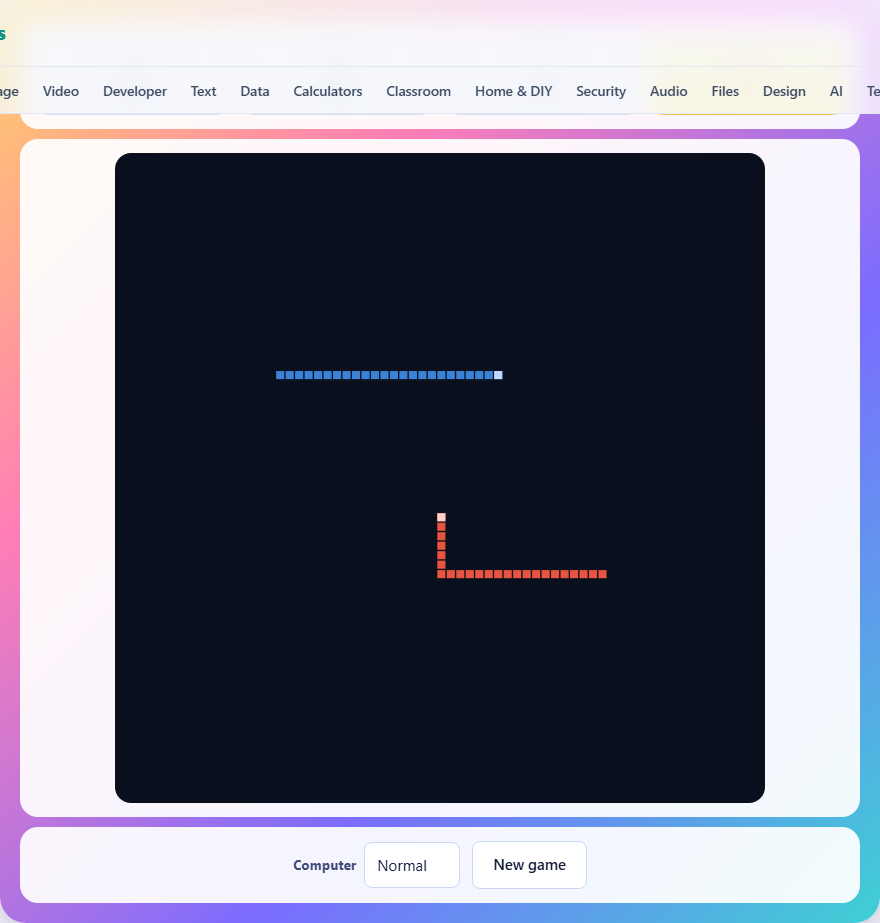
What happens on the board
Two bikes start on opposite sides of a dark grid. Both move forward at the same steady pace and neither one can brake. Every square a bike passes through becomes a solid wall in that rider's colour. Blue marks your trail and red marks the computer's trail. The moment either bike drives into any wall, whether it belongs to the opponent, to itself, or to the edge of the board, that rider crashes and loses the round.
The match is best of five, so the first player to win three rounds takes the whole thing. If both bikes crash on the same step, that round is a draw and neither side scores. The stat bar above the board shows rounds won by each side and the target number needed to clinch the match. After each round, win or draw, the grid resets and a fresh round starts automatically.
Controls and how to steer
On a keyboard, steer with the arrow keys or with W, A, S and D. On a phone or tablet, swipe in the direction you want to go. There is no button to press for speed or braking because there is no speed control: both bikes advance at the same fixed rate, and neither can slow down or stop.
Trying to reverse is always ignored. If your bike is heading right, pressing the left arrow does nothing. This is a safety measure. Reversing would mean driving straight into your own wall, which is instant death, and on a keyboard that press is almost always an accident rather than a real intention. Only forward, left turn and right turn are available at any moment.
Difficulty levels and what changes
The Computer dropdown below the board offers three settings: Easy, Normal and Hard. Changing the level and pressing New game starts a fresh match.
The difference between levels is not speed. All three run at the same pace. What changes is the size of each grid cell, which makes the board hold more or fewer squares overall. Easy uses a coarser grid with fewer total cells, so the arena fills up slowly and there is plenty of room to manoeuvre. Hard uses a finer grid with many more cells, and the computer also thinks further ahead when choosing its next move. On Hard the opponent scans a much larger area of the board before committing to a direction, so it is far better at avoiding dead ends and sealing you into tight spaces.
How the computer decides where to go
The computer does not chase you. Chasing is how a rider loses, because following somebody else puts you behind and gives them control of where the trail goes. Instead, the computer looks one step ahead at every legal direction it could take, then flood-fills the open space it would leave itself from that new position. It picks whichever direction gives it the most open room.
There is a small extra pull toward your bike. When two directions offer the computer roughly the same amount of space, it will lean toward the one that brings it closer to you. That is not about chasing. It is about cutting. Moving toward you is how it slices the board in half and traps you in the smaller piece. Understanding this is the key to beating it: you need to be the one doing the cutting, not the one being cut.
Space is everything
The single most important idea in this game is that the rider with more open space wins. Once the two trails have divided the board into separate regions, each rider is locked inside their own region with nothing to do except fill it without crashing. The rider in the bigger region survives longer.
This means the entire game is decided by the moment the trails cut the board in two. Everything before that moment is about positioning for a good cut, and everything after it is about filling your region efficiently. If you end up on the larger side of the board, you have already won even though neither bike has crashed yet.
Opening moves: hug the edge
At the start of a round, the board is wide open and both bikes have room to go anywhere. Beginners often steer straight through the middle, but this is a mistake. Riding through the centre splits the board early, and you end up walling yourself off from half the grid before the computer has been forced into anything.
A stronger opening is to hug the outer edge. Ride along the wall of the board, turning corners as you reach them. This traces a large perimeter and keeps the entire interior open for later. The computer tends to do something similar, because the edges offer the most flood-fill room. By claiming a long stretch of the edge early, you set up a position where your future trail has access to a large connected area.
The mid-game: when to cross
After both bikes have laid down their opening trails, the board starts to feel smaller. This is when the game is won or lost. Watch for the moment when crossing in front of the computer would divide the remaining space unevenly in your favour. The goal is to cut across the board so that you keep the bigger piece.
Timing matters. If you cross too early, the computer still has room to dodge around you. If you wait too long, the computer may cut you off instead. A good rule of thumb is to make your crossing move when you can see that the path from your head to the far wall is shorter than the path from the computer's head to that same wall. You want to reach the dividing line first.
Filling your space neatly
Once the board is split and you are locked in your own region, survival depends on using every available square. The most efficient pattern is a tight back-and-forth sweep, like mowing a lawn in parallel lines. Each row or column is filled completely before you turn and start the next one. Turn at the last possible moment so no square is left behind.
Looping or spiralling wastes squares at every corner. A single wasted square can be the difference between surviving one step longer than the opponent or crashing one step sooner. On the finer grids at Hard difficulty, where regions can hold hundreds of cells, filling neatly makes a huge difference. Practice this pattern in easy rounds until it becomes automatic, because once the pressure is on you will not have time to plan each turn individually.
Mistakes that cost rounds
The most common mistake is cutting through the middle of the board early. This walls off your own territory before the computer has been pushed into a corner, and you end up trapped on the smaller side.
Another frequent error is reacting too late to a direction change. Because input is registered on the next game tick, a tap that comes a fraction of a second late sends you one square further in the old direction before the turn takes effect. On a tight grid that extra square can mean crashing into a wall you intended to turn away from. Steer a little earlier than feels natural, especially on Hard where the cells are small.
Finally, many players focus on the two bike heads and forget the bigger picture. The bikes are just two dots. What matters is the shape of the empty space between the trails. Train yourself to look at the gaps, not the riders. Whoever controls the larger gap controls the game.
Privacy and how the game runs
Trail Duel runs entirely inside your browser. No moves are sent anywhere, there is no account to create, and no data leaves your device. Your match results are stored in local storage on this device only and will not follow you to another machine. Once the page has loaded, the game works offline with no change in behaviour. The board scales to fit your screen, and the touch controls are sized for comfortable use on a phone.