
Walking Every Path Without Lifting the Pencil
Trail is a graph-tracing puzzle based on one of the oldest results in mathematics. You walk every path in a park exactly once, visiting posts as often as you like but never reusing a path. This article explains the rules, the role of odd and even posts, how to avoid dead ends, and why counting before you start tells you almost everything you need.
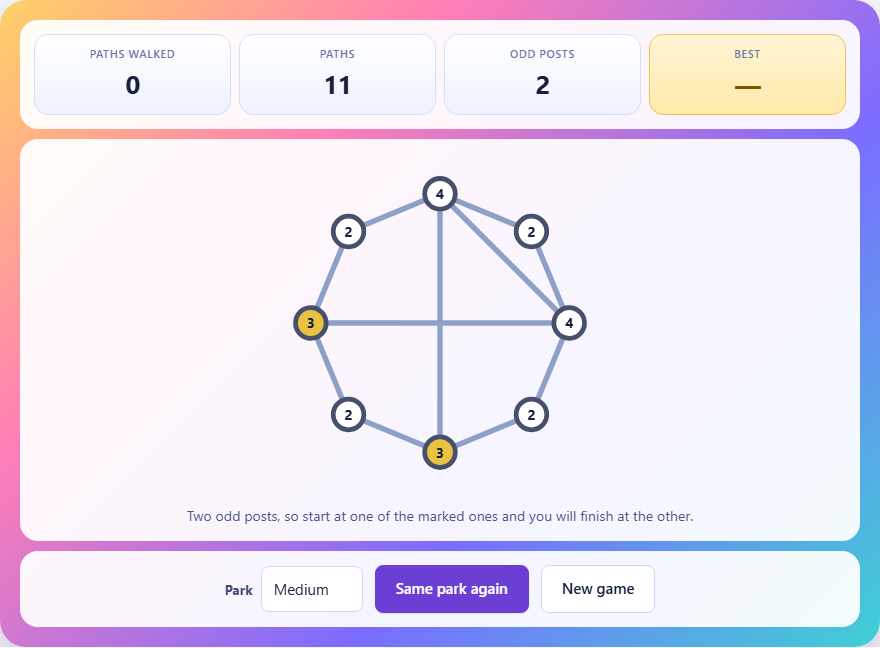
Where a park comes from: a ring, a few tries, and a lot of rejected drafts
The posts are not scattered about. For a park of six, eight or ten posts, the code walks once round a circle and drops a post at each step. It begins at the top and turns by one whole step each time. The circle has a radius of 38 and sits at 50, 50 inside a square 100 units wide, and each post is drawn as a small circle of radius 4.5. On a six-post park that puts the top post at 50.0, 12.0, the next one at 82.9, 31.0, and the bottom one at 50.0, 88.0. Every post lands on that one circle, which matters more than it sounds.
Then the paths go in. First a ring: each post is joined to the next one round, and the last is joined back to the first. Six posts give six ring paths, and each post begins with two. After the ring come the chords, the lines that cut across the middle. The number of tries is fixed by the size you picked: three tries for Small, five for Medium, eight for Large. Each try picks two posts at random. The try is thrown away if it picked the same post twice, or if those two posts are joined already. So a try is not the same thing as a chord, and a Large park does not always get eight of them.
On a Small park half the tries go nowhere. Once the first post is drawn, three of the six choices for the second are dead: the post itself, and the two posts either side of it, which the ring already joins. On Medium it is 3 of 8, and on Large 3 of 10. Later tries can also clash with a chord that is already there, so the odds get a bit worse as the park fills up.
The finished draft then has to pass three checks. The count of odd posts must be nought or two. The park must be in one piece. And the path count must reach the post count plus two. Fail any one of them and the whole draft is binned and drawn again, up to 400 times. That is why a Small park always ends up with 8 or 9 paths, a Medium one with 10 to 13, and a Large one with 12 to 18. The one-piece check can never actually fail, because the ring already joins every post to every other. It is a safety net rather than a working filter. If all 400 drafts somehow fail, the code gives up and hands you two posts joined by a single path.
Here is a draft it can produce, with the sums written out. Six posts, so the ring gives 0-1, 1-2, 2-3, 3-4, 4-5 and 5-0. Say the three chord tries give 0 to 2, then 2 to 4, then a repeat of 0 to 2 which is dropped. Now count the paths at each post. Post 0 has three, post 2 has four, post 4 has three, and posts 1, 3 and 5 have two each. Those add up to 3 + 2 + 4 + 2 + 3 + 2 = 16, which is twice the eight paths, as it has to be, since each path is counted at both ends. Two posts are odd, 0 and 4, so the first check passes. Eight paths is exactly six plus two, so the third check passes as well. The board opens showing Paths 8, Odd posts 2, and Paths walked 0.
- Small: 6 posts, 6 ring paths, 3 chord tries, 8 or 9 paths in the end
- Medium: 8 posts, 8 ring paths, 5 chord tries, 10 to 13 paths
- Large: 10 posts, 10 ring paths, 8 chord tries, 12 to 18 paths
- A draft is scrapped if it has four or more odd posts, or too few paths
- The generator tries 400 times before it gives up
The single post a walk can die at
Take the park above and walk it. Post 0 is yellow, so tap it to begin. Then tap 1, then 2, then 0 again along the chord, then 5, then 4, then 3, then 2, and last of all 4 along the second chord. That is one tap to stand somewhere and eight taps that each walk a path. The counter climbs 1, 2, 3 and on to 8, and a line greys out each time. On the eighth the game sees that no path is left unwalked, plays a high note, and puts up the message Every path walked, all 8 of them, without lifting the pencil. You end on post 4, the odd post you did not start from, which is the only place the walk could have ended.
Now for the part the board does not spell out. Where can a walk actually die? Look at any post other than your start. Each time you reach it you spend one path arriving. If you leave again you spend a second. So the paths spent there come in pairs, plus the one you rode in on and never paid back. That is an odd number. You are stuck there only if that odd number is the whole count at the post. So a dead end needs a post with an odd path count. Your starting post works the other way. You spent one path leaving it at the very start, so its tally is even.
Put those two facts together and something neat falls out. In a park with two odd posts you must begin at one of them, so you can never be stranded there. The only post left that can strand you is the other odd one. In a park with no odd posts at all, no other post can trap you, so the only place a walk can die is the post you set off from. Either way, a failed walk dies in the exact spot a good walk was meant to finish. That is worth knowing, because the danger is never scattered around the board.
What the game checks after each move is narrow. It looks at the post you are standing on and asks whether one unwalked path still touches it. If none does, you get a low buzz and a line of text telling you so. That is a local test. It never asks whether the paths you have left can still be reached from where you stand. So a walk can be beyond rescue for many moves before anything is said. The round is not marked as lost either. The game simply runs out of moves it can give you, and Same park again clears your route while keeping the layout.
Two more habits to unlearn here. The number printed inside a post is its total path count, and it never ticks down as you walk, so the only honest guide to what is left at a post is which of its lines are still dark. And because every park carries a full ring, no path is ever the only link between two halves. Take away any single path and the park is still joined up, so the old advice about hoarding a lone connecting path does not bite on these layouts.
- Paths walked counts paths, not taps, so the tap that picks your starting post is free
- The score saved when you finish is just the number of paths in that park, so the Best figure is really the largest park you have cleared
- That figure is only written when you complete a walk, and it lives in this browser alone
- There is no clock, no move limit, no undo of one step, no hint and no solver
- Changing the Park box builds a fresh park straight away, so the one on screen is gone
- Parks are random with no seed, so a layout you enjoyed cannot be called back
What you are trying to do
The board shows a park made of posts and paths. Posts are the dots. Paths are the lines between them. You pick a starting post, then move from post to post along paths, and each path you walk greys out behind you. The goal is to walk every single path exactly once. Posts can be visited as often as you need.
The puzzle is not about finding a special route. It is about order. Every path must be crossed, and none may be crossed twice. Where you start and which direction you go at each post determines whether you finish or get stuck.
Odd posts and even posts
Each post shows a number inside it. That number is how many paths meet at that post. If the number is odd, the post is highlighted in yellow. If the number is even, the post is plain. This distinction decides everything.
Every time you pass through a post, you use two paths: one to arrive and one to leave. So a post you pass through must have an even number of paths. The only exceptions are the post you start at and the post you finish at, where you use one extra path on the way out or in. That means a park can have at most two odd posts, and those must be the start and the end.
The two cases: zero odd posts or two
If the park has no odd posts, every post can be passed through cleanly. You can start anywhere and you will finish back where you began. The route forms a circuit.
If the park has exactly two odd posts, you must start at one and you will finish at the other. The game enforces this by refusing to let you start at any post that is not one of the yellow ones. There is no third case in this game. Every park is generated to have either zero or two odd posts, so a complete walk always exists.
Controls and buttons
Tap a post to start there. If there are two odd posts, only the yellow ones accept the first tap. Once you have a starting post, tap any neighbouring post that is connected by a path you have not yet used. The path greys out and you move to the new post. Posts that you can reach are highlighted so you can see your options.
The Park selector offers Small, Medium, and Large. Small has six posts. Medium has eight. Large has ten. More posts means more paths and more chances to make a wrong turn. The Same park again button resets your walk without changing the park, so you can retry a layout you got stuck on. New game generates a fresh park.
The bridge rule: save the only link
A bridge is a path that is the only connection between two halves of the park. If you cross it early, everything on the far side is cut off from everything on the near side. You will walk all the paths on one side and then have no way back to the other.
The fix is simple: clear one side of the bridge before crossing it. Walk all the paths in the smaller region first, come back to the bridge, cross it, and then finish the larger region. If you are ever unsure whether a path is a bridge, ask yourself: if I remove this path, can I still get from any post to any other? If the answer is no, save that path for later.
Even posts cannot trap you
Here is a reassuring fact. If you arrive at a post with an even number of paths, you can always leave again. When you arrive, you used one path. That leaves an odd number of remaining paths at that post, which means at least one is still available to walk out on. Only odd posts can trap you, because arriving at an odd post leaves an even number of paths, and if you have already used most of them, you might have zero left.
This means you should try to use up paths at odd posts early. The fewer unused paths an odd post has when you visit it later, the more likely it is to trap you. Save your moves at even posts for the end of the walk, because those posts are always safe to revisit.
Strategy for finishing at the right post
When a park has two odd posts, you know exactly where you will end up. Your last step must arrive at the odd post you did not start from. If you find yourself at that post with paths still unwalked elsewhere, something has gone wrong. You walked into the finish too early.
To avoid this, plan a rough route mentally before you begin. Trace a path that sweeps through the park and arrives at the far odd post as its final step. You do not need to plan every detail. Just make sure you are not heading toward the finish too soon. If most of the unwalked paths are behind you and the finish post is one step away, take a different path first.
A worked example on a Small park
Imagine six posts arranged in a circle: A, B, C, D, E, F. The ring gives six paths. Two extra chords connect A to C and C to E. That means A has three paths, C has four, and E has three. The rest have two each. The two odd posts are A and E.
You start at A. Walk A to B, then B to C. Now take the chord C to E, but stop. If you go to E now, you are at the finish with three paths still unwalked. Instead, go A to C via the chord. Then C to D, D to E, E to F, F to A, A to B, B to C, C to E. Actually, let us be more careful. Start at A, go to F, then to E (even post, safe), then to D, then to C, then use the chord to A, then to B, then to C, then use the chord to E. All eight paths walked, finishing at the other odd post.
Common mistakes that cause dead ends
The most frequent error is crossing a bridge too early. The park splits in half and you get stuck on the wrong side with paths left on the other.
Another mistake is heading straight for the finish. With two odd posts, you must end at one of them. If you walk there on your third move, you have walked three paths and left the rest stranded. Resist the pull of the destination until you have cleared the rest of the park.
- Crossing bridge paths early instead of saving them
- Arriving at the finish post before clearing the rest of the park
- Ignoring the degree numbers inside each post
- Giving up after one dead end instead of pressing Same park again and trying a new order
Difficulty levels and park size
Small parks have six posts and are good for learning the odd-post rule. The parks are small enough to plan a route mentally before starting. Medium parks have eight posts and noticeably more paths. The extra connections create more forks and more chances to pick the wrong one. Large parks have ten posts and a dense web of chords. These require careful bridge detection and usually a couple of retries.
Every park is generated so that a complete walk is possible. The generator builds a ring of posts, adds random chords in pairs to keep the odd-post count at zero or two, and verifies that the park is a single connected piece. No impossible park is ever offered.
Privacy and offline play
The game runs entirely inside your browser. The park generation, path tracking, and scoring all happen on your own device. Nothing is sent to a server. There is no account, and your results are stored in this browser only. Once the page finishes loading, you can play with no internet connection at all.