
Planning Every Move Before You Touch the Pegs
Tower of London is a ball-and-peg puzzle that tests pure planning. Three pegs of different heights hold three coloured balls, and you rearrange them to match a target layout in the fewest moves. This article explains the rules, the peg capacities, how the move limit works, and strategies for thinking through the whole sequence before you start.
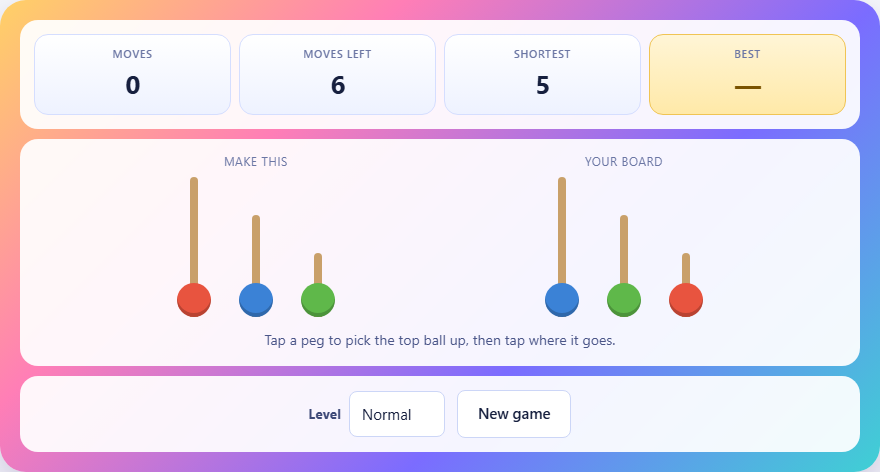
The setup and the goal
The board has three pegs standing side by side. The left peg holds up to three balls. The middle peg holds up to two. The right peg holds only one. Three coloured balls, red, blue, and green, are placed across the pegs in a random arrangement. A target arrangement is shown beside the board. Your job is to move the balls, one at a time, until your board matches the target.
You can only move the top ball on a peg. You pick it up by tapping the peg, and you place it by tapping another peg. If you tap the same peg again after lifting a ball, the ball goes back where it was and the move does not count. A peg that is already at its capacity will not accept another ball.
There is no size rule
This is not the Tower of Hanoi. In the Hanoi puzzle, a big disc can never sit on a small one, and the solution is a fixed algorithm you can memorise. Here there are no size restrictions at all. Any ball can go on any peg, as long as that peg has room. The only constraint is the different capacities: three, two, and one.
That small change turns the problem from a procedure into a genuine planning task. There is no formula. Every puzzle has its own sequence, and you have to think it through from scratch each time.
Controls and how to interact
Tap a peg on your board to lift its top ball. The peg highlights to show it is selected. Then tap another peg to drop the ball there. If there is no room, the game tells you the peg is full and the ball stays lifted. Tap the original peg to put it back without using a move.
The Level selector offers Easy, Normal, and Hard. Easy puzzles need three moves and give you two extra. Normal puzzles need five moves and give you one extra. Hard puzzles need seven moves and give you no extra moves at all. The New game button generates a fresh puzzle at the selected level. The scoreboard shows your move count, the moves remaining, and the shortest possible solution.
How the move limit is set
Before the puzzle is shown, a search runs through every possible arrangement of three balls on three pegs. The space is small enough to search completely and instantly. The shortest path from the starting arrangement to the target arrangement is found, and the move limit is set to that number plus the slack for the chosen level.
On Easy the slack is two, so a three-move puzzle gives you five moves. On Normal the slack is one, so a five-move puzzle gives you six. On Hard there is no slack. You must find the shortest solution or fail. The number shown as Shortest on the scoreboard is the true minimum, verified by that complete search.
Working backwards from the target
The most reliable strategy is to look at the target arrangement and ask: which ball has to go in last? On the tall peg, the bottom ball must be placed first. If that ball is currently buried under another ball on the same peg, you have to move the ball on top before you can do anything useful.
Once you know which ball goes to the bottom of the tall peg, ask where the other balls need to wait while you free it up. The one-ball peg holds exactly one thing, so it is a temporary parking space. You put something there for one move while you free the tall peg, then move it to its final spot. That parking-space logic is the heart of most solutions.
The parking-space technique
The one-ball peg can only hold one ball at a time, but that single slot is often the key to the whole puzzle. Suppose the red ball needs to go to the bottom of the tall peg, but green is sitting on top of red. You lift green and park it on the one-ball peg. Now red is free. You move red to the tall peg. Then you move green from the parking space to wherever the target says it belongs.
Problems arise when the parking space is already occupied. If you need to park something but the one-ball peg is full, you must first move that ball somewhere else. That extra shuffle is what pushes a three-move puzzle up to five moves. On Hard, there is no room for unnecessary shuffles, so you must plan the parking in advance.
A worked example on Normal
Suppose the start has red on the left peg, blue and green on the middle peg with blue on top, and the right peg is empty. The target has green at the bottom of the left peg with red on top, and blue alone on the middle peg. The shortest solution is five moves.
Move one: lift blue from the middle peg and park it on the right peg. Move two: lift green from the middle peg and place it on the left peg, on top of red. Move three: lift red from the left peg, which was on top of nothing since green just went under it. Actually, let us re-read the layout. Green is now under red on the left peg, but we need green at the bottom with red on top. They are already in the right order. Move three: take blue from the right peg and put it on the middle peg. That matches the target in three moves. The game would accept that as a perfect score.
Common beginner mistakes
The biggest mistake is moving without a plan. Because the move limit is tight, especially on Hard, every wasted move can cost you the puzzle. The game is designed to test how long you think before acting, not how quickly you act.
Another common error is treating the one-ball peg as a dump rather than a parking space. If you place a ball on it early without knowing when you need it back, you can find yourself stuck. You need that slot at a specific moment, so do not fill it until you know you can empty it in time.
- Moving before planning the full sequence
- Blocking the one-ball peg too early
- Focusing on where balls need to go without noticing what needs to move out of the way first
- Forgetting that tapping the same peg puts the ball back without using a move
Difficulty levels and what they test
Easy puzzles have three-move solutions and two spare moves. They teach the basic mechanics: how the peg capacities work, how to lift and drop, and how the target layout reads. Most players can solve these by experimenting.
Normal puzzles jump to five moves with only one spare. You need to plan at least four moves ahead to avoid running out. This is where the parking-space technique becomes necessary. Hard puzzles demand seven moves with zero slack. Every move must be part of the shortest path. These puzzles reward the habit of solving the entire sequence mentally before touching any peg.
Neuropsychologists have used this exact task to measure planning ability. The clinical scoring often focuses on how long a person pauses before their first move rather than how fast they finish. A long pause followed by a clean run is a better result than a quick start full of corrections.
Why the middle peg is the bottleneck
The middle peg holds two balls. It is large enough to be useful, but not large enough to hold the whole set. On many puzzles the middle peg ends up as a staging area. You move one ball to the middle peg, clear the tall peg, place the bottom ball, and then pull the middle peg's contents back into place. If the target arrangement has two balls on the middle peg, you need to get them there in the right order, bottom first. A wrong order means an extra shuffle, and on Hard that extra shuffle pushes you over the limit.
Privacy and local play
Everything runs inside your browser on your own device. The puzzle generation, the search for the shortest path, and the scoring all happen locally. Nothing is uploaded, there is no account, and your best score is stored only in this browser. Once the page has loaded, the game works offline.