
Closing Roads to Speed Up Traffic
Toll is a traffic puzzle built on a counter-intuitive idea: sometimes removing a road makes every journey shorter. This article explains the rules, how the road network works, what the equilibrium means, and how to spot the road worth closing. It also covers strategy for larger towns and why the puzzle gets harder when more drivers are on the network.
What the puzzle is about
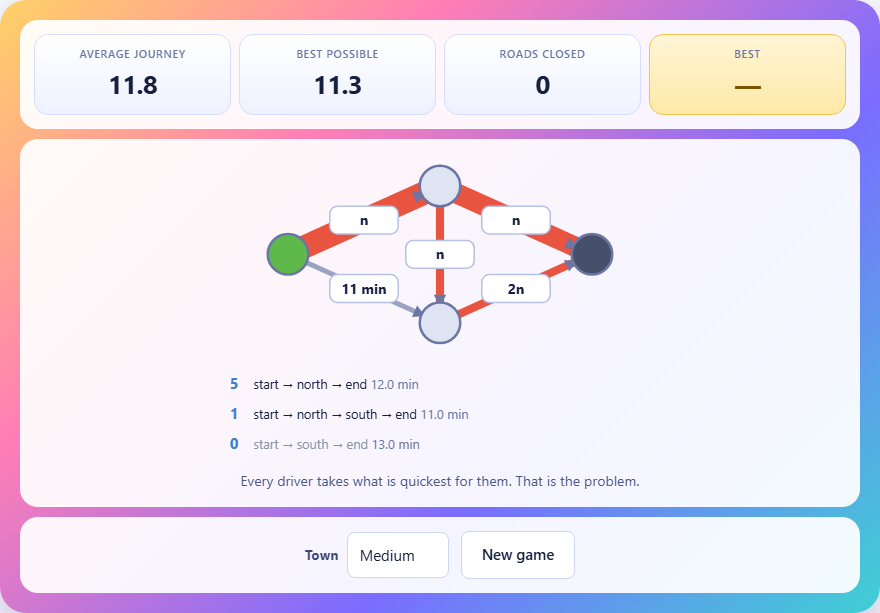
Cars drive from a green starting node to a dark destination node. Each road has a travel time. Some roads take a fixed number of minutes no matter how many cars use them. Others get slower as more cars pile on. Every driver picks the route that is fastest for them, given what everyone else is doing. They keep switching until nobody can improve their own journey by changing route.
That arrangement is called an equilibrium. It is stable because no single driver wants to leave it. But it can be bad for everyone. Your job is to close one or more roads until the average journey time drops to the best possible value. Tap a road to close it. Tap it again to reopen it.
Understanding road labels
A road labelled with a plain number, like six or ten, takes that many minutes regardless of traffic. Four cars or forty, the time is the same. These roads are safe valves in the network. They do not get worse.
A road labelled with the letter n takes one minute per car on it. If four cars use that road, each of them spends four minutes on it. If eight cars use it, they all spend eight minutes. A road labelled 2n takes two minutes per car, so four cars means eight minutes each. These congesting roads are where the problem lives, because drivers crowd onto them when a fast connecting link makes them part of the best individual route.
Controls and the information panel
The board shows a network of nodes connected by roads drawn as lines with arrows. Tap any road to close or reopen it. Closed roads are greyed out and labelled as closed. Below the network is a route list that shows every possible path through the town, how many cars take each path, and how long the journey takes on that path.
The scoreboard shows three values: the current average journey time, the best possible average, and how many roads you have closed. The Town selector offers Small, Medium, and Large networks. Small has four cars. Medium has six. Large has eight and sometimes adds a bypass road. The New game button generates a fresh town.
Why the short link is usually the culprit
Most generated towns have a short connecting link between the two middle nodes. That link looks helpful. It lets a driver use the congesting road at the start of the network and the congesting road at the end, hopping between them through the shortcut. Every driver sees this as the quickest route, so they all take it.
The result is that both congesting roads carry all the traffic. Four cars on each congesting road means four minutes each, plus the fixed-time roads on either side. Close that short link and the drivers are forced to split. Half take the top route and half take the bottom. Each congesting road now carries only two cars, which halves the time on those segments. The average journey drops even though you removed a connection.
Thinking about equilibrium
The game computes the equilibrium exactly. It finds the arrangement where no driver could get home faster by switching, using a mathematical approach where the sum of costs is minimised in a specific way. This is not the same as the arrangement that makes the average shortest. That gap is the whole point of the puzzle.
When you close a road, the drivers settle into a new equilibrium on the roads that remain. The route list updates instantly to show the new split. You can watch the car counts shift as you open and close roads, which helps build an understanding of how the balance works. Nobody is behaving badly. Each driver is doing the right thing for themselves. The problem is what those individually correct choices add up to when everyone makes them at once.
Strategy for Small towns
With four cars and four or five roads, the puzzle is usually about one closure. Look at the route list before you close anything. If every car is taking the same route, that route almost certainly goes through two congesting roads linked by a shortcut. Close the shortcut. If the average drops to the target, you are done.
Sometimes the answer is not the most obvious link. If the town has an unusual layout where the shortcut runs from south to north instead of the typical direction, the drivers use a different pair of congesting roads. Read the labels. Find the two roads marked n or 2n. Then find the road that lets a single journey use both of them. That connector is your target.
Strategy for Medium and Large towns
More cars amplify the damage from congestion. Six cars on an n-road means six minutes each instead of four. The gain from splitting them is proportionally larger, but there are more roads to consider and sometimes more than one closure is needed.
Large towns can include a bypass road directly from start to end. That bypass often has a high fixed cost, so drivers avoid it when the congesting routes look cheaper. But after you close the short link, the bypass becomes competitive and some drivers switch to it. This three-way split can bring the average down further than a simple two-way split. Try closing one road at a time and watch the list. If the average is still above the target after one closure, look for a second road that is pulling traffic onto a congesting segment.
Common mistakes and dead ends
Closing a fixed-time road almost never helps. Those roads do not get worse with traffic, so pushing cars off them just forces more onto the roads that do get worse. Focus on the congesting roads and their connectors.
Over-closing is another trap. Past a certain point you are simply removing capacity. If you close two roads and the average goes up instead of down, reopen one. The game lets you reopen anything for free, and only the state of the roads when you achieve the target counts. Experiment freely.
- Closing fixed-time roads, which does not reduce congestion
- Closing so many roads that there is barely a route through the town
- Ignoring the route list, which tells you exactly where the traffic is going
- Assuming the same road is the answer in every town, when the layout changes each game
Why this works in real life too
The idea behind this puzzle was described by Dietrich Braess in 1968. He showed that adding a road to a network can make every journey longer, because drivers choose individually and a fast new link tempts everyone onto roads that congest. The same effect has been observed in real cities. The principle is now a standard part of transport planning.
Every town in this game is checked before it is offered. The game tries every combination of closures and confirms that at least one set of closures genuinely improves the average. It also checks that at least two wrong closures exist, so there is always something to work out.
Scoring and what counts as a win
You win when the current average journey drops to the best possible value shown on the scoreboard. The game records how many roads you closed to get there. Fewer closures is a better score. If two different sets of closures both reach the target, the one that closes fewer roads wins.
The best possible average is not always a whole number. The scoreboard shows it to one decimal place. Because the equilibrium arithmetic involves dividing the total travel time by the number of cars, averages like 6.5 or 7.3 minutes are common. Match that number exactly and the board clears.
Privacy and how the game runs
The entire game runs in your browser. The equilibrium calculations, the road generation, and every closure test happen on your own device. Nothing is uploaded. There is no account, and your best score is stored locally in your browser. Once the page has loaded, the game works offline.