
Pitching every tent in Tents and Trees
The three rules that must all be true at once, why marking grass is just as important as placing tents, and the deduction chains that solve a board without any guessing.
The three rules explained
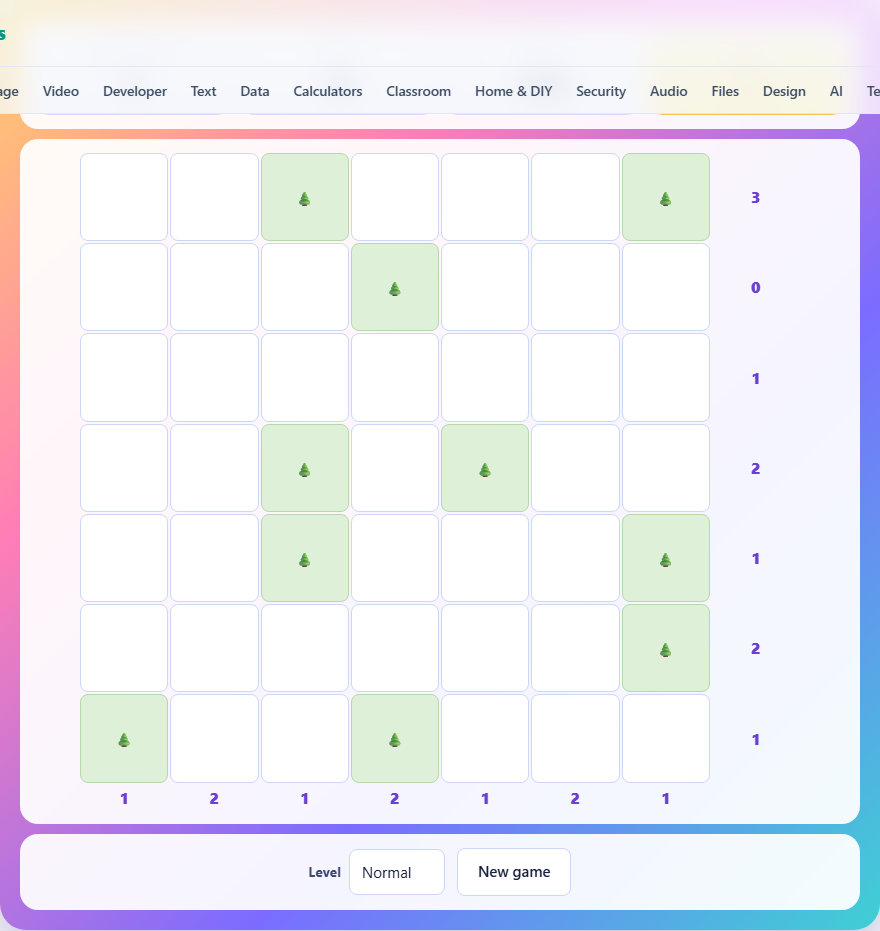
Tents and Trees gives you a grid with trees scattered across it. Numbers run along the right edge and the bottom edge. Your job is to place one tent next to every tree, following three rules at the same time.
First, every tree gets exactly one tent, placed directly above, below, left or right of it. Diagonal does not count. Two trees can never share the same tent. Second, no two tents may touch each other, not even at a diagonal corner. A tent blocks all eight squares around it. Third, the number at the end of each row and column counts exactly how many tents belong there. All three rules must hold at once for the puzzle to be complete.
Tapping the grid
Tap an empty square once and a tent appears. Tap the same square again and it changes to a grass dot, which means you have ruled that square out. Tap a third time and it goes back to empty. Tree squares cannot be tapped.
The grass marker is not decoration. It is one of the most powerful tools in the puzzle. Once you know a square cannot hold a tent, marking it as grass shrinks the problem. Many advanced deductions depend on knowing which squares are definitely empty. The Level dropdown offers Easy, Normal and Hard, and New game deals a fresh board.
Starting with what you know for certain
The safest opening move is to look at the edge numbers. Any row or column marked with a zero has no tents at all. Mark every non-tree square in that line as grass immediately. This is free information and it often clears a large part of the board.
Next, look at each remaining square and ask: is there a tree next to it? A tent must be directly beside its tree. If a square has no tree above, below, left or right, it can never hold a tent. Mark it as grass. Between the zero lines and the no-neighbour rule, you can usually grass out a third of the board before placing a single tent.
The forced-tent deduction
A tree has at most four squares where its tent could go: above, below, left and right. Some of those might already be grass, off the edge of the board, or occupied by another tree. If only one of those four squares is still available, that square must be the tent. Place it with confidence.
After placing that tent, mark every square around it, all eight neighbours, as grass. That often pushes a nearby tree down to one remaining option, triggering the same deduction again. These chains are the heart of the puzzle. One forced tent leads to forced grass, which leads to another forced tent, and the board collapses toward the solution.
Using the row and column counts
The edge numbers are not just a final check. They are active clues throughout the solve. If a row needs two tents and there are exactly two non-grass, non-tree squares left in it, both of those squares must be tents. Place them and grass everything around them.
The opposite also helps. If a row already has its full count of tents, every remaining empty square in that row is grass. Mark the whole row and move on. The same logic applies to columns. Checking the counts after every placement keeps the board tight and prevents guessing.
The no-touching rule is your friend
A placed tent removes eight squares from play at once. That is a large exclusion zone on a small board. On a six-by-six grid with six trees, placing one tent eliminates up to eight of the thirty-six squares instantly.
This means that two tents in the same region of the board push each other apart. If two trees are close together, their tents must go on the sides that face away from each other. Recognising this early prevents placing a tent in a spot that makes it impossible to tent the neighbouring tree.
Strategy for harder boards
On larger boards the zero-line and forced-tent openings will not solve everything. You will reach a point where every tree still has two or three options. At that moment, turn to the edge counts again. Look for a row where the count equals the number of open squares minus one. That means all but one of those squares is a tent. You cannot tell which one is empty, but you know all the others are full, and that knowledge often forces a chain elsewhere.
Another strong technique is to pair trees mentally. If two trees are next to each other and one of them can only tent toward the other, their pairing is forced and you can mark the second tree's tent on the opposite side. This avoids the sharing trap where two trees seem to compete for the same square.
Common mistakes and how to avoid them
- Forgetting that diagonal touching is forbidden. Two tents in neighbouring corners look far enough apart but break the rule. Always check all eight squares around a tent, not just the four sides.
- Placing tents without marking grass around them. A tent blocks eight squares. Skipping the grass markers means you lose track of the exclusion zone and end up with illegal neighbours.
- Ignoring trees that share a potential tent square. Two trees side by side cannot both tent on the square between them. One of them must tent in the other direction.
- Relying on the count alone. A row might have the right number of tents but the tents might be touching, or they might not pair properly with their trees. All three rules must hold at once.
- Guessing when the logic stalls. Every puzzle generated here has exactly one solution, and that solution can be reached by deduction alone. If you feel stuck, look for a zero row, a tree with one option, or a row whose count matches its open squares.
A solve from start to finish
Imagine a six-by-six grid. Row 1 has a count of zero, so mark every non-tree cell in that row as grass. Column 4 also has a count of zero, so grass the whole column. That knocks out roughly a quarter of the board.
Now scan for trees with only one free neighbour. A tree in row 2, column 1, has its left and top neighbours as grass. If column 1 has a tree below it and there is a tree to its right, only one side remains open. Place a tent there and grass the eight squares around it. That forces the tree in row 3 to tent upward, which forces another tree to tent to the right. The chain runs until five of the six tents are placed and the last one drops into the only remaining gap.
The whole solve took no guessing. Every placement followed from a rule. That is what makes Tents and Trees a pure logic puzzle.
The three difficulty levels
Easy uses a six-by-six grid and gives four minutes. There are roughly seven trees and the board is open enough that zero lines and forced tents often carry you straight to the end.
Normal is a seven-by-seven grid with six minutes. The extra row and column add more trees and more interaction between them. You will usually need the count-based deductions alongside the forced-tent chains.
Hard is an eight-by-eight grid with eight minutes. The board is dense enough that several trees compete for the same squares, and the no-touching rule creates long chains of forced grass that ripple across the grid. Clearing the zeros and the no-neighbour squares first is essential to keep the board manageable.
Nothing is sent anywhere
The entire puzzle is generated and checked on your own machine. No board layout, no tent placement, and no score is ever transmitted to a server. Your best result is kept in local storage inside this browser and stays on this device only. Once the page has finished loading you can disconnect from the internet and keep playing.