
Solving the rhythm puzzle in Tempo
How the coloured tracks divide a bar of music, why fixing one collision often fills a silence at the same time, and the step-by-step thinking that turns a jumbled drum pattern into a clean groove.
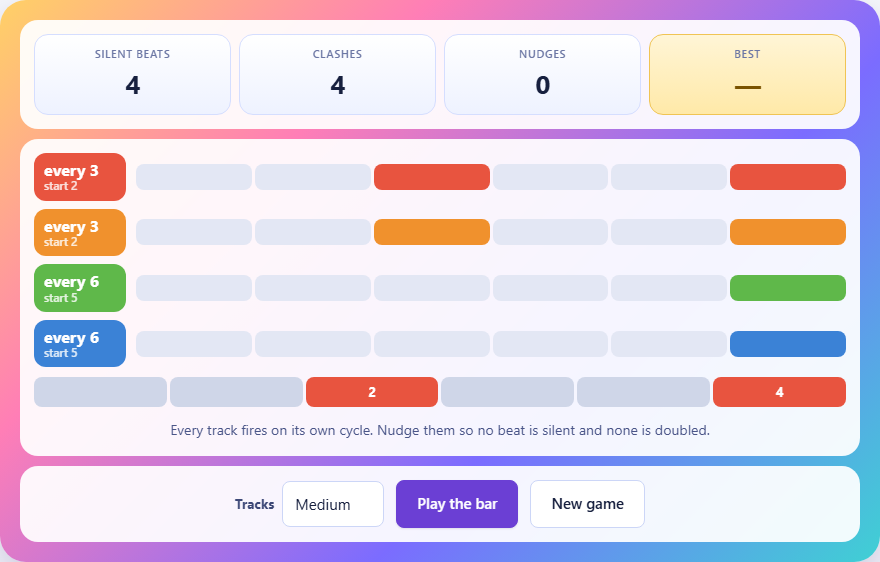
What the puzzle asks you to do
Tempo gives you a bar of music divided into a fixed number of beats. Several coloured tracks sit above the bar. Each track fires on a repeating cycle. One might fire every two beats, another every three, another every four. You cannot change how often a track fires. The only thing you control is which beat it starts on.
Your job is to nudge the tracks so that every beat in the bar has exactly one hit. No beat may be silent and no two tracks may land on the same beat. When the bar is a solid row of green, the puzzle is solved.
Reading the tracks and the bar
Each track has a label. It says something like every 4, start 2. That means the track fires on beats 2, 6, 10, 14 and so on, repeating every four beats. The coloured dots on the track row show where those hits land.
Below all the tracks is the bar, a row of squares that represents every beat in the pattern. Each square is coloured. Green means exactly one track fires on that beat. Grey means no track fires there, which is a silence. Red means two or more tracks collide, and a small number inside the red square tells you how many hits overlap.
The length of the bar is not random. It is the smallest number that lets every cycle line up and repeat. If your tracks fire every 2 and every 3, the bar is 6 beats long, because that is the first number both 2 and 3 divide evenly.
The one control you have
Tap a track to nudge its starting beat forward by one. If a track fires every 4 and currently starts on beat 0, tapping it moves the start to beat 1. Tap again and it moves to beat 2. After beat 3 it wraps around back to beat 0. Every tap moves the entire pattern of that track one beat to the right.
That wrapping is important. A track with cycle 4 has only four possible starting positions: 0, 1, 2 and 3. No matter how many times you tap, it cycles through those same four slots. A track with cycle 2 has only two positions. Fewer positions means fewer choices, but also less flexibility.
Why the fractions always add to one
A track that fires every 2 covers half the beats in the bar. A track every 3 covers a third. A track every 4 covers a quarter. For the puzzle to have a solution, these fractions must add up to exactly one. Half plus a third plus a sixth equals one, for example. The puzzle generator guarantees this by starting with a single track that covers every beat and then splitting it into smaller tracks. Each split preserves the total coverage, so the fractions always balance.
This is also why you can trust the puzzle. There is always at least one arrangement that fills the bar perfectly. Sometimes there is more than one, and any of them counts as a win.
Start with the track that covers the most ground
The track with the shortest cycle is the most constrained and the most powerful. A track that fires every 2 claims half the bar all by itself. Moving it shifts half the beats at once. Settle that track first and then fit the rest into the gaps it leaves.
After the biggest track, look for pairs. Two tracks with the same cycle must start on different beats. If they both fire every 4, one might start on beat 0 and the other on beat 2. Between them they cover half the bar, and their positions relative to each other are fixed once you place the first one. Those pairs are usually the last pieces of the puzzle because they snap into place once everything else is set.
Fix collisions, not silences
When you see red squares in the bar, it is tempting to look at the grey squares and try to fill them. That is backwards. A collision means at least one of the tracks sitting on that beat belongs somewhere else. Moving it away from the collision often drops it straight into a silent beat, fixing two problems at once.
Count the collisions and the silences separately. If you have two collisions and two silences, moving two tracks will probably clear the board. If you have one collision with a count of 3, two tracks need to leave that beat and fill two specific silences. The numbers in the red squares tell you exactly how many tracks are stacked up and how many need to move.
Using the sound to check your work
Press Play the bar and the pattern loops. Each track has its own pitch, so you can hear whether a beat is silent, clean, or cluttered. A collision is usually easier to catch by ear than by eye, because two notes at once sound obviously different from one. A silence is a gap in the rhythm that your ear picks up before your eye does.
The sound is there as a tool, not a requirement. The puzzle is fully solvable without it, just by reading the coloured bar. But if you are stuck, listening to the bar loop once or twice often reveals the problem beat faster than scanning the grid.
The three puzzle sizes
Small gives you three tracks and a bar up to twelve beats long. The fractions tend to be simple halves and thirds, and the puzzle often has multiple solutions. It is a good place to learn how nudging and wrapping work.
Medium has four tracks and a bar up to sixteen beats. The fractions get tighter. A combination of every 2, every 4, every 4 and every 8 leaves only a handful of valid starting positions. The puzzle usually has one or two solutions and takes ten to twenty nudges.
Large uses five tracks and a bar up to twenty-four beats. The fractions involve thirds and sixths alongside halves and quarters, and cascading nudges become common. Moving one track to fix a collision creates a new collision elsewhere, and you have to see two steps ahead.
Walking through a medium puzzle
Suppose the bar is twelve beats long and you have four tracks: every 2, every 3, every 4 and every 12. The every-2 track covers six beats, every-3 covers four, every-4 covers three, and every-12 covers one. Those fractions add up to a half plus a third plus a quarter plus a twelfth, which equals one.
Start with the every-2 track. It has two starting positions: beat 0 or beat 1. Pick beat 0 so it fires on 0, 2, 4, 6, 8 and 10. That fills the even beats. Now every-3 must avoid them. Starting on beat 1, it fires on 1, 4, 7 and 10. Beat 4 and 10 collide with the every-2 track. Nudge it to start on beat 3 instead: it fires on 3, 6, 9 and 0. Still colliding on 0 and 6. Try starting on beat 1 again but move the every-2 track to beat 1 instead, so it fires on 1, 3, 5, 7, 9 and 11. Now every-3 on beat 0 fires on 0, 3, 6 and 9. No collisions. The every-4 track on beat 2 fires on 2, 6 and 10. Beat 6 collides. Move it to start at beat 4: fires on 4, 8. Wait, that is only two hits. With cycle 4, starting at 4 fires on 4, 8, 0. Beat 0 collides. Starting at 2 gives 2, 6, 10. Beat 6 collides with the every-3 track. Starting at beat 2 and tweaking the every-12 track fills the last gap. This is the kind of reasoning each puzzle asks for.
Common mistakes when starting out
- Tapping randomly hoping to stumble on the solution. Each nudge changes the whole track pattern, so random tapping rarely converges.
- Trying to fix every silence individually. Focus on collisions instead. A silence is a symptom, not the root cause.
- Ignoring tracks with short cycles. A track every 2 is the most important to place first because it controls the most beats.
- Forgetting that nudging wraps around. A track with cycle 3 has only three starting positions. If none of the three work, the track is fine and the problem is elsewhere.
- Not pressing Play. A single listen often reveals the clashing beat instantly, saving several rounds of visual scanning.
The puzzle stays on your device
Every puzzle is built inside your browser by splitting a single track down into smaller ones. No rhythm patterns are downloaded from a server, no account is needed, and your best score is stored in local storage on this device only. Once the page has finished loading you can play offline. Closing the tab is all the cleanup required.