
Winning with the king in Viking Chess
How the asymmetric board works, why sandwiching is nothing like chess capture, what the corners and the throne do, and the thinking that gets a king safely out from the middle of eight enemies.
Two sides, two completely different jobs
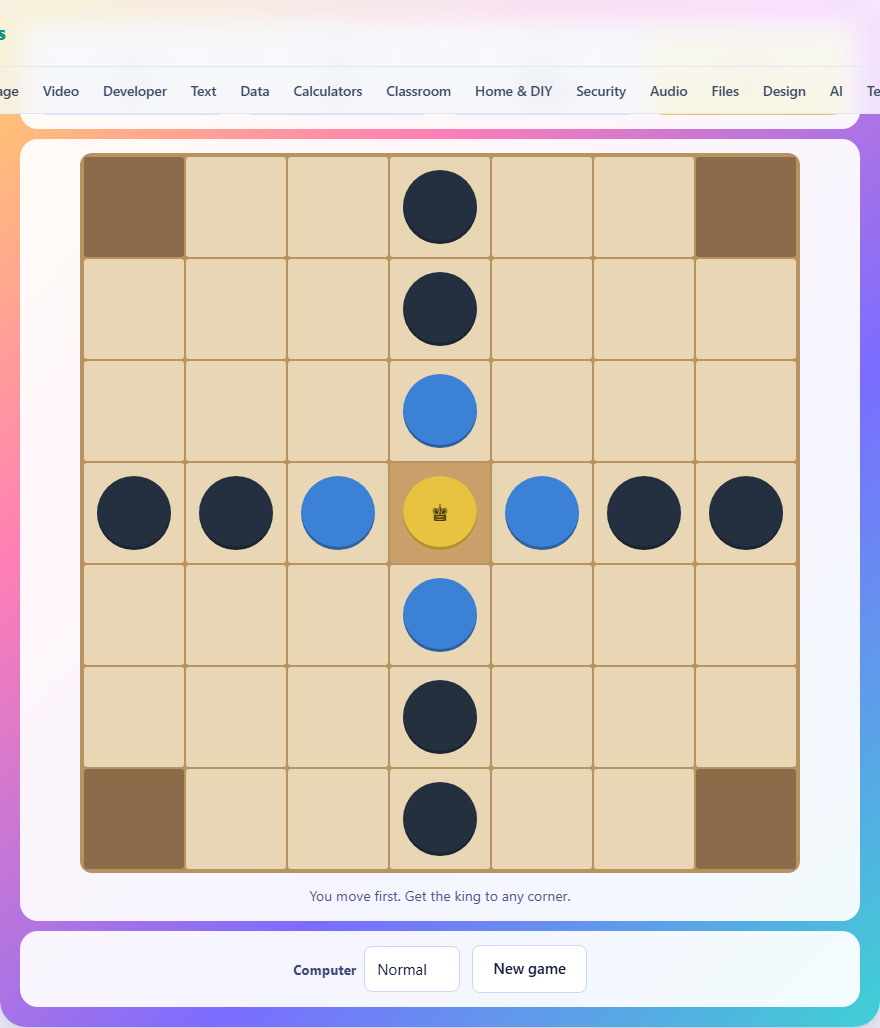
Viking Chess sets up a fight that is unfair on purpose. You control one king and four defenders, all starting in the centre of a seven-by-seven board. The computer controls eight attackers arranged around the edges. The two sides do not share a goal. Your king wins by reaching any of the four corner squares. The attackers win by surrounding the king on all four orthogonal sides at once.
Because the aims are so different, counting pieces tells you almost nothing about who is ahead. A player with three defenders left but a clear run to a corner is in a much better position than one with all four defenders still standing but the king boxed into the middle. The balance comes from the shape of the contest, not from equal armies.
How every piece moves
Every piece on the board, king and attacker alike, moves the same way. It slides in a straight line along a row or column, any number of squares, but it can never jump over anything. If a friendly or hostile piece sits in the path, you stop before it. That makes every piece something like a rook in chess, except there is no capture by landing on a square.
The king has one privilege that nothing else shares. Only the king may stand on a corner square or on the throne, which is the centre square where the king begins the game. Attackers and defenders are forbidden from stopping on those five squares. The throne and the corners also act as hostile squares for capture purposes, which matters in a way the next section explains.
Sandwiching, not capturing
To take an enemy piece you must close a sandwich. Move one of your pieces so that an enemy is caught directly between it and another of your pieces, along a row or a column. The trapped piece is removed at once. You can take more than one piece in a single move if the piece you move completes more than one sandwich at once.
The rule that surprises newcomers is that moving into a gap between two enemies is completely safe. Capture only happens when the side doing the trapping is the one that moves. You can walk straight between two attackers and nothing happens to you. This one detail makes the game feel unlike any chess variant. It means you can use gaps aggressively, slipping through lines that look dangerous.
The corners and the empty throne count as hostile squares for everyone. That means a defender standing next to a corner can be captured by a single attacker on the other side, because the corner itself acts as the second jaw of the trap. Likewise, if the throne is empty, it plays the same role.
Taking the king is harder than it looks
The king cannot be captured by a simple two-piece sandwich. To remove the king from the board, the attackers must surround him on all four orthogonal sides. That means four attackers, or three attackers and a board edge, or some combination that fills every square directly above, below, left and right of the king. As long as a single one of those four neighbours is empty or occupied by a defender, the king survives.
This is why the tip to keep a defender beside the king matters so much. With a friendly piece on one side, the attackers can never close the fourth gap. They would need to capture that defender first, but doing so opens a square the king can immediately use to escape.
Opening strategy for the defending side
A common instinct for new players is to keep the king on the throne with all four defenders close by, forming a tight ring. This feels safe but it loses slowly. The attackers have eight pieces to your five, and if you sit still they will methodically close every line to the corners.
Instead, break out early. Move the king off the throne within the first few turns. The goal is to reach a row or a column that has a clear path to two different corners at once. When the king threatens two corners simultaneously, the attackers can only block one of them. That fork is the single most powerful idea in the game.
- Open a corridor by pushing a defender to one side of the board, drawing attackers away from a corner.
- Keep one defender close to the king as a permanent shield while sacrificing the others to clear lanes.
- Avoid moving the king toward the centre of an edge, where it threatens only one corner at most.
How the computer plays against you
The computer searches ahead using a method called alpha-beta pruning. On Easy it looks two moves deep, Normal goes three moves deep, and Hard looks four moves ahead. At every position it scores how close the king is to the nearest corner and how many pieces each side still has. Distance from the corner matters far more than material in its scoring, so leaving a corner unguarded is punished almost instantly.
Knowing this tells you something useful. On Easy the computer often misses a combination that takes more than two moves to pay off. On Hard it will see a trap four moves in advance and steer around it. If you are learning, Easy is genuinely forgiving. Hard is a fair challenge even once you understand the tactics.
Reading the controls
Tap one of your pieces and the board highlights every square it can legally reach this turn. Tap a highlighted square to complete the move. Tap the same piece again to deselect it. After your move, the computer takes its turn and the board updates.
The stats bar shows three numbers. Moves counts your total moves so far, and it becomes your score if you win. Attackers tells you how many enemy pieces remain. Turn shows whose move it is. Below the board, the Computer dropdown chooses Easy, Normal or Hard, and New game starts a fresh game at whatever level is selected.
Common mistakes and how to fix them
- Staying on the throne too long. The throne is where you start, not where you want to finish. Move the king out within the first three turns.
- Spreading defenders to all four sides. That leaves each one alone and easy to sandwich. Keep two defenders working together near the king and accept that the other two are expendable scouts.
- Ignoring the hostile squares. A defender standing next to an empty throne or next to a corner can be captured by a single attacker, not two. Think of those special squares as invisible attackers.
- Chasing kills instead of running. Capturing attackers feels satisfying but it rarely matters. The game ends when the king escapes, not when the attackers are gone. Every move spent chasing is a move not spent running.
- Moving toward a single corner. If the king has only one escape route, the computer will block it. Always aim for a position that threatens two corners at once.
Sacrificing defenders to clear the path
Defenders are expendable. The only piece that matters is the king. If pushing a defender toward a corner draws two attackers away from the opposite side of the board, that trade is almost always worth making. Even if the defender gets sandwiched on the next turn, those two attackers are now out of position and the king has a clearer run.
A deliberate sacrifice works best when the king is already near the centre of a rank or file that reaches two corners. Send a defender toward corner A. The computer will usually chase it. While the attackers are busy, move the king toward corner B. If the attackers split their attention, one side is too thin and you walk through.
The three difficulty levels
Easy sets the computer's search to two moves ahead. It will miss many traps and is a good place to learn the sandwich rule and the corner escape without pressure. Normal goes to three moves and plays a competent game that punishes obvious blunders. Hard runs four moves deep and will block corner forks, set up its own sandwiches, and occasionally sacrifice a piece to close a corridor. A win on Hard in under twenty moves is a strong result.
Everything stays on your machine
The game runs entirely inside your browser. No moves are sent to a server, no account is needed, and your best score is saved in local storage on this device only. You can disconnect from the internet after the page loads and keep playing. Closing the tab is all the cleanup there is.