
One arrangement of stones, three stubborn suns
How the shadow puzzle works when you cannot move the stones between hours, what the marker symbols actually demand, why morning and evening pull in opposite directions, and the elimination steps that narrow dozens of possible placements down to the only one that satisfies all three times of day.
The idea behind the puzzle
A flat field sits under an open sky. Three times during the day the sun crosses from a different direction. In the morning it shines from the east, at midday from the north, and in the evening from the west. You are given a handful of tall stones and asked to place them on the field. Each stone casts a shadow that runs in a straight line away from the sun, all the way to the far edge of the field.
Scattered across the field are markers. Each marker shows three small symbols, one per hour, telling you whether it needs to be in sunlight or in shade at that time of day. A sun symbol means it must be lit. A moon means it must be shaded. You must find the single arrangement of stones that gives every marker exactly what it asks for at all three hours at once.
The rules spelled out
Each stone blocks light in a straight line behind it for a given hour. In the morning, light comes from the east, so a stone shades everything to its west along the same row. At midday light comes from the north, so a stone shades everything below it in the same column. In the evening light comes from the west, so a stone shades everything to its east in the same row.
Shadows do not stop at other stones or markers. They run from the stone all the way to the edge of the field. A second stone in the same shadow line changes nothing because the first stone already blocked the light.
You cannot place a stone on a square occupied by a marker. The markers are fixed. Only empty squares accept stones. The puzzle tells you how many stones to place, and you must use exactly that many.
Reading the markers
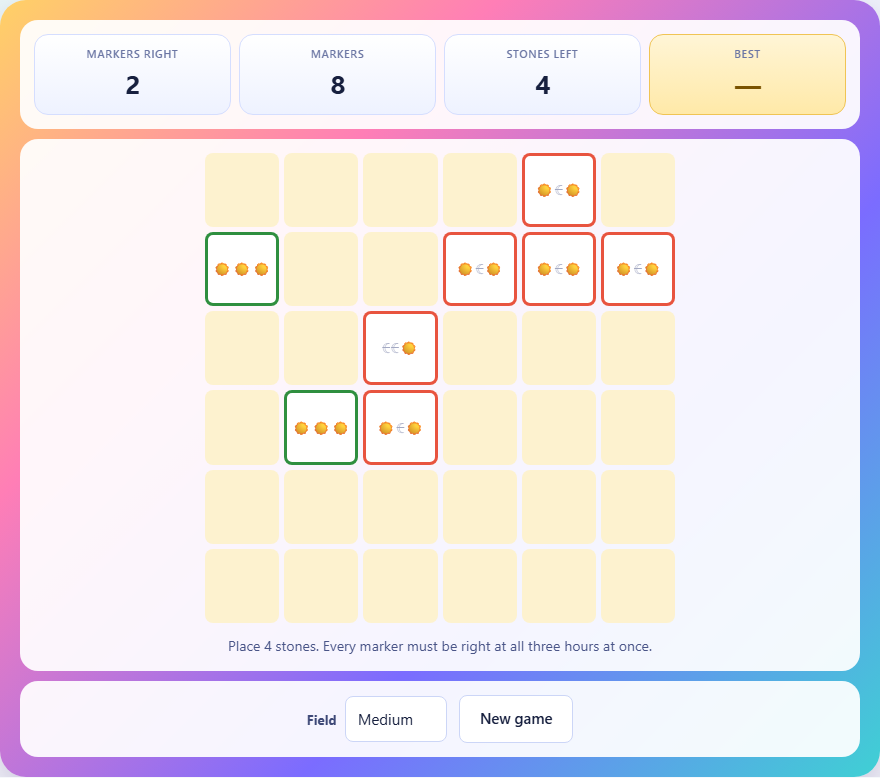
Each marker displays three symbols in a row, one for each hour. Left is morning, middle is midday, right is evening. A small sun means the marker wants to be lit at that hour. A small moon means it wants to be in shade.
When a marker's requirement is currently wrong, the symbol for that hour is struck through. This visual feedback tells you at a glance which hours are failing and which are already correct. A marker with all three symbols clear is fully satisfied. A marker with one strikethrough is one hour away from being right.
The ground itself is shaded to show how much of the day each empty square still sees. A square lit all day is bright. A square shaded at two out of three hours is darker. This ambient shading helps you visualise where your stones are casting shadows without having to trace every line manually.
Controls and field sizes
Tap an empty square to place a stone. Tap a stone to lift it again. You cannot place more stones than the puzzle allows. When all your stones are down and you try to place another, the game tells you to lift one first.
The Field selector offers three sizes. Small uses a five by five grid with three stones and four markers. Medium uses six by six with four stones and eight markers. Large uses seven by seven with five stones and eleven markers. The small and medium puzzles are checked to have exactly one solution. The large puzzle is guaranteed to be solvable but may have more than one valid answer, since checking every arrangement on a larger grid takes too long.
Strategy: start with the markers that are lit all day
A marker that demands sunlight at all three hours is the strongest constraint on the board. It means no stone may stand anywhere in the morning shadow line, the midday shadow line, or the evening shadow line of that marker. That rules out three entire lines at once, and on a small board that eliminates a large fraction of the available squares before you have placed a single stone.
Look for these markers first. Draw the forbidden lines in your mind: nothing to the east of it in the same row (or a stone there would shade it in the morning), nothing above it in the same column (midday shadow), and nothing to the west in its row (evening shadow). Every square those lines cross is off limits.
Strategy: morning and evening fight each other
Morning light comes from the east and evening light from the west. A stone placed to the east of a marker shades it in the morning. A stone placed to the west shades it in the evening. The two directions are opposite.
A marker that needs shade at both morning and evening therefore needs a stone on each side of it in the same row. That is two stones committed to one marker. If you only have three or four stones total, that is a huge investment, and it constrains where the remaining stones can go.
A marker needing shade in the morning but sun in the evening wants a stone to its east but nothing to its west. Look at the row and see which squares are free on the eastern side. Often only one square works without conflicting with another marker's demands, and that gives you a placement for free.
Strategy: midday is the cheap hour
Midday light comes from the north, straight down the columns. A single stone placed high in a column shades every marker below it for the midday hour. That makes midday the easiest requirement to satisfy with the fewest stones.
Use this to your advantage. If several markers in the same column need midday shade, one stone near the top handles all of them. Then you can spend your remaining stones on the morning and evening requirements, which are harder to satisfy simultaneously because they run along rows rather than columns.
When a marker needs to be lit at midday, it means nothing may stand above it in its column. Check whether that column is already clear or whether another marker's demand would force a stone there. Conflicts between midday-lit markers and morning or evening shade demands are where most puzzles get their teeth.
A worked example on a small field
You pick Small and get a five by five grid, three stones, and four markers. One marker sits in the middle row, needing sun at all three hours. You draw the forbidden lines: its entire row is off limits for stones that could cast morning or evening shadows on it, and its entire column above it is off limits for midday. That eliminates a dozen squares.
A second marker in the bottom left corner wants shade at morning and midday but sun in the evening. It needs a stone to its east (morning), a stone above it in its column (midday), and nothing to its west (but nothing is to its west, since it is in the corner already). You look for a square that is both to its east and above another marker needing midday shade. One square fits both jobs. You place your first stone there.
With one stone down, the marker feedback updates. Two of the four markers now show one satisfied hour each. You reason through the remaining two stones, place them, and watch all four markers clear. The game reports every marker right at morning, midday and evening.
Mistakes that waste your stones
- Placing two stones in the same shadow line. The second stone adds nothing because the first already blocked the light. Each stone must shade at least one marker that nothing else is shading.
- Forgetting that a stone casts three shadows at once. A stone placed for its morning shadow also casts midday and evening shadows, and those may shade a marker that needed to be lit. Always check all three hours before committing.
- Solving one hour at a time. Placing stones to satisfy all the morning markers first will usually wreck the evening requirements. Solve the tightest markers across all three hours before the loose ones.
- Ignoring the ground shading. The ambient colour of each empty square tells you how much daylight it still gets. A square already in shade at two hours might be exactly where you need a stone, or it might be a trap.
Nothing leaves your machine
The puzzle is generated in your browser. The markers are placed randomly, the three hours are computed, and the requirements are read off the result. No data is sent anywhere and no account is needed. Close the tab and there is nothing to clean up.