
Why your brain fights you in a colour naming game
What happens when a word says one colour but the ink says another, why that tug of war is so hard to win, how the six buttons and the twin clocks keep the pressure on, and what experienced players do to quieten the voice in their head that keeps reading the wrong thing.
The trick your brain plays on you
A word appears in the centre of the screen. It spells out a colour name, something like RED or BLUE or PURPLE. But the ink it is written in is a different colour entirely. The word might say RED while the letters themselves are painted green. Your job is to name the ink, not the word.
That sounds trivial until you try it. Reading is so deeply automatic for a fluent reader that the word arrives in your mind before you have consciously chosen to read it. Naming a colour, on the other hand, takes a fraction of a second longer. The two answers collide, and the wrong one always gets there first. That collision has a name. It was first measured in 1935 and has been studied ever since. The measurable delay it causes is real, consistent, and almost impossible to eliminate entirely. This game turns that delay into a race against the clock.
The rules in full
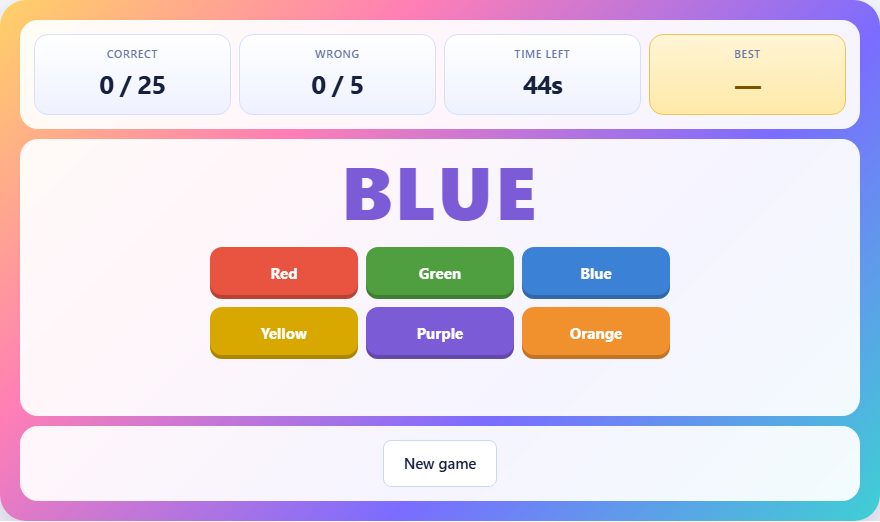
Each round shows one word printed in one colour. Below it sit six buttons labelled Red, Green, Blue, Yellow, Purple and Orange. You tap the button that matches the ink colour of the word. That is the only decision: which colour are the letters actually painted in?
You need twenty-five correct answers inside forty-five seconds. Get there and you win. Along the way, five wrong answers end the game immediately, even if time remains. If the clock runs out before you reach twenty-five, the game also ends. The display tracks your correct count out of twenty-five, your wrong count out of five, and the seconds remaining.
Why some rounds match on purpose
Not every round is a trap. Roughly one time in six, the word and the ink colour are the same. The word says BLUE and the ink is blue. This is not a kindness.
Without those matching rounds, a clever player could adopt a simple rule: whatever the word says, never pick that colour. That shortcut would bypass the entire effect because you would never need to identify the ink at all. The occasional match forces you to actually look at the colour every single time. You cannot just read the word and pick something else.
How the controls and the display work
The playing area is clean. The word sits large and central, easy to see from any distance. The six answer buttons are arranged below it, each one tinted with the colour it names so you can locate it by sight rather than reading. Above the game, three counters track your progress: correct answers, wrong answers, and the time left in seconds.
On a phone the buttons are sized for a thumb. On a wider screen they spread out into a row. The game responds the moment you tap, with a short sound to confirm whether you were right or wrong. After a correct answer the next word appears almost instantly. After a wrong one it lingers for a fraction longer and shows a message naming the correct ink colour, giving you a moment to see what you missed before moving on.
A New game button below the board starts a fresh round whenever you want. There is no difficulty selector because the difficulty is built into the effect itself. Everyone finds it hard. The question is only how hard.
Strategy: slow your eyes and speed your hand
The single most effective technique is to let your vision go slightly soft. If you look at the word with a relaxed gaze rather than reading it sharply, the colour becomes the dominant signal and the letters lose their grip. You are not trying to blur the screen. You are trying to see the colour before the word has time to register.
Speaking the answer out loud before you press is another anchor. When you say the colour name to yourself, even under your breath, it competes with the word your brain just read and often wins. Players who press silently find that the word ambushes them at the last moment, sending the wrong finger to the button.
Position your hand or thumb centrally rather than hovering over one button. The colours appear in a random order, and favouring one side means a longer reach when the answer is on the other. Keeping a neutral starting position shaves small amounts of time off each answer, and across twenty-five rounds those fractions add up.
Strategy: read the feedback, not the word
After a wrong answer the game tells you what the ink colour was. That message is not decoration. It tells you which colour you are confusing under pressure. If the same colour catches you twice, you know your weakness.
Most people have one pair that trips them up more than others. Yellow text spelling ORANGE is a common stumble because the two colours sit near each other on the visible range. Purple and blue cause trouble under some screen settings. Knowing your own weak pair means you can slow down when you see those two colours together rather than rushing into the same mistake.
Another useful pattern: when the score reads four out of five wrong, you have one life left. The instinct is to speed up and finish before time runs out, but that instinct is precisely what costs the final answer. One deliberate pause to be certain is worth the second it costs.
A round from start to finish
You press New game. The clock begins at forty-five seconds and starts counting down. A word appears: YELLOW, printed in purple ink. You look at it, recognise the purple colouring, and tap Purple. A short high tone plays, the correct counter moves to one out of twenty-five, and the next word arrives.
This one says GREEN in orange ink. You tap Orange. Two out of twenty-five. Then BLUE in blue ink, a matching round. You tap Blue. Three.
After twelve correct in about twenty seconds you hit a run of four where the mismatch is fierce: ORANGE in green, PURPLE in yellow, RED in blue, GREEN in red. You get three right but misread the fourth and tap Red instead of Blue. The wrong counter goes to one of the five you are allowed, and the feedback line says the ink was blue. Nineteen seconds left, fifteen correct, and ten still to find before the round is won.
You finish at twenty-three seconds with all twenty-five correct and two mistakes total. The win screen tells you how many seconds you had to spare. That spare time is your score, saved as your best on this device.
Common mistakes and how to avoid them
- Reading the word instead of looking at the colour. This is the whole game, and it never fully goes away. The soft-focus technique reduces it but does not eliminate it.
- Pressing before you are sure. Speed matters, but a wrong answer costs far more than a half-second pause. You have forty-five seconds for twenty-five answers, which is nearly two seconds each.
- Panicking after a mistake. One wrong answer out of five is nothing. Two is manageable. Rushing after an error is what turns one mistake into three.
- Ignoring the matching rounds. When the word and the colour agree, some players hesitate because every other round has trained them to distrust the word. Trust your eyes. If it looks blue and says blue, the answer is blue.
- Playing tired or distracted. The effect is worse when your attention is split. A noisy room or a late night makes the word dominate even more than usual.
What the scoring actually measures
When you reach twenty-five correct answers the game stops the clock and records how many seconds you had left. That remaining time is your score. A player who finishes with eighteen seconds to spare scored higher than one who finished with four. The score is saved as your personal best on this device.
What that number really captures is not just speed. It measures how well you can override an automatic response under time pressure. A fast reader who has never practised will often finish slowly because the words grip them harder. A player who has trained the soft-focus technique may not read as fast in everyday life but will tear through the rounds because they have learned to see colour ahead of letters. Comparing your best across sessions tells you whether the skill is developing.
Everything stays on your own device
The game runs entirely in your browser. There is no server involved in the play at all. Your best score is stored on this device in your browser's local storage, and it is never sent anywhere. You can prove this by loading the page, switching off your internet connection, and playing a full round. Everything works exactly the same, because there was never a connection being used in the first place.