
Consecutive runs and the logic that finds them
How the two rules of Straights work together, what the colours on the grid mean, why a run of one is free but a run of three can be deadly, and the step-by-step approach that cracks every size without guessing.
The two rules that drive every deduction
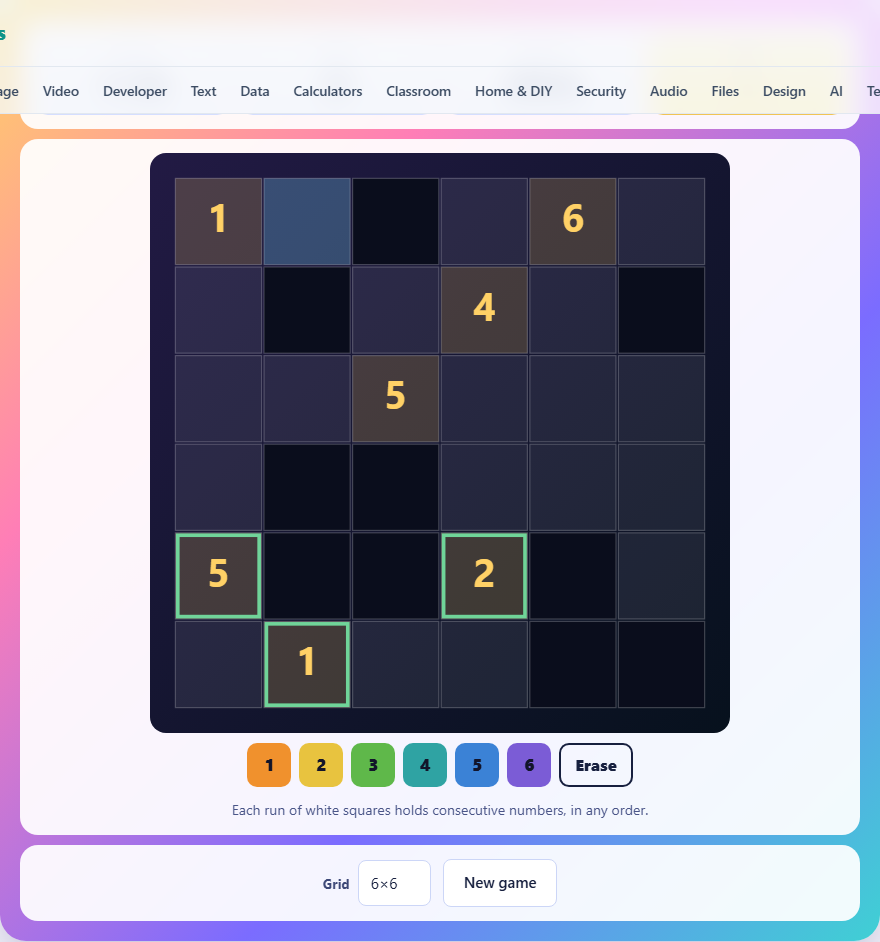
Black squares divide each row and column into runs of white squares. Every run must hold a set of consecutive numbers, in any order. A run of four containing 3, 5, 6 and 4 is perfectly valid, because those four numbers are consecutive when sorted. A run of three containing 2, 5 and 4 is not, because no set of three consecutive numbers includes both 2 and 5.
On top of the run rule, no number may appear twice in the same row or column. This second rule crosses the black squares. A 3 on one side of a black square rules out a 3 on the other side, even though they belong to different runs. The two rules feed each other: the run narrows the range of numbers that can go in a square, and the row or column eliminates specific values within that range.
Controls and the number pad
Tap a white square on the grid to select it. It highlights to show it is active. Then tap a number from the pad below the grid. The number appears in the square. Tap Erase to remove a number you have placed. Yellow numbers were printed on the grid when the puzzle was generated and cannot be changed.
A run outlines in green once every square in it is filled and the numbers form a consecutive set. That green outline is your confirmation that the run is correct. The puzzle is solved when every white square has a number, every run is consecutive, and no number repeats in any row or column.
The three grid sizes
The Grid selector offers three sizes. The five by five is the gentlest, with numbers from one to five and a time limit of about three minutes. The six by six uses numbers one through six and gives a bit more time. The seven by seven uses numbers one through seven, has more runs to manage, and gives the longest timer.
All three sizes use about one in five squares as black. That means a five by five grid has roughly five black squares, a six by six has about eight, and a seven by seven has about eleven. More black squares means shorter runs, which sounds easier but actually means more separate constraints to juggle at once.
The stats bar and the timer
Three figures sit above the board. Filled counts the white squares that have a number, shown as a fraction of the total. Runs shows how many separate runs the grid contains. Time left counts down from the starting time for that grid size.
If the timer hits zero before the grid is full, the game ends. Your score when you win is the number of seconds remaining, so faster is better. The best score for each grid size is saved in your browser on this device.
Strategy: find the shortest runs first
A run of two holds two numbers that must be next to each other, like 3 and 4, or 6 and 7. If one of those squares already has a printed clue, the other square has at most two possibilities, and the row or column rule usually narrows it to one. These short runs are the easiest to solve and the best place to start.
A run of one, a single white square sitting between two black squares, is free. It is consecutive by itself no matter what number goes in it. Only the row and column rules apply there, which makes it a pure elimination problem. Fill these in last if you can, because they rarely constrain anything else.
Strategy: use the span to rule out numbers
A run of three can only span three consecutive numbers. If the run already contains a 2 and a 6, the gap between them is four, but the run only has room for a span of three. That is impossible, and spotting it early tells you that your earlier placements need rethinking.
The formula is straightforward. In any run, the largest number minus the smallest must be at most one less than the run's length. A run of four can hold numbers whose highest minus lowest is at most three. If the spread is already too wide for the run to be consecutive, something is wrong.
This span check is the fastest way to catch mistakes before the grid is full. Run it mentally every time you place a number: look at the run it belongs to, note the current highest and lowest, and make sure the spread is still within the run's length.
Strategy: combine the run rule with row elimination
Imagine a run of three in row four. Two of its squares are empty and one has a 5. The run can hold 3-4-5, 4-5-6, or 5-6-7. Now check row four. If a 4 already appears in the row, the 3-4-5 option is gone. If a 7 also appears, the 5-6-7 option is gone, and the run must be 4-5-6 with the two empty squares holding 4 and 6. But wait, 4 was already in the row, so only 5-6-7 was possible after all, and only if 7 is not in the row.
This is the core solving loop. Each run gives a range of sets that could fill it. The row and column rules cut that range down. Often only one valid set remains, and the remaining numbers have only one legal position. When two constraints both point at the same answer, you know it is correct.
Common mistakes that waste time
- Ignoring the yellow clues. The printed numbers are there to anchor the puzzle. They tell you the neighbourhood of the run they belong to. Start with the runs that have the most clues.
- Placing a number that repeats in the row or column. The grid does not stop you from entering a duplicate. It only refuses to turn green at the end. Check the row and column before placing.
- Forgetting that the no-repeat rule crosses black squares. Two runs in the same row share the same no-repeat constraint, so a 4 in the left run forbids a 4 in the right run.
- Working without the timer in mind. The seven by seven grid has many squares. If you spend two minutes on a single tough run, the rest of the grid may not get enough time. Move on to something easier and come back.
- Guessing when stuck. Every puzzle has exactly one answer. If the next number is not clear, look at a different run or column. A fresh angle almost always reveals a forced value.
A worked example on a five by five
Imagine a five by five grid. Row three has a black square in column two, splitting it into a run of one on the left and a run of three on the right. The run of one already has a clue of 4. That is solved: it is a single square and the number is fixed.
The run of three in columns three through five holds a clue of 2 in column four. The run must be three consecutive numbers including 2. The only sets are 1-2-3 or 2-3-4. Check the column and row for each option. If column three already has a 1 in another row, the set 1-2-3 would need a 1 or a 3 in column three. But 1 is taken in that column, so column three must hold 3, which means the set is 1-2-3 and column five holds 1. If column three does not have a 1, both sets remain possible and you move on to another run for now. This back and forth between runs and lines is exactly how every grid is solved.
How the puzzles are generated
The grid is filled completely first, with a valid set of consecutive runs and no row or column repeats. Then clues are removed one at a time in random order. After each removal, the generator counts the number of ways the grid can be completed. If there is more than one, that clue is put back. The result is a puzzle with exactly one answer that can be solved by logic.
The yellow numbers that remain are the minimum set needed to keep the answer unique. Some puzzles end up with more clues than others because of how the runs interlock, which is why difficulty varies within the same grid size.
Everything runs on your device
The grid is generated, played and scored entirely inside the page. There is no server roll, no upload of your moves, and no account to maintain. Your best time for each grid size lives in your browser on this device and is never sent anywhere. Once the page has loaded, disconnecting from the network changes nothing.