
Placing stars without touching and without guessing
The full rules of the star placement puzzle, how the no-touching constraint drives every deduction, what the crosses are really for, and the specific techniques that solve each grid size without a single guess.
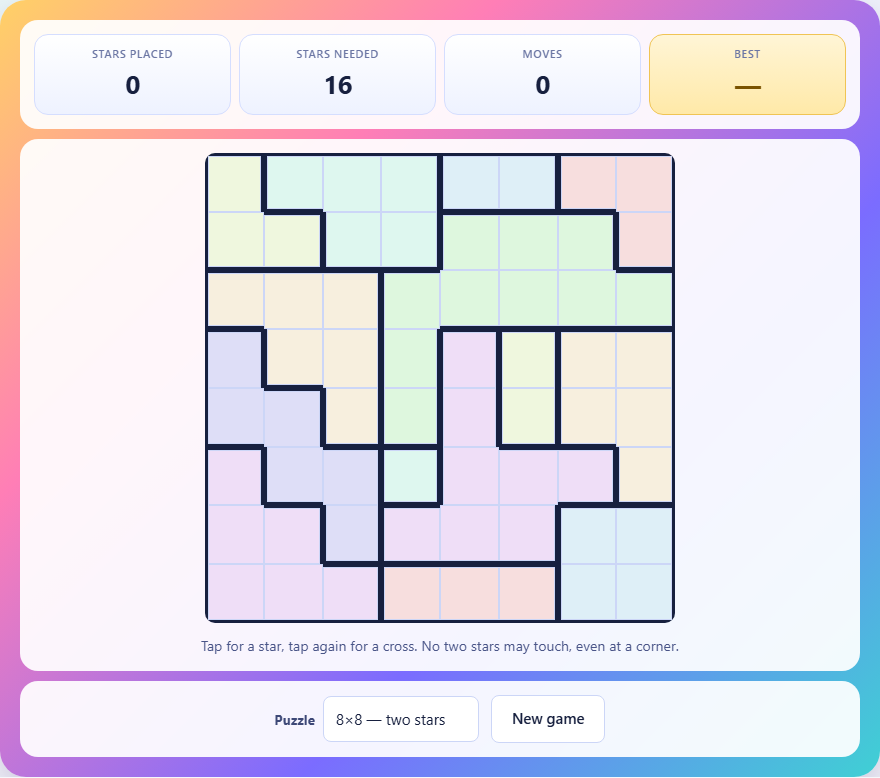
The three rules that define the puzzle
The grid is divided into outlined regions. You must place a fixed number of stars so that every row contains that number, every column contains that number, and every region contains that number. No two stars may touch, not even at a corner. A star blocks all eight squares around it.
On the six by six grid, the number is one star per row, column and region. On the eight by eight and the nine by nine, the number is two. That single change from one to two makes the puzzle dramatically harder, because now the stars inside each region must also be far enough apart from each other that they do not touch.
Controls and the three-state tap
Tap a square once to place a star. Tap the same square again to replace the star with a cross. Tap a third time to clear the square entirely. On a touchscreen, a tap works exactly like a click.
The stats bar above the board shows three things. Stars placed is the count of stars currently on the grid. Stars needed is the total the puzzle requires, which is the grid size multiplied by the star count per line. Moves counts every tap, whether it places a star, marks a cross, or clears a square. Lower is better and the move count is saved as your best score.
What the crosses are for
Crosses mark squares you have ruled out. They do nothing to the puzzle itself. The grid does not check them and they do not affect whether your answer is correct. They are entirely for your own reasoning.
That said, they do most of the work. Marking where a star cannot go is what makes the next deduction visible. Experienced solvers cross off squares before they place a single star, because once the impossible squares are marked, the forced positions reveal themselves. Treating crosses as optional is the biggest mistake a beginner can make, because without them the grid looks like a sea of identical empty squares and there is nowhere for your eye to land.
The three grid sizes and how they differ
The Puzzle selector offers three choices. The six by six with one star is the gentlest. Six regions, six stars in total, and each star blocks eight neighbours. Most of the deduction comes from small regions: a region of two or three squares has very few places to put even one star, and crossing off the neighbours of that forced star often solves half the grid.
The eight by eight with two stars is a large step up. The grid is bigger, but the real difference is that each region now needs two stars that cannot touch each other. A thin region shaped like a snake often has only one pair of squares far enough apart to hold two non-touching stars. Spotting those forced pairs is the key skill.
The nine by nine with two stars is the hardest offered. More squares, more regions, and the same two-star constraint. Puzzles at this size often require several layers of deduction, where ruling out one square in a region forces a star in another region, which in turn eliminates squares in a third.
Strategy: start with the smallest regions
A region of three squares that needs one star has only three possible positions. Place the star in any one of them and the other two are crossed out, along with all eight neighbours of the star. On a six by six grid, that single placement can eliminate eight or nine squares at once.
For two-star grids, a region of four squares that needs two non-touching stars often has only one or two legal pairs. Work those out before touching the larger regions. The smaller a region is, the less freedom it has, and the more information you get from it.
Strategy: regions confined to two rows
When a region sits entirely within two rows, something powerful happens. Those two rows must use all their star quota inside that region. Any square in those two rows that is outside the region can be crossed off immediately, because the rows have no stars left to give it.
This works for columns as well. A region that only touches two columns means those columns spend their quota inside it, and every other square in those columns is ruled out. This technique is often the first move on a fresh grid and produces a cascade of crosses that makes everything else easier.
Strategy: counting remaining squares in a line
After crossing off neighbours and impossible squares, look at each row and column individually. If a row still needs one star and its remaining open squares all lie within a single region, then that region's star in this row is confined to those squares. Even if you cannot say which square exactly, you know the region's star is somewhere in that row, which may let you cross off the region's squares in other rows.
This technique of constraining a star to a subset of a line, without placing it yet, is what separates clean solving from guessing. The puzzle always has exactly one answer, so any position you can prove by logic is correct, and any guess risks sending you down a wrong path with no error message until the end.
Common beginner mistakes
- Forgetting that diagonals count. Touching at a corner is still touching. It is the rule people miss most often and the one that makes the puzzle work.
- Skipping the crosses. Without marks showing what is ruled out, the grid is a blank canvas and the deductions are invisible.
- Starting with the largest region. Large regions have the most freedom and tell you the least. Start small.
- Guessing when stuck. Every puzzle served has exactly one answer and can be solved by logic alone. If you feel stuck, look for a line or region where only one or two positions remain open.
- Placing stars without checking all three constraints. A star must satisfy the row, the column and the region simultaneously. Checking only one leads to placements that look right but conflict with another line.
Strategy: the neighbour cascade
Every star you place forbids eight squares around it. On a six by six grid that is eight out of 36, which is more than a fifth of the board from a single placement. Two stars near different corners can between them cross off a quarter of the grid.
Train yourself to immediately cross off all eight neighbours every time you place a star. Do it before you think about the next move. That mechanical step produces fresh information, and the fresh information often forces the next star. Skipping it or doing it later means you are solving a harder puzzle than the one in front of you.
On the two-star sizes, the cascade is even stronger because the second star in a region must avoid the first star's exclusion zone, which often leaves only one or two legal squares for it.
A worked example on the six by six
Imagine a fresh six by six grid. One region sits entirely in the top two rows and covers three squares. It needs one star. Place the star in the middle square of that region. Cross off all eight neighbours. Two of those neighbours are in the first row but in a different region, crossing them off. The first row now has only two open squares left, both in the same region. That region gets its star in one of those two squares, and the other one is crossed off.
Now look at the columns those two forced stars occupy. Each column has its star, so every other open square in those columns is eliminated. From just two placements and their neighbour crosses, you might have ruled out fifteen or more squares across the grid. The remaining placements often fall into place with little further thought.
How the puzzles are built
The stars are placed first, in a legal pattern, and then the regions are grown outward from them so that each region ends up with exactly its quota. The puzzle is then checked to have a single answer, and the region boundaries are adjusted until it does. A grid drawn by placing regions first and hoping stars will fit almost always has multiple solutions, which looks the same to the player but is not a real puzzle. The sizes offered are the ones that reliably produce unique solutions: a one-star grid larger than six by six almost never has a single answer, which is why it is not on the menu.
Nothing leaves your browser
The puzzle is generated inside the page. There is no server choosing the grid, no upload when you place a star, and no account to create. Your best score for each grid size lives in your browser on this device. Once the page has loaded it works offline, so there is no connection to maintain and nothing to wait for between games.