
Solving the winding-number thread puzzle
What a winding number actually measures, how the thread crosses add up, why minus one is not just outside, and the loop-building habits that reach par or close to it.
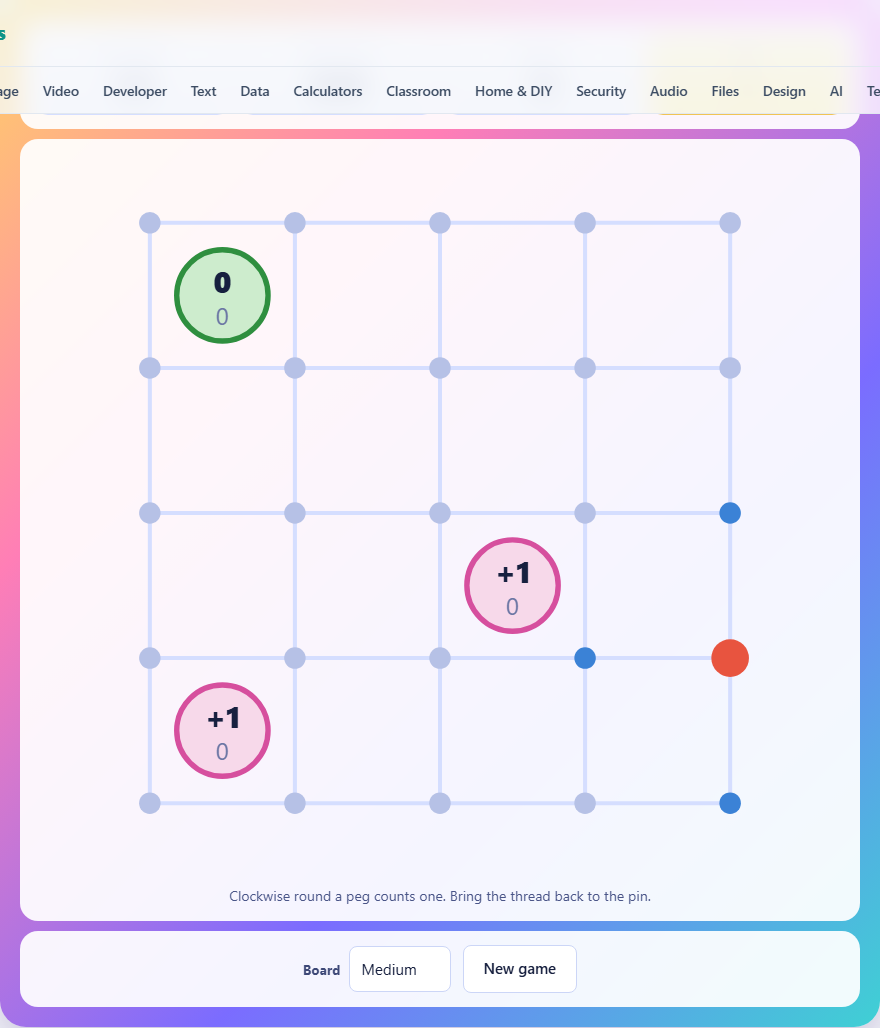
The board and what you are asked to do
A grid of points sits on screen. Some of the spaces between points hold pegs, each marked with a number. A dark dot, the pin, marks where your thread starts. Your job is to lay a single closed thread along the grid lines, beginning and ending at the pin, so that every peg winds up with exactly the count it asks for.
Going clockwise round a peg adds one to its count. Going anticlockwise subtracts one. A peg asking for zero must end up outside the loop entirely, or be wound once each way so the two cancel. A peg asking for minus one needs the thread to pass it anticlockwise. The thread may cross itself and may run along the same grid line more than once.
How the counting actually works
The game counts winding numbers by drawing an imaginary ray to the right from each peg and watching the thread cross it. Every time the thread crosses that ray going downward, the count goes up by one. Every time it crosses going upward, the count goes down by one. The total is the winding number.
This method works for any shape of loop, no matter how tangled. It gives the same answer no matter which direction the ray points, which is why the game can count it exactly instead of guessing. You can verify it yourself: pick a peg, look to its right, and count the thread crossings by hand. The number you reach will match what the board shows.
Controls: laying thread and pulling it back
Tap any grid point next to the current end of the thread to extend it by one segment. The thread can move up, down, left, or right, one step at a time. Points that are reachable from the current end glow slightly.
To undo, tap the end of the thread itself and the last segment peels back. You can undo as many segments as you like, all the way back to the pin. There is no penalty for pulling thread back. The board checks your answer only when the thread returns to the pin, and if the answer is wrong you can continue laying without starting over.
Closing the loop and what happens next
Bring the thread back to the pin and the board checks every peg. If they all match their target, the puzzle is solved and the game shows how many segments you used compared to the shortest possible path, called par. If one or more pegs are wrong, the board tells you what each peg currently reads, and you can keep going from the pin or pull segments back to try a different route.
A loop shorter than four segments does not enclose anything, so the board waits for a real loop before checking. You can pass through the pin on your way to somewhere else without triggering the check, as long as the thread is still too short to form a real loop.
Sorting pegs into inside and outside first
Before laying any thread, look at the pegs. Any peg asking for a positive number needs to be inside the loop. Any peg asking for zero needs to be outside. Group the positive pegs in your mind and imagine the simplest rectangle that encloses them all while leaving the zeros outside.
If that rectangle works, lay it and check. Often it gets most of the counts right on the first try. The pegs that still read wrong are the ones that need a more creative route, like a second lobe or a figure-of-eight crossing.
Dealing with minus one and double winds
A peg asking for minus one needs the thread to pass it anticlockwise. In practice that means the thread must form a lobe that goes around the peg in the opposite direction from the main loop. If your main loop runs clockwise, attach a small anticlockwise loop next to it that wraps the target peg.
A peg asking for two needs to be wound twice. The thread must cross the imaginary ray twice in the same direction. This usually means the thread passes the peg, crosses over itself, and passes the peg again. The figure-of-eight shape is the classic building block: it winds one peg clockwise and the neighbouring peg anticlockwise in a single path.
The figure-of-eight and why crossings are your friend
A figure of eight crosses itself once between two pegs. That crossing flips the direction of the loop, so one side of the eight winds clockwise and the other winds anticlockwise. Two pegs sitting side by side, one asking for plus one and the other for minus one, are solved in one figure-of-eight loop.
More complex patterns are just combinations of these basic shapes. Three pegs in a row asking for plus one, minus one, plus one need two crossings, making a shape like a chain of three circles. Each crossing flips the direction, and each flip changes the sign of the winding for the peg inside that section.
The three board sizes
The Board dropdown offers Small, Medium, and Large. Small uses a three-by-three grid with two pegs. The thread is short and the puzzle is gentle. Medium uses a four-by-four grid with three pegs, which adds enough room for crossings and lobes to matter. Large uses a four-by-five grid with four pegs, and the puzzles often require multi-crossing paths.
Each size also comes with a thread budget: the total number of segments you are allowed to use, which is par plus a few extra. The budget appears in the stats bar as the second number in the thread counter. If you run out, pull some thread back and find a shorter route.
Par and why it is exact
The par number shown in the stats bar is the shortest closed thread that satisfies every peg. The game finds it by searching over all possible paths, tracking both position and winding at each step. Because the search includes the winding as part of the state, it does not miss a shortcut through a crossing. When the game says par is twelve, there is no eleven-segment solution.
Reaching par is hard but not required. Any correct loop wins the game, regardless of length. Par is there as a challenge for players who want to optimise, and the high-score table records your shortest successful thread.
Common mistakes when building a path
- Trying to solve the whole board in one smooth rectangle. Simple loops rarely satisfy all the pegs. Be ready to cross the thread over itself.
- Forgetting that zero is not the same as untouched. A peg wound once clockwise and once anticlockwise reads zero, and sometimes that path is shorter than going around the peg entirely.
- Running out of budget by taking a wide detour. Straight lines along the grid use fewer segments than winding routes. Keep the thread tight.
- Ignoring the current-reading numbers under each peg. The board updates the count in real time as you lay thread. Check it after every few segments to catch mistakes early.
- Closing the loop without enough crossings. If a peg needs minus one and your loop only goes clockwise, no amount of rerouting without a crossing will fix it. Add a crossing between two pegs to flip the direction.
A worked example on a small board
Imagine a three-by-three grid with two pegs. One peg sits at the centre and asks for plus one. The other sits in the top-left corner and asks for zero. The pin is at the bottom-left grid point.
The simplest path is a rectangle that encloses the centre peg and avoids the corner one. From the pin, go right two steps, up two steps, left two steps, and down two steps back to the pin. That makes eight segments. The centre peg is inside, reading plus one. The corner peg is outside, reading zero. Both match. If par says six, you know a shorter path exists, perhaps one that cuts a corner. Pull back and try a tighter shape that still encloses the centre.
Everything runs on your own device
The puzzle generator and the shortest-path finder both run inside the browser. No board, no thread, and no result is sent to a server. There is no login and no account. The game works offline once the page has loaded, and your best score is stored in the browser on the device you are using. Closing the tab is all the cleanup there is.