
Clearing all eight suits in the layered card puzzle
What the ten-column layout means, why same-suit runs are the only ones that travel, how to read the stock and the empty columns, and the habits that separate a stuck board from a clean win.
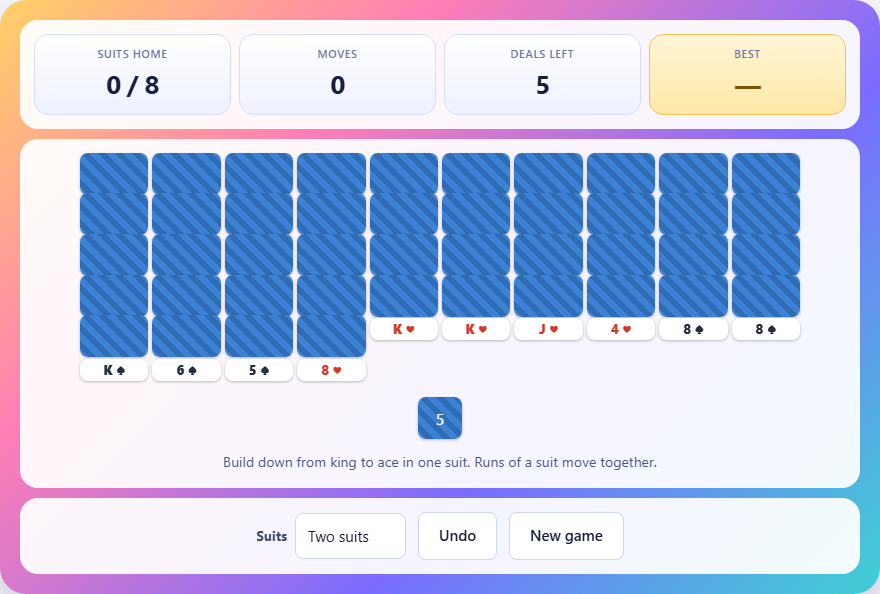
The setup and the goal
Two full packs of cards are shuffled together, giving one hundred and four cards in total. Fifty-four are dealt face down across ten columns: six cards in each of the first four columns, five in each of the remaining six. The top card of every column is turned face up. The other fifty cards form the stock, sitting in five deals of ten.
The goal is to build eight complete runs, each from king down to ace in a single suit. Whenever a run is finished it lifts off the table automatically. Clear all eight and you win. The game counts your moves, and fewer is better.
Moving cards between columns
Tap a face-up card, then tap the column you want to move it to. A card may land on any face-up card that is exactly one rank higher, regardless of suit. A five goes on a six, a jack on a queen, and so on. Any card may also move into an empty column.
Here is the key rule: a group of cards moves together only when every card in the group shares the same suit and descends by one rank. A run of five spades from nine down to five travels as a block. A run of five cards that mixes hearts and spades must be taken apart one card at a time. That difference is the entire game.
The stock and why empty columns block the deal
When you run out of useful moves, tap the stock pile on the right. It deals one card face up to every column at once, ten cards in total. There are five deals available, and each one buries whatever was on top.
The deal is refused while any column is empty. A card dealt onto nothing would be stranded with no way to get underneath it, so the rules insist that every column has at least one card before the deal goes ahead. This means you sometimes need to fill an empty column just to unlock the next deal, which feels wasteful but is part of the planning.
Turning face-down cards and why it matters most
Every hidden card is a decision you cannot make. You do not know its rank or suit, so it might be exactly what you need or it might block everything. Turning a face-down card over gives you information, and information is what lets you plan.
When two moves are otherwise equal, prefer the one that reveals a face-down card. A pretty in-suit stack that leaves all the hidden cards buried is almost always worse than a messy move that flips one. Early in the game, focus on columns with fewer face-down cards; clearing those first gives you an empty column sooner.
Empty columns are the most valuable thing on the board
An empty column accepts any card. That means it is the only place where you can temporarily park a card that is in the way. Need to reach a nine buried under a jack? Move the jack to the empty column, move the ten somewhere else, grab the nine, then put everything back.
Guard empty columns. Do not fill one with a king unless you are certain nothing else needs that space. A king in an empty column locks that column for the rest of the game, because nothing is higher than a king and nothing will ever land on top of it. The best use of an empty column is a sequence of short-term parks that end with the column empty again.
Building in suit even when off-suit is legal
Placing a black nine on a red ten is legal. The nine sits on the ten and everything looks tidy. But now those two cards are welded together. Moving the nine later means moving just the nine, because the ten is a different suit. The run does not travel as a group.
Whenever there is a choice between an in-suit placement and an off-suit one, take the in-suit option. A complete in-suit run from king to ace is the finish line, and every off-suit placement is a step away from it. Sometimes off-suit is unavoidable, but treating it as a last resort rather than a habit makes a visible difference in win rate.
The three difficulty levels
The Suits dropdown offers one suit, two suits, and four suits. One suit uses only spades, copied enough times to fill two packs. Every card matches every other card, so every run travels as a group and the only challenge is the layout. It is a gentle way to learn the mechanics.
Two suits adds hearts, so roughly half the time a placement is off-suit and locks two cards together. The difficulty jumps noticeably. Four suits uses all four, and now three out of four placements are off-suit on average. Four-suit Spider is widely regarded as one of the hardest single-player card games. Start at one suit and move up only when one suit feels routine.
Using undo to explore without committing
The Undo button takes back the last move, and there is no limit on how many times you press it. You can undo all the way back to the opening deal. Undo does not add to your move count; it rolls it back.
Use this freely. Try a sequence of moves, see where it leads, then undo the whole thing if it goes nowhere. The game is a puzzle, not a memory test, and playing without undo punishes exploration. The best players undo more, not less, because they test more lines before committing.
Common mistakes that lock the board
- Filling an empty column with a king too early. That column is now permanently occupied and you have lost your best parking space.
- Dealing from the stock before checking every possible move. A deal buries ten cards and reduces your options. Exhaust the board first.
- Building long off-suit runs. A thirteen-card mixed run looks impressive but cannot move at all. You will need to disassemble it card by card, and that requires empty columns you may not have.
- Ignoring the columns with the most face-down cards. Those columns hide the most information and will cause the most trouble later. Prioritise uncovering them.
- Forgetting that the stock requires full columns. If you empty a column and then cannot fill it, you are stuck until you find something to put there.
Planning the first few moves
Before you touch anything, scan the ten face-up cards. Look for two things: in-suit placements that are free right now, and columns where the face-up card is low enough to accept something useful. A face-up three is more promising than a face-up king, because cards can land on the three immediately while the king needs the whole alphabet stacked on top of it.
If two or three in-suit moves are available from the start, make them all before doing anything else. Each one frees a column position, may turn a face-down card, and builds toward a run. After those obvious moves, look at what the newly revealed cards offer before committing to anything off-suit.
Reading a stuck board
When nothing seems to move, check three things. First, is there a card one rank higher than a run you need to extend, sitting at the bottom of another column? That tells you how many parks you need. Second, do you have enough empty columns or soon-to-be-empty columns to hold the cards you need to move out of the way? Third, is there a deal left in the stock that might give you the card you need on top of a useful column?
If all three answers are no, the game is likely lost. The game will tell you when no moves remain, but spotting it early saves time and lets you undo to a point where a different line might work.
Your cards stay on your device
The game runs entirely inside the page. No part of your game state is sent to a server, there is no login, and no record of your play exists anywhere except the high-score entry stored in your browser on this device. Once the page has loaded it works offline. Closing the tab ends the session completely.