
Winning at the trick-bidding card game with a partner
The full rules of the partnership card game, how bidding and bags work, when to risk a nil, reading your hand before the first card is played, and the mistakes that quietly lose a hundred points.
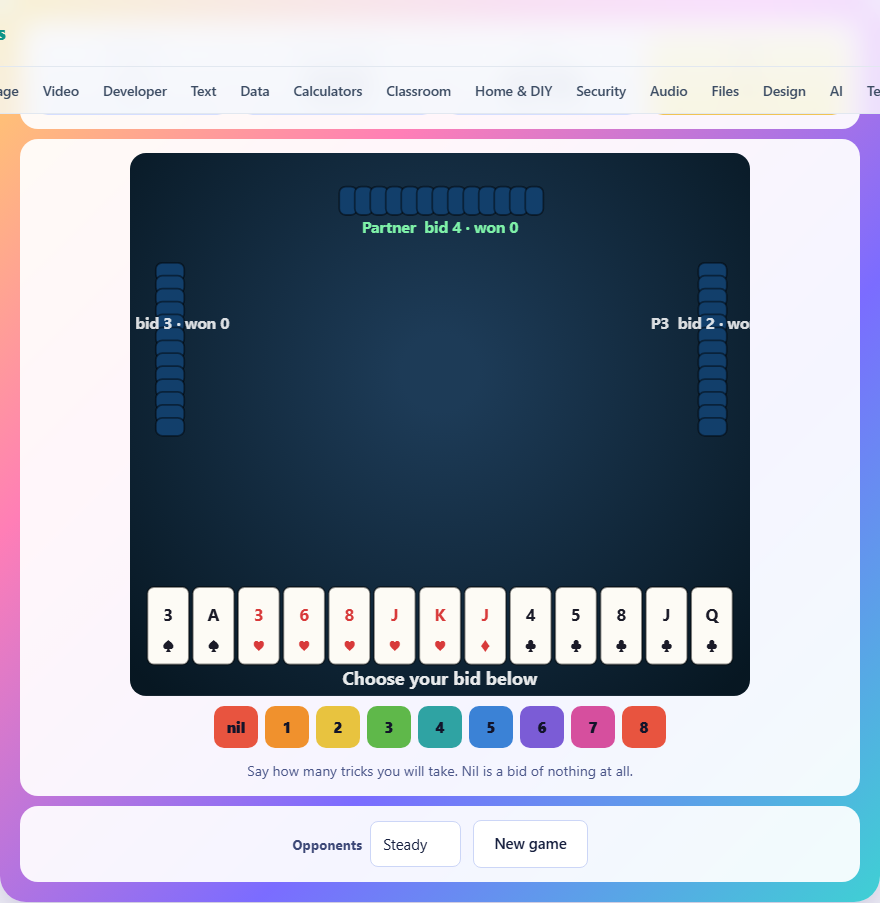
The shape of a hand from deal to score
Four players sit around a table, and the two opposite each other are partners. Each player gets thirteen cards from a standard deck, and before any card is played every player bids a number: how many tricks they expect to win. The pair's bids are added together, and the team must take at least that many tricks between them.
A trick works like most card games. Someone leads a card, the others follow in order, each playing one card of the same suit if they can. The highest card of the led suit wins the trick, unless a spade was played, in which case the highest spade wins instead. Spades are always the trump suit and cannot be escaped.
Following suit, breaking spades, and leading
If you hold a card of the suit that was led, you must play one. You may choose any card of that suit, high or low; there is no obligation to beat what is already on the table. Only when you have none of the led suit may you play something else, and that something else includes a spade.
Nobody may lead a spade at the start of a trick until spades have been broken. Breaking happens when a player, unable to follow suit, throws a spade onto somebody else's lead. After that moment, spades can be led freely for the rest of the hand. If you hold nothing but spades and it is your turn to lead, you may lead one even before they are broken.
How scoring rewards precision and punishes greed
Make your bid and you earn ten points for each trick in the contract. Fall short and you lose ten per trick in the contract instead. That swing is sharp: a pair bidding seven and taking six loses seventy rather than gaining sixty.
Tricks taken over the bid are worth one point each, but every overtrick also counts as a bag. Bags accumulate across hands, and once a pair reaches ten bags it loses a hundred points and the count resets. Five overtricks in one hand and five in the next would trigger the penalty on the second. This means that winning by too much is often worse than winning by exactly the right amount.
Nil: the high-risk hundred-point bet
Any player may bid nil, meaning they will take no trick at all. Succeed and the team earns a hundred points on top of whatever the partner's bid produces. Take even one trick and the team loses a hundred instead. The partner still plays their own bid normally, so a nil does not change the other half of the score.
Nil is tempting with a hand full of low cards and no aces. It is a trap with one high card that might accidentally win. The computer opponents in this game will occasionally bid nil when their hand looks right, and covering a partner who has bid nil is the hardest thing in the game: you need to win the tricks they cannot afford to take.
Reading your hand before you bid
Aces are close to a trick each, but not quite certain. An ace of hearts wins unless someone is out of hearts and trumps it. Kings are worth roughly three quarters of a trick for the same reason. Low cards in any suit other than spades are worth almost nothing.
Spades are different because they are trump. Every spade past the fourth is nearly a guaranteed trick, because by the time the hand reaches that point most other players are out of spades and cannot beat it. A hand with six spades and not a single face card is often worth three or four tricks. Count your aces, add most of your kings, count any long spades past four, and that is roughly your bid.
Playing with your partner, not against them
The most common mistake in partnership play is overtaking a trick your partner is already winning. If your partner has played the highest card on the table, throw your lowest card of that suit. Beating them wastes a winner you might need later and adds a bag neither of you wanted.
When your partner leads a low card, they are probably trying to draw out an opponent's high card. Play along. Drop a low card of your own and let the opponents spend their ace. When your partner leads high, they are taking the trick. Do not compete for what is already yours.
Dumping losers and controlling the lead
A short side suit is valuable because it lets you void early. Once you are out of hearts, every heart led by an opponent is a chance to throw a spade and steal the trick. Holding a doubleton in a suit is two tricks of following, and after that you are free to trump.
Controlling the lead matters because you choose what suit is played. If you lead a suit the opponents are likely short in, they might trump, but your partner might be long in that suit and win it. If you lead a suit you are strong in, you force the opponents to follow with cards they might rather keep. The player who wins a trick leads the next one, so every trick is partly a decision about what comes next.
The three difficulty levels
The dropdown labelled Opponents offers three settings. Loose opponents bid carelessly and sometimes overtake their own partner. They are good for learning the mechanics without pressure. Steady opponents bid more accurately and will throw low when their partner is winning. Sharp opponents do both of those things and also play their spades more carefully, saving them for tricks where the win actually matters.
The level affects only the computer players. Your own bidding and play are entirely your choice. Switching the level starts a fresh game immediately.
Common mistakes that cost more than they seem
- Bidding one too many. A bid of five that lands on four loses fifty, while a bid of four that lands on five loses only the bag. Underbidding by one is almost always better than overbidding by one.
- Leading spades early just because you have them. Spades are trump, and spending them before the opponents have run out of side suits is like spending your savings before the bill arrives.
- Ignoring the bag count. One or two bags per hand seem harmless, but four hands later you are at nine bags and a single overtrick costs a hundred. Track the running total.
- Bidding nil with a king. A king loses to only the ace, and if the ace does not appear in that trick the king wins. One trick is all it takes to turn a hundred-point gain into a hundred-point loss.
- Not paying attention to what has been played. If three diamonds have been played and you hold the ace of diamonds, it is nearly safe to lead it. If none have, someone may be void and trump it.
A sample hand from bid to score
You hold the ace of clubs, the king of hearts, a queen and a ten of diamonds, and four spades including the jack and the nine. The aces count for one, the king for most of one, and the two high spades are likely winners once others run dry. You bid four.
Your partner bids three, making a combined target of seven. The opponents bid six. Thirteen tricks on the table means the bids add up to thirteen, which is exactly the total available. Every trick taken by one side is a trick the other side cannot have. You take seven, they take six, and you score seventy points plus zero bags. A clean hand.
Your cards stay in the browser
The whole game runs on your own device. The three computer players are driven by code that runs inside this page, and no part of the hand is sent to any server. There is no login, no account, and your best score is stored in the browser on the machine you are using. Disconnecting from the internet after the page has loaded changes nothing about how the game plays.