
Winning at Klondike when every deal can be solved
The complete rules of the card game, how the tap and double-tap controls work, what the ten-minute clock means for your strategy, and the thinking habits that turn face-down cards into finished suits.
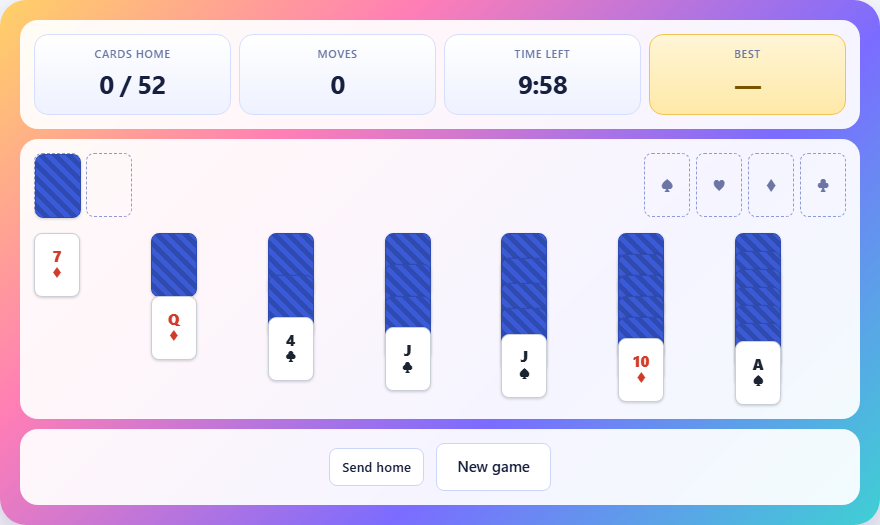
The layout and the goal
Fifty-two cards are dealt into seven columns. The first column has one card, the second has two, and so on up to seven. Only the bottom card in each column is face up. The rest of the deck sits face down as a stock pile in the top left corner. Twenty-eight cards go to the columns and twenty-four remain in the stock.
Four empty foundation slots sit at the top right, one for each suit. Each slot shows its suit symbol as a placeholder until you place the first card. Your goal is to build every suit from ace to king on its foundation. When all fifty-two cards are home, you win.
How cards move
Tap a face-up card to select it, then tap where you want it to go. In the columns, cards stack downwards in alternating colours: a red six goes on a black seven, a black ten goes on a red jack. Only a king can be placed into an empty column. A run of correctly stacked cards moves together as one unit.
Tap the face-down stock pile to turn one card over into the waste pile. When the stock is empty, tap again to recycle the waste back into the stock, face down, and start through it again. There is no limit on how many times you cycle through the deck.
Double-tap a face-up card to send it straight to its foundation if it can go. This shortcut saves a lot of tapping, especially for aces and twos that have no reason to stay in the columns.
The Send home button
Below the board is a button labelled Send home. It checks every face-up card in the columns and the waste pile and sends each one that can legally go to its foundation, repeating until nothing more can move. At the end of a game, when most of the board is clear, one press of Send home can finish off a dozen cards in a second.
If nothing can go home, a small notice tells you so. The button never moves a card that would be illegal.
The clock and scoring
Each deal comes with a ten-minute countdown. The timer appears in the stats row and ticks down in real time. If the clock reaches zero the game ends, even if cards remain in play. Running out of time counts as a loss.
The game tracks three numbers: cards home (out of fifty-two), moves made, and time remaining. Your best result is stored by move count, not by time, so a slow and careful win in fewer moves beats a fast and sloppy one. The best score is saved in your browser on this device only.
Every deal can be won
Before you see a deal, the game tests it with a greedy solver that plays only forced moves. If the solver can clear the board, the deal is kept. If it cannot, the deal is thrown away and a new one is shuffled. Roughly one in five random Klondike deals is unwinnable no matter how well you play, and there is no way to tell from looking. This filter removes those dead-end deals so every game you sit down to has a solution.
The filter is conservative: it also rejects some deals that a human could win with clever play but that the simple solver cannot crack. The result is that the deals you receive tend to be on the easier side of winnable, which is a fair trade for the guarantee that you are never wasting ten minutes on an impossible layout.
Strategy: uncover face-down cards first
Every face-down card is a piece of information you do not have. A move that flips a card face up is nearly always better than one that does not, because the newly revealed card might be exactly the ace or king you need to unlock a stuck column.
When you have a choice between two legal moves and one of them turns over a hidden card while the other rearranges cards that are already face up, pick the one that reveals something new. Building neat stacks of visible cards feels productive but does not improve your position the way uncovering hidden ones does.
Strategy: do not send everything home too early
It is tempting to push every card to its foundation the moment it can go. But a low card on the foundation pile cannot come back, and you may need it in the columns to hold a sequence together. A three of hearts on the foundation is no longer available as a landing spot for a two of spades in the tableau.
Aces and twos are almost always safe to send home immediately because nothing stacks on top of them in the columns. Threes and fours are usually safe too. But from fives upward, pause and check whether the card is doing useful work where it sits before you send it away.
Strategy: empty columns are powerful
An empty column is a parking space. You can move a king there to start a new sequence, or you can use it to temporarily hold a card while you rearrange another column. Filling an empty column with a random king just because you can is often a mistake. Keep it open until you have a king that actually unlocks a useful sequence.
The value of an empty column rises as the game goes on. Early in the game you have seven columns and plenty of room. Late in the game, a single empty column can be the only thing that lets you access a buried card. Guard your empty spaces.
Strategy: use the stock wisely
The stock turns one card at a time. Each card that comes up is either useful now or buried for another pass. Pay attention to what you see. If you spot a card you need three turns from now, remember where it sits in the cycle so you can plan for it the next time through.
Recycling the stock is free and unlimited, so do not rush. A patient player who cycles the stock four or five times, each time picking off the cards that now have somewhere to go, will clear more of the board than one who tries to force every card on the first pass. The stock is not a problem to solve, it is a resource to mine.
Mistakes that stall a winnable deal
- Cycling through the stock without watching what passes. Each time you turn a card, note what it is. When you recycle, you will see those cards again in the same order.
- Stacking face-up cards on top of a face-down card without thinking about the column. A tall stack of visible cards on top of a hidden one is hard to undo if the hidden card turns out to be important.
- Moving a run to a new column without a reason. Moving cards just because the rules allow it wastes a move and might block a better play later.
- Ignoring the clock. Ten minutes feels generous at the start, but a stuck board with forty cards still in play can eat three or four minutes of cycling the stock. If five minutes have passed and fewer than twenty cards are home, look for a different approach.
- Forgetting that kings go to empty columns. No other card can go there, so emptying a column when you have no king ready achieves nothing.
- Sending a five or six to the foundation when it is the only card holding a run in place. Check what sits on top of it before you double-tap.
Everything stays in your browser
The cards are shuffled on your machine. The deal test runs on your machine. Your best score is stored in your browser's local storage and is never sent anywhere. There is no account, no server, and no leaderboard. Once the page has loaded, you can turn off the internet and play as many deals as you like.