
Racing to a hundred on a board that bites back
The full rules of the race, what the three board layouts change, why the exact-landing rule matters, and how a game with zero skill has kept people coming back for centuries.
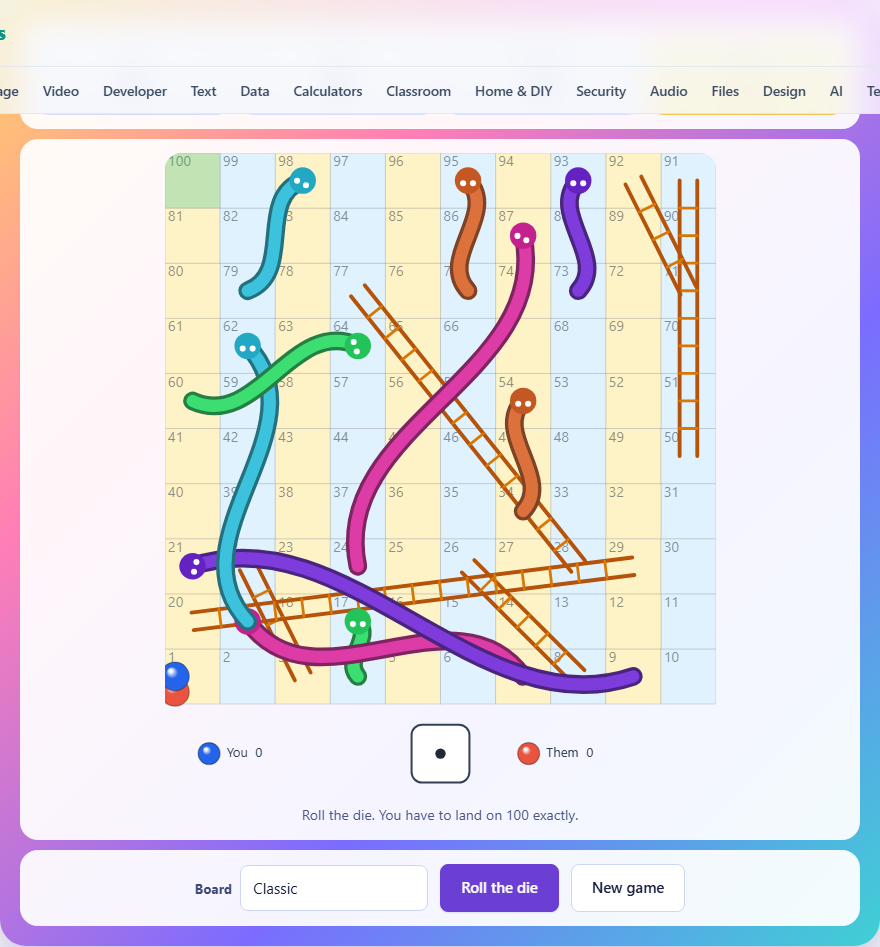
The rules, square by square
You and a computer opponent each start off the board. On your turn you press Roll the die, a die spins briefly, and your token hops forward that many squares along a numbered track from one to a hundred. The track runs left to right along the bottom row, then right to left along the row above, then left to right again, zigzagging up to square one hundred at the top.
Land at the foot of a ladder and you climb it instantly, jumping straight to the square at the top. Land on the head of a snake and you slide down to its tail, sometimes dropping dozens of squares in a single moment. The first player to land on a hundred exactly wins.
If your roll would take you past a hundred, your token stays where it is and the turn passes. From square ninety-seven you need a three. A four, five, or six is wasted. This exact-landing rule is what gives the endgame its tension.
The three board layouts
The Board dropdown offers three choices. Kind has seven ladders and eight snakes, with the ladders spread generously and no snake longer than about fifty squares. Games on this board tend to be short and forgiving, making it a good choice for younger players or a quick round.
Classic uses six ladders and ten snakes, including the famous long snake on square ninety-eight that drops you back to the seventies. This is the layout most printed boards follow, and it balances hope and disaster about evenly.
Cruel has only four ladders and eleven snakes. The ladders are concentrated in the lower half of the board, and the top thirty squares are thick with snakes. Being ahead at square ninety on a Cruel board means very little, because the density of snakes near the finish makes the last stretch brutal.
How a turn plays out
Press Roll the die and the die graphic on the board spins for a moment before settling on a number. Your token then hops one square at a time so you can count the movement. If you land on a ladder or a snake, the token slides smoothly along it with a trail effect. The note below the board tells you what happened: which square you reached, whether you climbed or slid, and where you ended up.
After your turn finishes, the computer rolls automatically with a short delay. You can see its token hop and slide just as yours did. The stats row tracks your position, the computer's position, and how many times you have rolled.
A die strip under the grid shows the last roll as a proper die face with pips. Your token is blue, the computer's is red, and both are labelled with their current square number so you always know the score at a glance.
Why there is no skill, and why that is the point
Nothing you do changes the odds. The die is random, the board is fixed, and you have no choices to make beyond pressing the button. Every game is decided entirely by the sequence of rolls and the positions of the snakes and ladders.
That is not a design flaw. The game is a machine for producing near misses: the agonising slide from ninety-eight back to the seventies, the lucky ladder from eleven to forty, the three turns spent overshooting a hundred by one. It is drama without decisions, which is exactly why it has lasted for centuries and still works for children who cannot yet handle strategic games.
The exact-landing rule and why it stays
Without the exact-landing rule, the game would end the moment somebody reached square ninety-five or higher, because any roll of five or six would push them past a hundred. With the rule, both players can spend several turns stuck in the nineties, each needing a precise number while the other catches up. It is the one rule that gives both sides a chance at the finish.
This version does not grant an extra roll for rolling a six. That is a common house rule, but it makes games much longer and much more one-sided, because a lucky streak of sixes compounds into an unbeatable lead.
Watching the board, not just the number
Even though you cannot control the die, watching the board teaches you how the layout works. On the Classic board, the ladder on square twenty-eight is the big one: it jumps you to seventy-seven, skipping almost half the board. The snake on ninety-eight is the cruelest: it drops you back to seventy-nine after you were two squares from winning.
On the Cruel board, pay attention to the cluster of snakes between squares forty-seven and sixty-four. Landing in that range is almost guaranteed to cost you twenty or thirty squares. The four ladders are all below square sixty, so once you pass them, the only way is forward one slow roll at a time.
A game that started as a sermon
The game began in India as Moksha Patam, a teaching tool about fate and virtue. The ladders stood for good deeds and the snakes for vices, and the original boards were arranged with more snakes than ladders, because the lesson was that falling is easier than climbing. Victorian-era publishers brought the board to Britain, evened out the counts, and dropped the moral message, which is roughly the version everyone plays today.
That history explains something about the game's staying power. It was designed to make you feel the unfairness of random chance. The near miss at the top of the board is not a bug in the design. It is the entire reason the game was invented.
A sample game on the Classic board
You roll a four and hop to square four. There is nothing there, so the turn passes. The computer rolls a two and lands on square two. You roll a six and reach square ten, then a three to land on thirteen. A ladder sits there and carries you straight to forty-six, jumping past thirty-three squares in one move.
The computer rolls a five, reaching square seven, then a six to thirteen. It catches the same ladder and arrives at forty-six alongside you. From here both tokens creep forward. You land on fifty-four and slide down to thirty-four via a snake. The computer reaches ninety-three and falls to seventy-three. Both tokens are stuck in the seventies, rolling and hoping to dodge the snake on ninety-eight. You reach a hundred first on roll seventeen. The game counts your win and shows the total rolls.
Common things new players wonder about
- You do not need a six to start. Both players begin off the board and any roll moves you forward, which keeps the opening turns from dragging.
- Two tokens can share the same square. They are drawn slightly apart so both remain visible.
- The computer does not cheat. It rolls the same random die you do, with the same one-in-six chance for each number.
- Games on the Kind board average around fifteen rolls each. Games on Cruel can take thirty or more because the snakes send you back so often.
- If both players are stuck overshooting a hundred, the game can last a surprisingly long time. This is normal on the harder boards and is part of the tension.
Choosing the right board for the audience
Kind is the best choice when playing with young children or when you want a fast game. The extra ladders keep the pace up, and the shorter snakes mean a setback costs ten or twenty squares instead of sixty. A Kind game rarely lasts more than a minute.
Classic suits most players. The board is balanced enough that both sides have a genuine chance, and the long snake near the top adds real drama without making the game feel punishing. Cruel is there for people who enjoy the misery. Four ladders cannot offset eleven snakes, and the board is deliberately weighted so that reaching the nineties is no guarantee of finishing.
Everything stays on your device
The board is drawn on a canvas inside your browser. The die roll uses your browser's random number generator. No data is sent to a server, there is no account, and no record of your games leaves your machine. The page works offline once it has loaded.