
Scheduling a boatyard with the critical path
What a critical path is, how to spot it on the board, why the promised day is always longer than the chain alone, and the ordering mistakes that strand a slipway while work sits waiting.
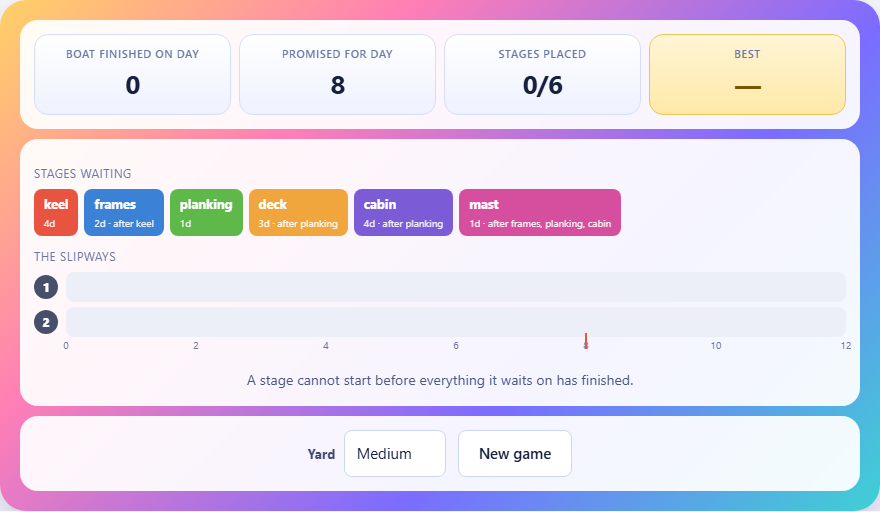
What the puzzle asks you to do
A boat is built in stages. Some of those stages depend on others: you cannot rig a mast before the mast exists. The yard has a fixed number of slipways, each doing one job at a time, and you must assign every stage to a slipway and put them in an order that finishes the boat by the promised day.
Each stage card tells you two things: how many days the work takes, and which earlier stages it has to wait for. Tap a stage, then tap a slipway to add it to that slipway's queue. Stages run in the order you queue them, strictly top to bottom, and no stage can begin until every stage it waits on has finished, even if they sit on a different slipway.
A Gantt-style chart underneath the slipways shows the result. Coloured bars appear for each stage, positioned along a time axis so you can see when each one starts and ends. A red marker on the scale shows the deadline. If the last bar sits to the left of the red mark, the boat launches on time.
The chain that nothing can shorten
Some stages form a chain: keel takes two days, frames waits on keel and takes three, planking waits on frames and takes two. That chain is seven days long, and no number of slipways can make it shorter, because each piece has to finish before the next one starts. This is the critical path.
Your first job on every puzzle is to trace that chain. Follow the waits from card to card, adding the day counts. If two stages both wait on the same thing, the one that leads to a longer total downstream is the critical one. Everything not on that chain has slack, meaning it can start later without pushing the deadline.
Why the promised day is longer than the chain
If the chain is nine days, why does the puzzle promise a deadline of eleven or twelve? Because the yard does not have enough slipways to run the chain and do all the other work at the same time. The extra stages need room on a slipway, and putting them in the wrong place blocks the chain from starting on time.
The promised day is found by trying every possible arrangement of stages across the slipways. It is the shortest schedule that actually works, counting both dependency waits and slipway contention. Meeting it means finding one of those optimal arrangements yourself.
The three difficulty levels
The Yard selector offers Small, Medium, and Large. A Small yard has five stages and two slipways. Medium raises it to six stages with two slipways, and Large gives you seven stages split across three slipways. The number of dependencies between stages is random, but the puzzle generator insists that the answer is never trivial: it rejects any board where simply reading the chain gives you the deadline, because the puzzle is the packing problem on top of the chain, not the chain itself.
Deadlines on generated boards fall between six and eighteen days. Anything shorter is too easy to solve by trial and error, and anything longer produces a chart too wide to read comfortably. On Large yards, the third slipway adds room but also adds more stages to schedule, so the puzzle does not get easier just because you have more berths.
Placing stages and reading the chart
Tap a stage card to pick it up. It highlights to show it is selected. Then tap a slipway to place it at the end of that slipway's queue. The chart redraws instantly so you can see the effect.
If you need to move a stage, tap its coloured bar on the chart to pull it back out. It returns to the waiting area and you can place it again. The stats row shows three numbers: the day the boat finishes on (or the word tangled if the order is impossible), the promised day, and how many stages you have placed out of the total.
A finish day that exceeds the promised day means the schedule works but is not tight enough. Take a stage back and try reordering the queue or moving it to the other slipway.
Tangles and how to fix them
A tangle happens when two stages create a circular wait. For example, stage A is queued behind stage B on the same slipway, but stage B waits on stage A. Neither can start. The game detects this and shows tangled instead of a day count.
The fix is always the same: pull one of the conflicting stages out and put it on a different slipway, or move it higher in the queue so it runs before the thing that depends on it. Watch the wait-on labels carefully before you place a stage behind another.
Tangles can also be indirect. Stage C might wait on stage D, which sits behind stage E, which itself waits on stage C through a longer path. The board does not tell you which stages caused the loop, only that one exists. When you see tangled, pull out the most recently placed stage first, since it is the most likely culprit.
Strategy: start the chain early
The most common mistake is putting a short independent stage at the top of a slipway because it looks harmless. It finishes in one day, but that day is a day the chain stage behind it cannot start. On a puzzle with a tight deadline, one wasted day at the top is the difference between launching on time and missing it.
Put the critical path stages at the top of one slipway so they begin on day zero. Then fill the other slipway with the independent work, ordered so that anything with a later dependency finishes in time. The chain sets the floor; your job is to keep the other slipway from raising the ceiling.
Strategy: order within a slipway matters
Two stages that both sit on the same slipway and neither waits on the other can go in either order. But one order might leave a gap in the chart while the other does not. If stage X takes one day and stage Y takes four, putting Y first means the slipway is busy for four days before X starts. Putting X first means it is busy for one day, then four, with no gap. Both total five days, but the stages behind them may have different wait constraints, and the gap might force a chain stage on the other slipway to sit idle.
When you are close to the deadline but one or two days over, swapping the order of two stages on the same slipway is often the answer.
A worked example
Imagine a Medium yard with six stages. Keel takes two days and waits on nothing. Frames takes three days and waits on keel. Planking takes two days and waits on frames. Paint takes one day and waits on nothing. Cabin takes two days and waits on planking. Mast takes one day and waits on nothing.
The critical chain is keel, frames, planking, cabin: two plus three plus two plus two equals nine days. Paint and mast are independent and total two days between them. The brute-force search might set the promised day at ten, because fitting paint and mast around the chain on two slipways costs one extra day.
Place keel, frames, planking, and cabin on slipway one in that order. Place paint and mast on slipway two. Slipway one finishes on day nine. Slipway two finishes on day two. The boat is done on day nine, inside the deadline of ten. A sound beep confirms the launch.
Common mistakes beginners make
- Spreading the chain across both slipways. Stages on the critical path should usually share a slipway so they run back to back with no slipway-switch delay.
- Ignoring the wait labels and placing stages in number order. Numerical order has no bearing on the correct schedule.
- Filling one slipway completely before touching the other. Parallel work is the entire point of having two slipways.
- Forgetting that order inside a queue matters. Swapping two stages on the same slipway changes when downstream work can begin on the other slipway.
- Not pulling stages back out. Once a stage is placed you can always remove it and try a different position.
- Reading the chart too quickly. A gap between two bars on the same slipway means the second stage could not start until something on the other slipway finished. That gap is idle time, and idle time pushes the finish later.
Your schedule never leaves the page
The entire puzzle runs inside your browser. Stage dependencies are generated on your machine, the brute-force search for the optimal schedule happens on your machine, and no data is sent anywhere. There is no account and no score shared with a server. Close the tab and the puzzle is gone.