
Reading the skyline to fill the grid
What the edge clues mean, why some are missing, how to start from the corners that are already decided, and the techniques that crack harder grids without guessing.
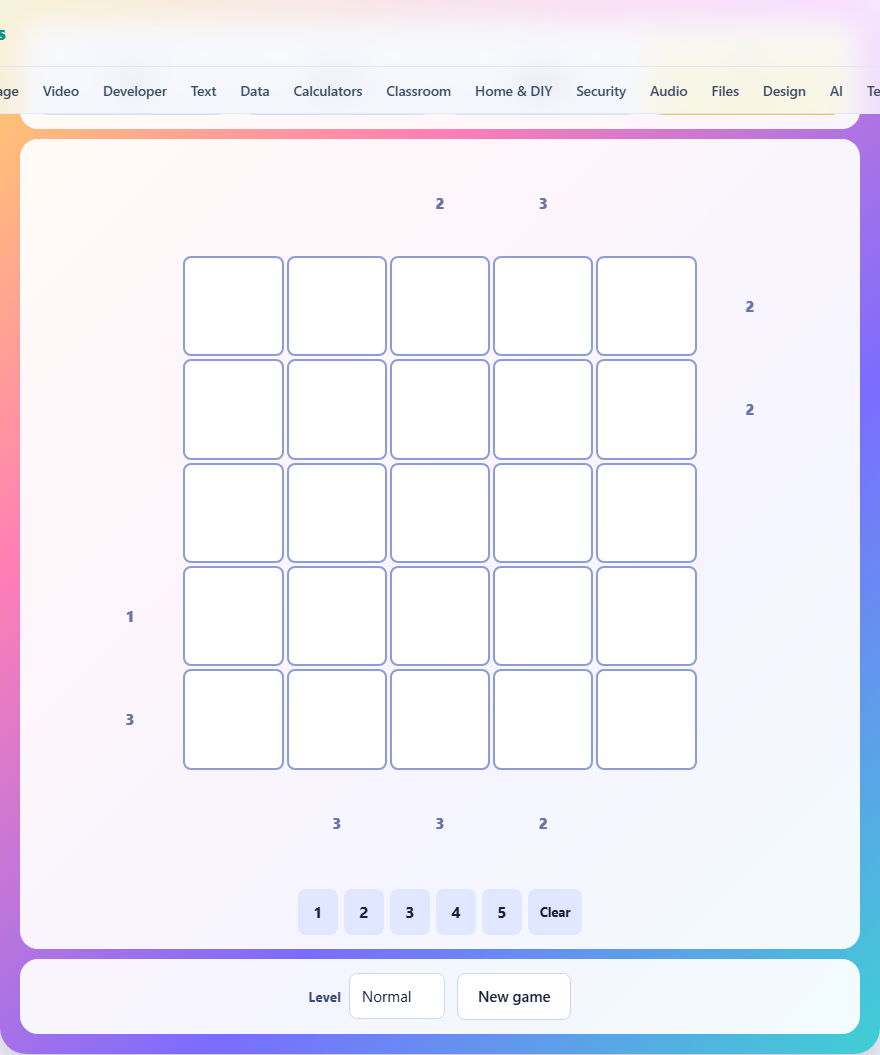
The puzzle at a glance
Skyscrapers is a number-placement puzzle. You fill a grid so that every row and column contains each height exactly once, just like a sudoku row. The difference is in the clues. Instead of given numbers inside the grid, the clues sit around the outside edge and tell you how many buildings you can see looking in from that direction.
Imagine each number as a building whose height matches its value. A 3 is three storeys tall, a 5 is five storeys tall. Standing at one end of a row and looking along it, a taller building hides every shorter one behind it. The clue is simply the count of buildings that are visible from where you stand.
Rules in full
Every cell in the grid holds a height from 1 up to the grid size. On a five-by-five board, the heights run from 1 to 5. Each height appears exactly once in every row and exactly once in every column. That alone gives you the same constraints as a sudoku row, but without any boxes.
The clues around the edge add a second layer. Each clue counts the buildings visible from its side of the grid. A clue of 1 means you can see only one building, which must be the tallest, sitting in the first cell. A clue equal to the grid size means every building is visible, so they must be arranged from shortest to tallest going away from you. Clues between those extremes narrow the possible arrangements without pinning them down to a single order.
Why some clues are blank
Not every edge position carries a number. The puzzle generator starts with every clue in place and then strips them away one at a time. After each removal, it checks that the puzzle still has exactly one solution. If removing a clue would create a second valid answer, that clue stays. What remains is the smallest set of clues that still forces a single solution.
A blank position is not a missing clue. It is a clue that was not needed, because the remaining clues and the one-per-row rule together pin down the answer without it.
Controls and difficulty
Tap or click a cell to select it. Then tap a number from the key row below the grid to place a height. On a keyboard, press a digit key to place a height in the selected cell. Press backspace, delete, or zero to clear it.
The Level dropdown sets the grid size. Easy is four by four, Normal is five by five, and Hard is six by six. Larger grids have more cells and more clues to read. The puzzles also become harder to reason about because more heights means more arrangements to consider. Five wrong placements end the puzzle, so place carefully.
Strategy: start with what is decided
Two clue values settle their cells before you lift a finger. A clue of 1 means the tallest building is in the first cell. On a five-wide grid that first cell is 5. Write it in and move on.
A clue equal to the grid size means the buildings climb from 1 up to the maximum in order. On a five-wide grid a clue of 5 means the row reads 1, 2, 3, 4, 5 from that edge. Both of these are free entries that cost nothing to find.
After placing those, look at what the one-per-row rule gives you. If you have placed a 5 in a column, no other cell in that column can be 5. That single deduction often settles another cell or two.
Strategy: work from both ends
Clues on opposite sides of the same row or column constrain each other. Suppose both clues are 2 on a five-wide grid. The left clue says the tallest building is not first, and the right clue says the tallest is not last. The tallest must sit somewhere in the middle three positions, and the buildings on either side of it must start with something tall enough to hide everything behind it except the tallest.
This kind of paired reasoning is the main technique for harder grids. A single clue limits the first few cells. Two clues facing each other can pin down the whole row.
Strategy: ruling out the tallest
A clue of 2 tells you that the tallest building is not in the nearest cell. If it were, you would see only one. So the tallest building sits somewhere further along, and exactly one building in front of it is visible. That rules out the nearest cell for the maximum height.
A clue of 3 goes further. The tallest is not in the nearest or second-nearest cell. Each step up in the clue value pushes the tallest building one cell deeper. On a five-wide grid a clue of 4 means the tallest can only be in the fourth or fifth cell from that side. These eliminations cascade quickly when you read several clues together.
A worked example on a four-by-four grid
Suppose the top edge of a four-by-four grid reads 1, blank, 3, 2. The left edge reads 2, blank, 1, blank. Start with the top-left cell. The top clue is 1, so the tallest building is right here: place 4. The left clue for row three is 1, so the first cell in that row is also 4. Now column one has two cells with 4 settled, but wait, both cannot be 4. The second 4 belongs in row three column one, and the first 4 in row one column one. Each column can only hold one of each height, so the rest of column one now cannot be 4.
The top clue of 3 for column three tells you the buildings are not in descending order from the top. Combined with the one-per-row rule and what you have already placed, several cells begin to have only one possible height. Follow this chain of deductions and the grid fills without ever needing to guess.
Common mistakes
- Placing a number and forgetting to check both the row and the column. Every height must be unique in both directions. A placement that looks correct for a row can still break its column.
- Ignoring the opposite clue. A row has clues on two sides. Solving from one end without checking whether the answer also satisfies the other end wastes placements and invites errors.
- Treating a blank edge as a clue of zero. A blank means no clue was given, not that zero buildings are visible. Zero buildings is impossible because at least one is always visible.
- Guessing when stuck. Every puzzle is generated with a single answer, and every clue is there because it is needed. If you feel stuck, re-read the clues from both ends of the row or column you are working on.
- Starting with the hardest rows. Rows and columns with extreme clues like 1 or the grid size are the easiest to fill. Start there and let the one-per-row rule fill in cells elsewhere.
How scoring works
The stats bar tracks three things. Squares left counts empty cells. Wrong shows how many incorrect placements you have made against the limit of five. Time counts up from when the puzzle was generated. A completed grid with no wrong placements and a fast time is the best result.
When all cells are filled correctly, the puzzle is solved and your time is shown along with how many wrong placements you made along the way. If you reach five wrong heights before finishing, the puzzle ends and a hint about basic clue reading appears. Press New game at any time to get a fresh puzzle at the same difficulty.
How this relates to sudoku
The one-per-row, one-per-column rule is the same as sudoku. If you are comfortable with sudoku, you already know half the puzzle. The difference is that sudoku gives you numbers inside the grid as starting clues, while Skyscrapers gives you visibility counts around the outside edge. There are no boxes to worry about.
Players who enjoy sudoku often find Skyscrapers refreshing because the deduction style is different. Instead of eliminating numbers by scanning rows and columns, you are reasoning about what can and cannot be hidden behind a taller building. The mental shift is small but it changes the feel of the puzzle entirely.
Everything stays on your device
The puzzle is generated and solved entirely inside your browser. No server is involved, no puzzle is sent anywhere, and no account is needed. Your best time stays in your browser's storage on this machine. Once the page has loaded, the whole game works offline.