
Winning the short-deck trick game
How the unusual rank order shapes every trick, when to spend your strong cards, how marriages work in practice, and what changes once the stock runs dry.
The take-or-throw test the computer runs
The computer's entire plan lives in one routine, and that routine forks in two. If you have already put a card down, it is following. If the table is bare, it is leading. Each fork runs a short test, and once you know the test you can often guess the card before it lands.
Following starts with a list of the cards it may legally play. From that list it picks out the ones that would beat your card. Those get sorted by point value, cheapest first. Then it looks at one number: the points printed on the card you led. Gentle grabs the trick whenever it can. Normal only bothers when your led card is worth 10 or more, which means a ten or an ace. Sharp lowers that bar to 4, so a king is worth a fight too. When the test fails, it throws its cheapest legal card instead.
That sort is by points, not by strength. A trump nine is worth nothing, so if a trump nine can win the trick it goes out first and the ace stays home. Leading is handled the other way round. Normal and Sharp scan their hand for a king or queen whose partner is present, in a suit they have not declared yet, and lead it to bank the marriage. Gentle never runs that scan. After that, cards are ranked by point value with 100 added for any trump. That one rule parks a trump nine, at 0 plus 100, above a plain ace at 11. While the stock lasts every level leads the bottom of that list, so out goes the cheapest plain card. Sharp is the only one that flips: once the stock is empty it leads the top of the list, which is its strongest trump if it holds one.
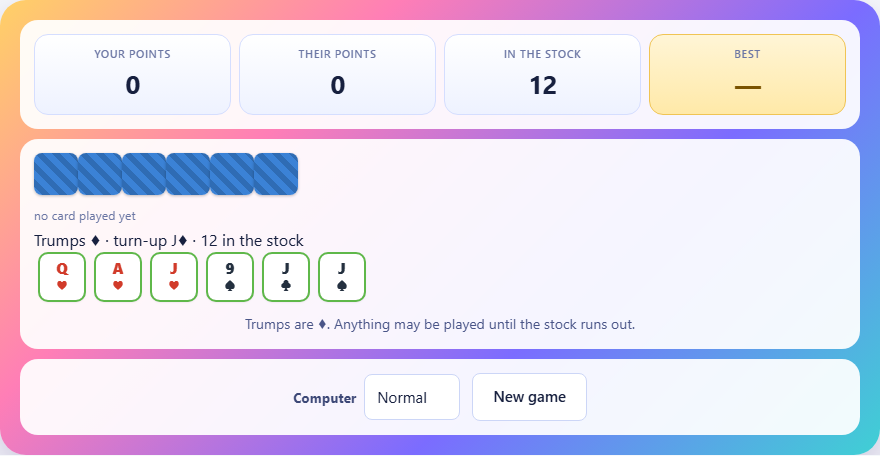
Here is a trick you can check yourself. It is the opening trick of a deal, so both scores sit at zero and you have the lead. Trumps are hearts. You lead the king of spades while holding the queen of spades, so a marriage lands right away: 20 points, because spades are not trumps. Your side of the scoreboard reads 20 before the second card is even played. Now say the computer holds the ace of spades, the nine of spades, the jack of diamonds, and no hearts at all. The card you led is worth 4. On Sharp, 4 meets the bar of 4, so it plays its only winner, the ace. The trick pays 4 plus 11, which is 15, and all of it goes to them: you 20, them 15. On Normal the very same hand behaves differently. 4 is under 10, so it ducks and throws its cheapest card, the nine, worth nothing. You take the trick for 4 plus 0 and stand at 24 while they are still on zero.
Twelve in the stock, and the rules this build leaves out
The pack is built as four suits of six ranks, so 24 cards in all. Six go to you and six to the computer, one card at a time. The next card off the top is turned face up to fix trumps, then tucked underneath the rest. That is why the stock counter reads 12 on the opening trick.
Both players draw after every trick, winner first, so two cards leave the stock each time. It runs dry the moment the sixth trick is settled, and forced following begins on the seventh. Twelve tricks fill a deal. Because the turn-up was tucked to the bottom, it is the second card dealt out on that sixth draw. In other words the player who loses the sixth trick always ends up holding the trump card you have both been looking at all game.
The finishing test is narrower than it seems. After a trick is settled, the code compares 66 against the winner of that trick only. Picture yourself on 50. You lead the trump king with the trump queen still in hand, so 40 lands and you are on 90. If the computer then takes that trick with the trump ace, the check is run on their score, not yours, and play carries on. Nothing is lost. The deal ends your way as soon as you win any trick, or when the cards run out. It simply gets called later than you would expect.
- An exact tie goes to the computer. When the hands empty with nobody on 66, the code asks whether your score is greater than theirs. Equal is not greater, so 60 apiece is recorded as a loss.
- Nothing extra is paid for the last trick. A trick is always worth the two card values added together, no more.
- The turn-up card can never be swapped for a low trump. Once it is placed in the stock it is only ever drawn, never traded.
- The computer's marriage scan takes the first pair it meets in hand order, not the richest one. It can lead a plain marriage for 20 while a trump pair worth 40 sits beside it.
- Each suit pays a marriage once per player per deal. Lead that king or queen a second time and the bonus is zero.
- Changing the Computer dropdown deals again immediately. There is no warning, so switching level in the middle throws the current deal away.
- The Best figure is your own point total from any deal that ran to the end, kept whenever it beats the old one. Losing 40 to 66 still writes a Best of 40 if 40 is the most you have ever scored.
A deck built for surprises
Sixty-Six uses only twenty-four cards. Each of the four suits carries just six ranks: ace, ten, king, queen, jack and nine. That small deck is what makes it possible to remember what has gone, and the memory game underneath is what lifts it above longer card games where luck does most of the work.
The rank order catches every new player at least once. The ten sits above the king. From top to bottom the order runs ace, ten, king, queen, jack, nine. Each card also carries a point value: eleven for the ace, ten for the ten, four for the king, three for the queen, two for the jack, and nothing for the nine. The total across all twenty-four cards is one hundred and twenty.
How a trick is won
One player leads a card and the other follows. The higher card of the suit that was led takes the trick, and both cards go to the winner. Trumps override that rule. A trump card beats any card of a plain suit, no matter how high. When both cards are trumps, the higher trump wins.
After each trick both players draw one card from the stock, winner first. The face-up card that named the trump suit at the start is the very last card drawn. Until the stock empties, hands stay at six cards.
The two phases of a deal
While the stock still has cards, anything goes. You do not have to follow suit. This freedom is at the heart of the first phase. You can toss a nine under a strong lead to keep your real cards for later. You can trump a trick you were not invited to contest. You can duck entirely by throwing a worthless card from a side suit.
Once the stock empties, the rules tighten. You must follow suit if you hold a card of the suit led. When you cannot follow, you must play a trump if you have one. Only when you have neither the led suit nor a trump may you discard freely. Every card wasted in the first phase comes home to roost here.
Scoring a marriage
A marriage happens when you hold both a king and queen of the same suit and you lead one of them. A plain-suit marriage is worth twenty points. A trump marriage is worth forty. The bonus lands as soon as you lead the card, before the trick itself is settled.
You cannot declare a marriage while following. That makes winning a trick to get the lead sometimes more valuable than the points on the cards, because the lead lets you cash a marriage that could push you over the line. Each suit can only yield one marriage per player in a single deal, so once you have claimed it, the pair no longer offers a bonus.
Reaching sixty-six
The first player to reach sixty-six points wins the deal. Points come from two places: the values printed on the cards you win in tricks, and the bonuses from declaring marriages. In a typical deal the winning score comes from a mix of high-card tricks and one or two well-timed marriages.
The scoreboard shows both totals throughout the deal, so the finish is never a surprise. If neither player hits sixty-six by the time all cards have been played, whoever has more points takes it.
Controls and difficulty
Your hand appears at the bottom of the screen. Tap or click a card to play it. During the endgame, cards that cannot legally be played appear dimmed and will not respond. The trump suit and the number of cards left in the stock are shown between the two hands.
The Computer dropdown offers three levels. Gentle plays without much planning and rarely saves strong cards. Normal looks for marriages and spends cards wisely on tricks worth taking. Sharp keeps its best cards for the forced endgame and leads aggressively once the stock is gone. Press New game at any time to deal again.
Strategy: when to spend nines
Nines carry zero points. That makes them the perfect cards for the free-play phase. When your opponent leads something you do not want to fight over, throw a nine. You lose nothing and keep every scoring card for a moment that actually matters.
Watch for the reverse signal too. When your opponent plays a nine under your lead, they are choosing not to fight. That means they are saving something strong. Use that information when you plan the next few tricks. A nine thrown early tells you one of their remaining five cards is a keeper.
Strategy: counting the trumps
With only six cards per suit, tracking trumps is realistic even without a perfect memory. You already know one of them before play starts, because the turn-up card is visible. As trumps appear in tricks, keep a running count. Once all six have been played, no trick can be trumped for the rest of the deal.
That knowledge is powerful in the forced phase. Without any trump threats, the ace of a plain suit is guaranteed to win its trick. Leading one at the right moment can collect the points that push you past sixty-six. The same logic applies to tens. If the ace of their suit has been seen, a ten becomes the strongest card in play and can be led safely.
Strategy: managing the lead
The lead matters more than any single card. The player who leads chooses the suit, controls the tempo, and is the only one who can declare a marriage. Winning a trick that is worth very little in points can still be the right play if it gives you the lead at the right moment.
In the free-play phase, winning the lead lets you declare a marriage next turn. In the endgame, the leader forces the follower to spend a specific suit, which can strip them of their strong cards one by one. If you find yourself following trick after trick in the forced phase, the opponent is dictating the entire deal and you are just reacting.
Sometimes it is worth spending a good card to reclaim the lead rather than holding it and hoping. A king played to win a trick worth four points is a poor trade in isolation, but if winning that trick lets you lead a queen for a twenty-point marriage, the four you spent comes back five times over.
Common mistakes
- Leading a ten when its ace has not appeared. The ten is worth ten points and loses to exactly one card. Spending it before you know where the ace is risks the most expensive single loss in the game.
- Holding a king-queen pair without winning the lead to declare it. A marriage must be led to score. Sitting on both cards and never winning the lead wastes twenty or forty free points.
- Trumping small tricks during the first phase. A nine and a jack together are worth only two points. Burning a trump to win that trick costs you a card that might decide the endgame.
- Ignoring the stock counter. The switch from free play to forced following changes everything. Knowing it is about to happen lets you plan your last few free-play moves to set up the endgame.
- Treating the ten like a middle card. It ranks second in its suit, above the king, and carries ten points. Losing one to an ace is a swing of twenty points: ten gained by them, ten lost by you.
About closing the stock
The traditional game includes a move where a player can turn the trump card face down, ending the free-play phase immediately and betting on reaching sixty-six before the opponent does. That move is not present in this version. The page notes this up front. Every other rule is in place: the rank order, marriages at twenty and forty, forced following once the stock empties, and the turn-up being the final card drawn.
Nothing leaves your browser
Every card is dealt and every trick is resolved right on your own device. There is no server running the game and no data is sent anywhere. Your best score stays in your browser on this machine alone. Close the tab and nothing remains.