
Stacking sieves in the only order that grades every grain correctly
Sift is a puzzle about how a stack of sieves separates a mixture of grains. Each sieve has a fixed mesh size, and a grain either passes through or rests on top depending on whether it is small enough to fit. Your job is to reorder the sieves so that every tray catches exactly the grains listed. The twist is that a sieve does not sort. It only splits whatever reaches it into two groups, and the order of the splits is the entire puzzle.
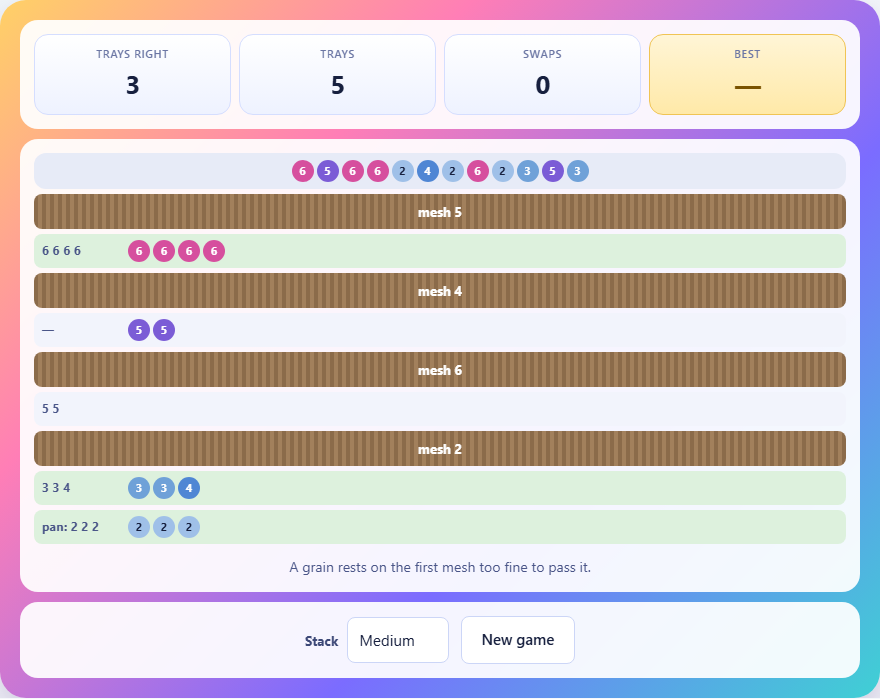
How grains and sieves work in this puzzle
A hopper at the top holds a collection of grains, each marked with a number that represents its size. Below the hopper sits a stack of sieves, and below the last sieve sits a pan. When the grains pour down, each one meets the sieves from top to bottom. A grain drops through a sieve when the mesh is at least as wide as the grain. It stops on the first sieve whose mesh is too fine to pass it. Any grain small enough to pass every sieve falls into the pan at the bottom.
Each sieve has a fixed mesh size that you cannot change. What you can change is the order the sieves sit in, and that order determines which grains each tray catches. A coarse mesh near the top passes almost everything and catches very little. The same mesh lower in the stack receives only what got past the finer sieves above it, so its catch is completely different. Position is everything.
Controls and how to make a swap
Tap or click a sieve to select it. It highlights to show it is picked. Then tap a second sieve to swap the two. Nothing else about the stack changes. The grains instantly resettle after each swap, and every tray updates to show what it now catches. You can see the effect of each decision right away, which makes it possible to learn by experiment.
Each tray shows two things side by side. The bold numbers are the target: what the tray must catch to solve the puzzle. The coloured beads beside them show what the tray is actually catching in the current arrangement. When the two lists match, the tray turns green. Solve the puzzle by turning every tray green, including the pan at the very bottom. Tapping the same sieve twice deselects it without making a swap, so a mis-click never costs you a move.
Scoring and what counts as a good result
Your score is the number of swaps you make. The game tracks your best across sessions, and fewer swaps is better. There is no move limit, so you cannot lose by running out of attempts. You can always keep swapping until you find the answer.
However, the puzzle has exactly one correct order. The generator checks every permutation of the sieves at creation time and only uses a layout when a single arrangement produces the required tray contents. That guarantee means there is no ambiguity and no second solution hiding behind the first. If two sieves had the same mesh size they would be interchangeable and the puzzle could never have a unique answer, so all mesh sizes are distinct.
Difficulty levels and what changes
The Stack selector offers three sizes. Small uses three sieves and eight grains drawn from five possible grades. Medium raises the count to four sieves with twelve grains and six grades. Large gives five sieves, sixteen grains and seven grades. More sieves means more possible orders to check and more interactions between the splits.
The generator also rejects boards where more than one tray comes out empty, because a sieve that catches nothing is doing no useful work and makes the puzzle less interesting. Every level is guaranteed to have a unique solution and to keep every sieve meaningfully busy. The result is that every puzzle rewards careful reasoning rather than trial and error.
Strategy: start from the top and work down
The top sieve is the most important because every grain meets it first. A coarse mesh at the top passes nearly everything and catches almost nothing, which means the trays below must do all the separating. A fine mesh at the top catches most of the grains and starves the trays below. Getting the top sieve right narrows the problem for everything beneath it.
Once the top tray is correct, move to the second sieve. Whatever passed the first sieve is now the input for the second, and you can think about that smaller group on its own. This top-down approach turns a five-sieve puzzle into a sequence of smaller decisions rather than one large guess. Each correct tray locks in one part of the answer and reduces the remaining problem to fewer sieves and fewer grains.
Strategy: thinking in splits rather than sorts
The natural instinct is to arrange the sieves from coarsest to finest, descending mesh sizes from top to bottom. That arrangement grades the grain neatly into bands, and it is the usual answer. But the puzzle sometimes asks for a tray that should catch an odd mixture, and that is the signal that a different order is needed.
Each sieve makes a binary split: everything it catches stays, and everything it passes moves on. The question is not which sieve is coarsest in the abstract, but which split you want to make first given the specific grains in the hopper. Two grains of the same size will always end up in the same tray no matter what you do, because every sieve treats them identically. That is why the puzzle grades rather than sorts, and why you should focus on the group boundaries rather than individual grains.
Common mistakes and what they teach
The most frequent error is ignoring the pan. The pan catches whatever falls through every sieve, so it is affected by every swap you make. A tray higher up can look correct while the pan is wrong, and fixing the pan by moving a sieve often breaks the tray you just fixed. Check the pan as part of your plan, not as an afterthought.
Another common trap is swapping sieves at the bottom of the stack while the top is already wrong. The bottom sieves only process what gets past the top ones, so their effect depends entirely on what reaches them. Fix the stack from the top down, or you will find yourself undoing work as each swap ripples through the trays below.
A third mistake is assuming that the answer must be a simple descending or ascending order. Many puzzles require one sieve to be out of the expected sequence, and finding which one is the core challenge.
Why exactly one order works
The generator builds each puzzle by picking a random sieve order, pouring the grains through it, and recording what every tray catches. It then walks every permutation of the sieves and counts how many produce the same result. Only puzzles where exactly one order fits are kept. With five sieves there are a hundred and twenty possible orders, and with four there are twenty-four, so the search is fast enough to be exhaustive.
This means the puzzle is fair in a precise sense. There is no guessing, no second answer you might have found instead, and no shortcut that works by accident. The difficulty comes entirely from reading the grain sizes and reasoning about what each split produces. If you find an order that turns every tray green, you have found the only one that could.
Privacy and how the game runs
Everything runs inside your browser. No grain, no sieve and no swap is sent anywhere. Your best score is stored in local storage on this device and is never transmitted. Once the page has loaded it works offline, so you can solve sieve puzzles on a commute or a flight with no connection at all.
The puzzle generator, the grain simulation and the uniqueness check all happen on your own processor in a fraction of a second. Even the exhaustive permutation walk that verifies there is only one solution is fast at these sizes, because five sieves produce only a hundred and twenty orderings to test. The result is a puzzle that is guaranteed fair, guaranteed unique, and generated entirely on your machine.