
How to play Shut the Box and close every flap
Shut the Box is a dice game traditionally played on a wooden tray with numbered flaps that fold down when you close them. You roll the dice and then close any combination of open flaps that adds up to the total. Keep rolling until every flap is shut or no combination of the remaining flaps can match the roll. The luck is in the dice and the skill is in choosing which flaps to close. A perfect game, where every single flap goes down, is rare enough to be satisfying and common enough to be worth chasing. This guide covers the rules, the controls, the three box variants, and the thinking that turns a good roll into a winning streak.
Rules of the game
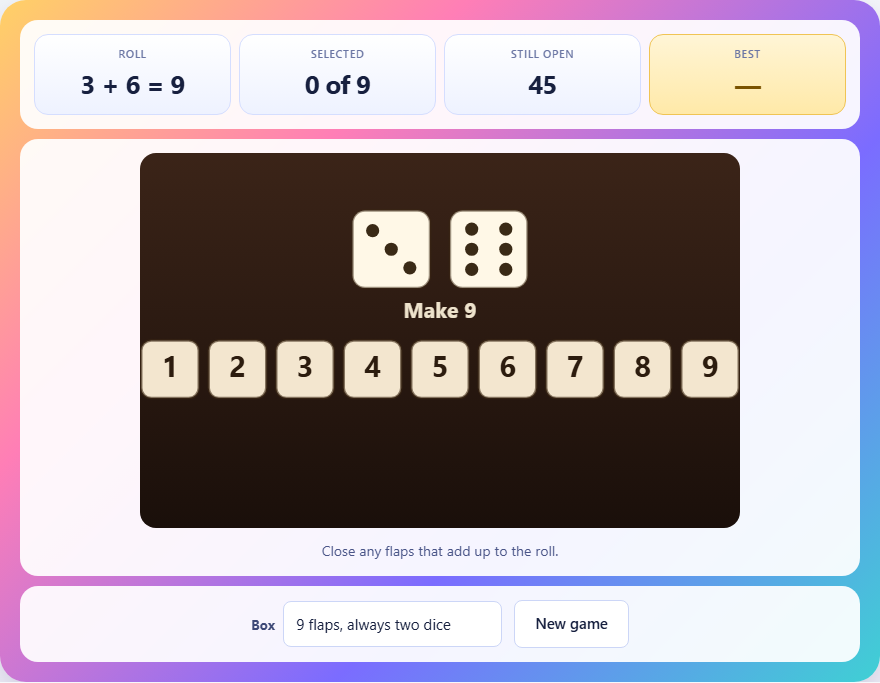
The box starts with all numbered flaps standing up. On the nine-flap box, those are one through nine. You roll two dice and see the total. Then you close any combination of standing flaps whose values add up to exactly that total. A roll of eight can be closed by the eight alone, by the three and five together, by the one, three, and four, or by any other group that sums to eight. Once you choose your flaps and they add up, they fold down and the dice roll again automatically.
The game ends in one of two ways. If every flap is closed, the box is shut and you win with a perfect score of zero. If no combination of the remaining open flaps can match the dice total, the game stops and your score is the sum of all flaps still standing. A lower score is better, and zero is the target.
Controls and interface
The board is drawn on a canvas that looks like a wooden box. Two dice appear at the top with the total written below them. The numbered flaps sit in a row beneath the dice. Tap or click a flap to select it. Selected flaps light up in gold. Tap a selected flap again to deselect it. When your selected flaps add up to exactly the roll, they close automatically and the dice roll again.
If you select flaps that exceed the total, a message warns you that the sum is too high. Deselect one to bring the total back down. The status bar above the board shows the current roll, the sum of your selected flaps, and the total of all flaps still open. On a phone, the box scales to fit the screen and the flaps are large enough to tap comfortably.
The three box variants
The Box selector offers three options. The first is a nine-flap box with the traditional single-die rule: once every flap still standing is six or lower, you switch from two dice to one die. This is the classic pub game variant, and the single-die phase is what makes shutting the box a realistic goal rather than a fantasy. The second is a nine-flap box with two dice for the entire game. This is harder because you can never roll lower than two, and a lone flap of one can only be closed as part of a larger combination.
The third option is a twelve-flap box, with flaps numbered one through twelve and two dice throughout. The twelve-flap variant is the most challenging because the higher numbers are hard to close and the total of all twelve flaps is seventy-eight. The wider range of flap values creates more interesting choices on each roll but makes a perfect game extremely unlikely.
Strategy: close the big numbers first
The single most important habit is closing the high-numbered flaps as early as possible. A nine can only be closed by a roll of nine, or by giving up several small flaps to make nine. If the nine is still standing late in the game and you roll a nine, you can close it cleanly. But if the nine is standing and you roll a seven, the nine is useless and you need other flaps to match.
Small flaps like one, two, and three are valuable because they combine with almost any total. A one can be added to any group to bump the sum by one, which gives you flexibility on nearly every roll. Closing these small flaps early removes that flexibility. As a general rule, when you have a choice between closing one large flap and closing two small flaps that add up to the same total, close the large one and keep the small ones for later.
Strategy: reaching the single-die phase
On the nine-flap box with the traditional rule, the game switches to a single die once nothing above six is open. A single die rolls between one and six, and with only flaps one through six remaining, every possible roll can be matched by a single flap. This means that if you reach the single-die phase with all six low flaps still standing, you are guaranteed to close at least one flap on every roll from that point forward.
Getting to the single-die phase is the most reliable route to shutting the box. Focus your early rolls on eliminating the seven, eight, and nine as quickly as you can. Once those three are down, the game shifts in your favor. Even if you do not shut the box completely, your final score will be low because only small numbers remain.
Strategy: reading the odds
With two dice, some totals are much more likely than others. Seven is the most common roll, appearing in six out of thirty-six combinations. Six and eight each appear five times. Two and twelve are the rarest, each appearing only once. This matters when you have a choice. If closing the seven leaves the twelve standing, you may never see a twelve again. If closing the seven removes it from a future combination, consider whether the remaining flaps can still cover the more common totals.
Late in the game, with only a few flaps open, you can count the exact rolls that will end the game. If flaps three and five are all that remain, you need a roll of eight, three, or five. With two dice, eight appears five times out of thirty-six, three appears twice, and five appears four times. That gives you an eleven-in-thirty-six chance per roll of making progress, roughly thirty percent.
Common mistakes to avoid
The most frequent mistake is closing small flaps when a single large flap would match the roll. If you roll a seven and both the seven and the three-plus-four are available, closing the seven is almost always better. The seven can only be matched by a total of seven, while the three and four can contribute to many different totals on future rolls.
Another common error is ignoring the flap of one. On the two-dice variants, a roll of one is impossible. The one can only be closed as part of a combination, such as one plus six to make seven. If you close the six early, the one may become stranded with no way to incorporate it into a future roll. Keep an eye on which flaps the one can pair with, and avoid closing those partners until the one has gone down.
A third mistake is rushing to close flaps without thinking ahead. It is tempting to snap down whatever matches the roll, but pausing for a moment to consider which flaps you might need on future rolls often leads to a better outcome. The game does not have a timer, so there is no cost to thinking.
Scoring and tracking your best
Your score is the sum of all flaps still standing when the game ends. Zero means you shut the box completely, which is the perfect result. Any other score represents the value you could not close. The game tracks your best score for each box variant and shows it in the stats bar. A best score of zero on the traditional box is a genuine accomplishment, and achieving it on the twelve-flap box is a rare event worth celebrating.
Because the dice are random, there will be games where no sequence of choices can avoid a poor score. The skill is in making the right choice given the roll you received. Over many games, better choices produce lower average scores even though individual games will sometimes end badly.
Privacy and how the game runs
The entire game runs inside your browser. No rolls are sent to a server, no data leaves your device, and there is no account to create. Your best score is stored in local storage on this device only and will not follow you to a different computer. Once the page has finished loading, you can disconnect from the internet and the game will continue to work without any change.