
How to play Sevens and block your opponent
Sevens is a classic card game that goes by many names, including Fan Tan, Parliament, and Card Dominoes. The full deck is dealt between you and the computer. A suit can only be started by its seven, and after that it grows upward toward the king and downward toward the ace, one card at a time. On each turn you play one legal card, or pass if none of your cards fit. The first player to empty their hand wins. It looks like a game that plays itself, but the decision of which legal card to play, and especially when to sit on a seven, is where all the skill lives. This guide covers the rules, the controls, and the blocking strategy that separates a good player from a lucky one.
Point values the computer puts on each card
The opponent never just grabs the first card it can use. Each turn it takes every legal card in its hand, gives each one a number, sorts the list from high to low, and plays the top card. The sum is small enough that you can do it in your head while you watch. There are only two forms of it: one for sevens, one for everything else.
For a card that is not a seven, the score has two parts. The first part looks at the card that would come next in that run. Play the six of a suit and the next card down is the five. If that follow-up card is in the same hand, the card earns 5 points. If it is not, the card loses 1 point. The second part adds 0.4 for every rank the card sits away from the seven. A king or an ace is 6 ranks away, so it collects 2.4. The six and the eight are 1 rank away and collect 0.4. Add the parts up and any card that is not a seven scores between minus 0.6 and 7.4.
A seven is judged on its own terms and the table is not consulted at all. It opens at minus 4, and that penalty is the whole reason the computer sits on sevens. It then gains 6 if the same hand holds the six of that suit, and another 6 if it holds the eight. Finally it gains 1 point for every card of that suit in the hand, and the seven counts itself. So a seven with neither neighbor is worth its suit length minus 4: minus 3 when it stands alone, minus 1 with three cards of the suit, and exactly 0 once four cards are held.
- The deal is the whole pack. All 52 cards are shuffled, then handed out one at a time to alternate sides, so each hand starts with 26.
- The seven of diamonds decides who moves first, and nothing more. The opener is free to lay down any seven, not that one.
- A card passes the legality test in only two ways: it is a seven of a suit nobody has opened, or it is exactly one rank past the low end or the high end of an open run.
- Each suit on the table is kept as a pair of numbers, its low end and its high end. A play shifts one of those numbers by a single rank.
- If two cards end up on the same score, the one sitting earlier in the hand goes down. Hands stay sorted by suit in the order spades, hearts, diamonds, clubs, then by rank inside a suit.
- The reply is deliberately slowed so you can follow it: 0.7 seconds at the deal, 0.62 seconds after a card of yours, and 0.5 seconds after you pass.
A three-way choice, and what the score misses
Here is a real turn with the arithmetic laid out. The spades on the table read 6 to 8. The hearts read 7 to 9. The diamonds show the seven by itself. The clubs are still shut. The computer has six cards left: the five of spades, the ten and jack of hearts, and the two, seven and king of clubs. It holds no diamonds. Three of those six cards are legal. The jack of hearts must wait for the ten, and the two and king of clubs need their suit opened first.
The five of spades would push the spade run down a step. The card after it is the four of spades, which this hand does not have, so that is minus 1. The five is 2 ranks off the seven, which adds 0.8. It lands on minus 0.2. The ten of hearts pushes the heart run up. The card after it is the jack of hearts, which the hand does have, so that is 5. The ten is 3 ranks off the seven, adding 1.2, for a total of 6.2. The seven of clubs opens at minus 4, picks up nothing for a six or an eight because it has neither, and adds 3 for its three clubs. It ends on minus 1. The ten of hearts wins easily, and the note under the table reads that they played the 10 of hearts.
Look at the two losers and you can see the block working. Even the five of spades, a card with no follow-up at all, beats the club seven by 0.8 of a point. That gap is not an accident of this deal. The worst any non-seven card can score is minus 0.6, while a seven with no neighbor scores its suit length minus 4. So the computer will never break a lone seven while any other card is legal, and it takes four cards of that suit before the seven is even level with a bad alternative. It gives up a seven readily only when it holds the six or the eight beside it, since either one is worth 6 points on its own.
- The score reads two things: the table and the computer's own cards. Your hand is never looked at, so it cannot tell that a suit it is about to open is stacked in your favor.
- It thinks one move at a time. Nothing in it searches ahead, so a trap that only pays off three turns later is invisible to it.
- The 0.4 distance weight settles close calls and little else. Holding the follow-up card swings 6 points, while the whole distance range covers 2, so a card it can chase always outranks one it cannot.
- Passing carries no score. The computer passes only when not one card in its hand is legal, exactly as the rules demand of you.
- Your recorded result is the number of cards you played, and that is 26 in every win, because a win means your whole hand is gone. Lower counts as better here, so the stored best stops moving after your first win. A loss saves nothing at all.
- The Passes stat is one shared tally for both sides, so it will not tell you which of you kept getting stuck.
- The Deal menu holds a single choice, the whole pack across two hands. There is no softer or tougher opponent to pick, and no three-handed or four-handed version.
- Cards stranded in the loser's hand are counted but never turned into points. Plenty of house rules score the losing hand; this one simply names the winner and says how many cards were left over.
Rules of the game
All fifty-two cards are dealt evenly, so you and the computer each hold twenty-six. Whoever has the seven of diamonds goes first. On your turn you must play exactly one card from your hand, and it must be legal. A card is legal in two cases: it is a seven, which opens a new suit, or it is the card immediately above or below the current run in an already opened suit. For example, if the hearts run shows six through nine, only the five and the ten of hearts are playable.
If none of your cards are legal, you must pass. The pass button only activates when you truly have no options. There is no way to pass voluntarily when you hold a playable card. The game enforces this rule automatically. Whoever empties their hand first wins, and the game ends at that moment regardless of how many cards the loser still holds.
Controls and interface
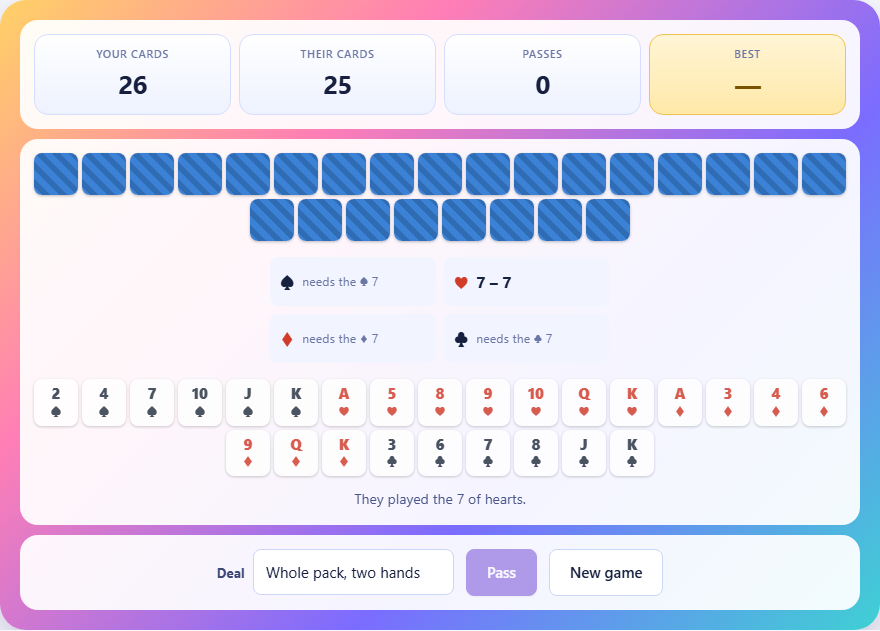
Your hand is displayed as a row of face-up cards along the bottom of the screen. Cards that are currently legal have a highlighted border, while locked cards appear dimmed. Tap or click a highlighted card to play it. If you tap a locked card by accident, a message explains why it cannot be played.
Above your hand sits the table, which shows the four suit runs. Each run displays the suit symbol and the range of cards currently placed, such as five through nine of spades. If a suit has not been opened yet, the table shows that it needs its seven. The computer's hand appears as a row of face-down cards along the top, so you can always see how many cards the opponent holds. The Pass button appears between your hand and the table and only becomes active when you have no legal play.
Why sevens are the key to the whole game
A seven is the only card that can open a suit. Until it is played, every other card in that suit is stuck. This makes holding a seven the strongest blocking move available. If you sit on a seven, neither you nor the opponent can play any card in that suit, which means the opponent's cards in that suit are dead weight in their hand.
The cost of holding a seven is that your own cards in the same suit are equally stuck. If you hold a seven along with the six, five, and four of the same suit, refusing to play the seven strands three of your own cards. Long suits have to be opened sooner, because the more cards you hold in a blocked suit, the more you are hurting yourself. Short suits, where you hold few cards besides the seven, are the ones worth holding back.
Strategy: choosing which card to play
When two or more cards are legal on the same turn, play the one where you hold the next card in the sequence. If the run of clubs shows five through eight and you hold both the four and the nine, check your hand. If you also hold the three of clubs, play the four, because the three becomes legal on your next turn and the run keeps coming back to you. Playing the nine instead hands the initiative to whoever holds the ten.
Every card you play makes the next card in the sequence available for whoever holds it. You cannot avoid opening things, but you can choose to open things for yourself rather than for the computer. Think of each play as a question: does the card this unlocks sit in my hand or in theirs? You will not always know the answer, but when you do, the choice is clear.
Strategy: reading what the opponent holds
The game has no hidden information in the traditional sense. Every card is either in your hand, in the opponent's hand, or on the table. When the computer passes, it tells you something: none of the twenty-six cards that are not in your hand and not on the table are legal. That means the computer does not hold any card that is adjacent to the current end of any open run, nor any unplayed seven. You can use that to narrow down what suits it is holding back.
Similarly, when the computer plays a card that extends a run in a direction that helps you, it probably had no better option. If you see the computer open a suit where you hold many cards, it is a sign that the computer holds few cards in that suit and needed to play the seven to avoid passing.
Handling kings and aces
Kings and aces sit at opposite ends of the suit. They can only be played last in their direction: a king goes down once the queen is on the table, and an ace goes down once the two is there. Because they can only be played at one specific moment, they are dead weight for most of the game. Counting how many kings and aces you hold tells you how long you need the game to last.
If you hold three kings and two aces, you need at least five more turns after your other cards are gone, which is a long time. In that situation, every card you play should aim to accelerate the runs in those suits so the kings and aces become legal sooner. On the other hand, if you hold no extreme cards at all, you want the game to end quickly before the computer gets its own stragglers out.
How the computer decides
The computer scores every legal card by weighing what it unlocks for itself against what it unlocks for you. It prefers to play cards where it holds the next card in the sequence, and it will hold a seven when the suit favors you. It sorts its options by this score and plays the best one each turn.
Because the computer uses a one-step lookahead, it will not see a two-turn setup where you play a mediocre card now to unlock a strong sequence later. If you notice a suit where you hold three or four cards in a row, opening it can create a chain of plays the computer cannot interrupt, even if the first card in the chain does not look like the strongest option on its own.
Common mistakes to avoid
The most frequent mistake is playing a seven too early. Opening a suit where the opponent holds the six and the eight gives them two immediate plays and costs you control of that run. Before you play a seven, check whether you hold the cards on either side of it. If you have neither the six nor the eight, wait if you can.
Another error is always extending the run in the direction of your highest or lowest card without checking whether you hold the cards in between. Playing the nine of hearts is pointless if you do not hold the ten, because the next card goes to the opponent. You are better off extending a run in the opposite direction where you hold a connected chain.
A subtler mistake is passing up a chance to block. If you hold a seven and have another legal play available, playing the other card and keeping the seven is often correct. The seven keeps an entire suit locked and forces the opponent to work around it. Let it go only when your own cards in that suit need releasing.
Privacy and how the game runs
Everything runs inside your browser. No cards are sent to a server, no data leaves your device, and there is no account to create. Your best score is stored in local storage on this device only and will not carry over to another machine. Once the page finishes loading, you can disconnect from the internet and the game will continue to work without any change.