
Patience with jumbled piles and no foundations
Scorpion is a patience game where any face-up card can be picked up together with everything stacked on top of it, no matter how mixed up that pile is. Only the card you grab has to fit its destination. This article covers the full rules, explains every control and difficulty setting, and walks through the planning skills that turn this from a game of luck into one where most losses feel like mistakes.
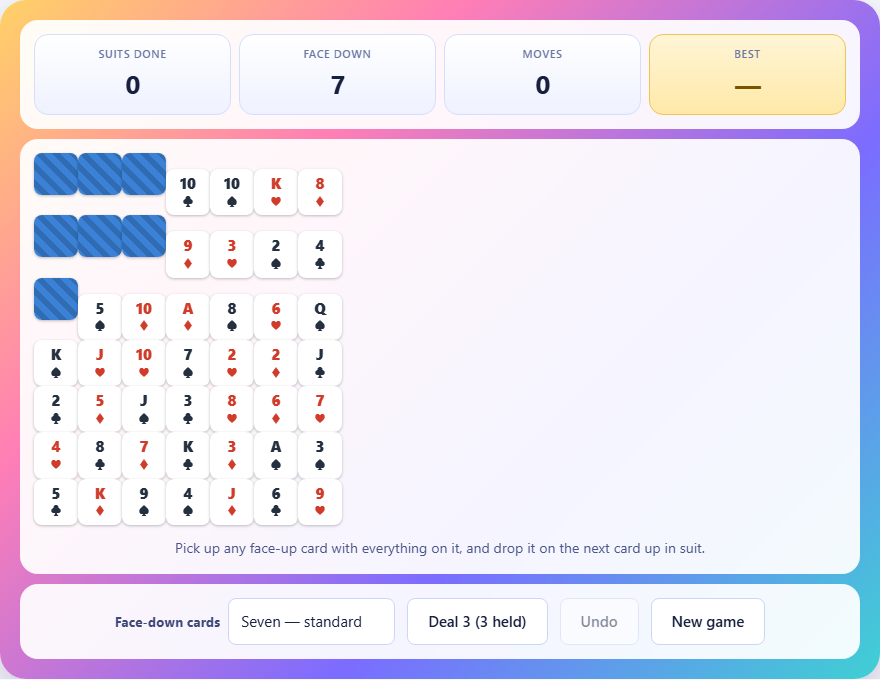
The layout at the start
The game deals forty-nine of the fifty-two cards into seven columns of seven. The remaining three cards are held back in a reserve. On the standard difficulty, seven cards are dealt face down. These hidden cards sit at the bottom of the first few columns, three in each, distributed as needed to reach the total. The face-down cards are the main obstacle because you cannot see what they are until the card directly above them is moved away.
There are no foundation piles in this game. Suits are completed right where they sit, inside the columns themselves. When a column holds a continuous run from king down to ace, all in the same suit, that suit counts as done. Build all four suits and you win. Because everything happens in the columns, there is no separate area to send finished cards to.
The movement rule that changes everything
The core rule of the game is that any face-up card can be picked up along with every card sitting on top of it, regardless of order. If a five of hearts has a king of clubs, a two of diamonds, and a nine of spades piled above it, you can pick up all four as a group by tapping the five. The entire group then moves to a new column, but only the bottom card of the group, the five of hearts, needs to match the destination.
The destination must be one rank higher and the same suit. That five of hearts can only land on a six of hearts. The king, two, and nine riding above it do not matter. They travel as passengers and can be in any order. This rule means that no face-up card is ever truly buried. A card with twenty others piled on it can still be moved, as long as there is a valid target for it somewhere on the board.
Controls and how to play
Tap a face-up card to select it. The card and everything above it lifts visually and the columns where a legal drop is possible are outlined. Tap an outlined column to complete the move. Tap the selected card again or tap anywhere else to cancel the selection. Only kings may be placed in empty columns, which is a standard rule for the game.
The Deal 3 button plays the three reserve cards, one onto each of the first three columns. You get this button once per game. Use it when you have genuinely run out of moves, not before. Dealing early just piles more cards onto columns that did not need them. The Undo button takes back one move. You can undo repeatedly back through your recent history, up to a limit. Undo counts as a move in the move counter, so it does not let you cheat your score.
Difficulty levels and what they change
The difficulty setting controls how many cards start face down. The gentle option hides only three cards, the standard option hides seven, and the hard option hides ten. Everything else about the deal stays the same: seven columns of seven cards, three in reserve, four suits to complete.
Fewer face-down cards means more information at the start. With only three hidden, you can plan long chains before you ever need to flip something. With ten hidden, the first few moves are partly guesswork because you cannot see a large portion of the layout. The standard setting of seven is a fair challenge where most deals are winnable but careless play loses more often than not.
Strategy for uncovering face-down cards
The most important goal in the early game is turning face-down cards face up. A face-down card flips automatically when the card directly above it is moved away. Since you cannot see what is hidden, every flip is new information that can change your plan. Prioritize moves that uncover hidden cards over moves that build neat sequences.
When two moves are equally good for your suits, choose the one that reveals a face-down card. The information is worth more than a slightly tidier column. A beautiful king-to-five sequence does not help if the ace you need is trapped under a face-down card in another column. Flip early and flip often. The sooner you know what every card is, the sooner you can plan the entire solution.
Managing kings and empty columns
Kings are the most awkward cards in the game because they have nowhere to go except an empty column. A king can never be placed on another card. If a king sits in the middle of a column with cards you need below it, the only way to free those cards is to move the king, and the only place for it is a gap. That means creating an empty column is one of the strongest moves available.
Emptying a column requires moving every card out of it. Once the column is clear, you can place a king there along with whatever is stacked on top of it. If no king needs to move, you can also use the empty column as temporary storage, placing any card there via its king and then reorganizing. The key mistake to avoid is burying a king deep in a column where it blocks other cards. A king that cannot move is dead weight, and the cards beneath it are effectively frozen.
When to use the reserve cards
The three reserve cards are dealt onto the tops of the first three columns when you press Deal 3. Because they land on top, they cover whatever was there before. That means dealing the reserve buries three column tops, which can lock you out of sequences you were building. The deal is a lifeline, not a power-up.
Save it for the moment when you truly have no legal move. At that point the deal adds three fresh cards that open new possibilities, and the columns they cover were already stuck anyway. Dealing in the middle of productive play wastes opportunity. Check every column for every possible move before you press the button. If you find even one move, make it. The reserve will still be there when you really need it.
Common mistakes and how to correct them
The biggest mistake is moving cards for the sake of making a move. Every move should have a purpose, either uncovering a face-down card, extending a suit sequence, or creating an empty column. Moving a stack from one spot to another without any of those outcomes just burns a move and changes nothing useful.
The second mistake is ignoring what the passengers are. Even though passengers can be in any order, they still take up space in the destination column. Moving a five with fifteen cards above it onto a six makes a very tall column. Tall columns are not a problem in themselves, but they can obscure the layout and make it harder to spot opportunities. Pay attention to how large the moving group is and whether the destination can handle it.
A third mistake is dealing the reserve too early. It adds three cards to the top of the first three columns. If those columns were in good shape, the deal spoils them. Wait until you are stuck. If the board seems difficult, use Undo to back up a few moves and try a different path before reaching for the reserve.
Privacy and how the game runs
The game runs entirely inside this page on your own device. The shuffle is generated in your browser, no cards or scores are sent anywhere, and there is no account. Your best score is saved in this browser only and will not follow you to another device. Once the page has loaded it works fully offline with no network connection needed.