
Captures, coins, and the hunt for the settebello
Scopa is an Italian card game where every hand comes down to four questions: who took the most cards, who took the most coins, who holds the seven of coins, and who scored the best primiera. This article walks through the complete rules, explains the capture logic and the compulsory single-match rule, breaks down the strange primiera scale, and offers strategies for beating the computer opponent.
The deck and the deal
The game uses a forty-card Italian deck with four suits: coins, cups, swords, and clubs. Each suit has cards numbered one through seven plus three face cards, the jack, queen, and king, valued at eight, nine, and ten. There are no eights, nines, or tens as separate cards. The number cards simply stop at seven and then the faces begin.
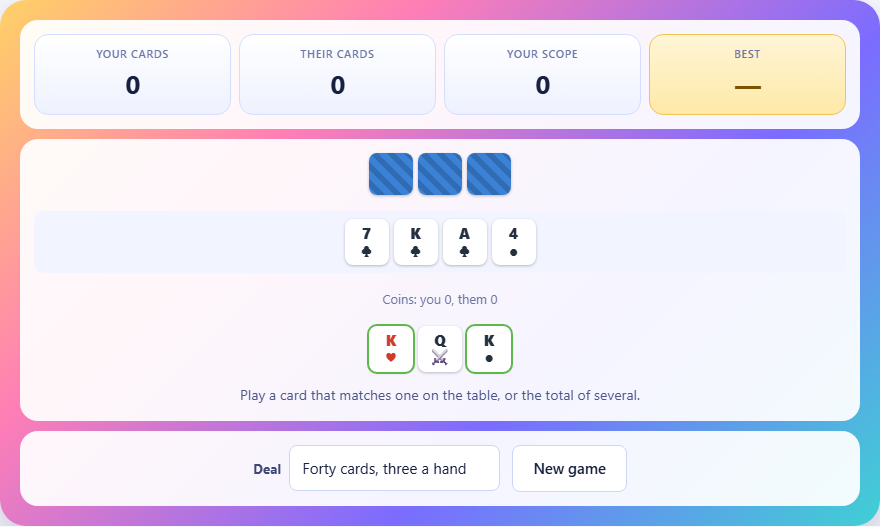
At the start of a hand, four cards are dealt face up to the table. You and the opponent each receive three cards. When both players have played their three cards, another three are dealt to each from the remaining deck. This continues until the deck is empty. Across an entire hand, all forty cards are played, nothing is left in the deck.
How capturing works
On your turn you play one card from your hand. If its value matches a single card on the table, you take that card and add both cards to your capture pile. If no single card matches but the values of two or more table cards add up to your card, you take all of those cards. For example, playing a seven when the table shows a three and a four captures both because three plus four equals seven.
If your card matches nothing on the table at all, it stays on the table face up. It is now available for the opponent to capture on their turn. At the end of the hand, any cards left on the table go to whichever player made the last capture. That rule quietly awards extra cards and can swing the most-cards point.
The compulsory single-match rule
If a card on the table matches your played card exactly by value, you must take that single card. You cannot choose a combination instead, even if the combination would capture more cards. This is a real rule from the traditional game and not a simplification.
This rule matters most with sevens. Suppose the table has a seven, a three, and a four. You play a seven. You must take the single seven. You cannot take the three and four even though they also add to seven. Sometimes this forces you to leave valuable cards behind, and sometimes it saves you from taking cards you did not want. Knowing the rule prevents confusion when the game takes a capture you did not expect.
Scoring the four points
At the end of each hand, four regular points are awarded. The first goes to whoever captured the most cards out of the forty. The second goes to whoever captured the most coins. The third goes to whoever captured the seven of coins, called the settebello. The fourth goes to whoever has the better primiera score.
On top of those four, each scopa is worth an additional point. A scopa happens when your capture clears the table completely, leaving nothing for the opponent. Clearing the table with the very last card of the hand does not count as a scopa. Scopa points add up, so a hand where you scored two scopas and won most cards and the settebello is worth five points to your three regular points plus the two scopa points.
How primiera works
Primiera uses a scoring scale that has no relation to the normal card order. On this scale, a seven is worth twenty-one points, a six is worth eighteen, an ace is worth sixteen, and a five is worth fifteen. The four, three, and two are worth fourteen, thirteen, and twelve. All three face cards are worth only ten each. The scale comes from much older Italian card games and rewards midrange cards over high ones.
To calculate your primiera, take the highest-scoring card you captured in each of the four suits and add the four values together. If you have no cards at all in one suit, your primiera score for that suit is zero, which usually means you lose the point. The player with the higher total wins primiera. Because sevens score highest, a player who captured all four sevens is almost guaranteed this point.
Strategy for capturing coins
Two of the four regular points involve the coin suit. Most coins is one point and the seven of coins is another. That means you should treat every coin card as more valuable than a card of the same rank in another suit. When you have a choice between two captures that net the same number of cards, pick the one that includes more coins.
The seven of coins deserves special attention. If it sits on the table and you can take it, do so even if another capture would give you more total cards. The one point from the settebello is guaranteed, while the most-cards point depends on the entire hand and can shift later. When the seven of coins is in the opponent's capture pile, you have already lost that point and should focus on the other three.
Strategy for setting up scopas
A scopa is an extra point scored by clearing the table entirely with one play. Setting one up requires thinking about what you leave behind as much as what you take. If you capture most of the table but leave a single card, the opponent will play onto that card and the moment is gone.
The best setup is to take everything in one sweep. That happens naturally when the table has few cards whose values add up to a card in your hand. It happens by design when you plan your plays to leave the table with fewer and fewer cards on each turn, aiming for a final capture that takes the last one. Watch the total value on the table and keep track of whether you hold a card that matches it. If you do, consider saving that card until the table is thin enough to clear.
What not to leave on the table
Every card you play that does not capture anything goes to the table for the opponent. Think about what you are giving away. Leaving a coin on the table lets the opponent build their coin count. Leaving a seven lets the opponent combine it with other cards for a large capture or use it to take your coins.
The most dangerous situation is leaving table cards that add up to seven. The opponent can then play any seven to sweep them. More broadly, avoid leaving the table with a low total, because that makes it easy for the opponent to find a card that matches the sum and clears the board for a scopa. If you must leave a card behind, a high-value card in a non-coin suit is usually the safest because it is harder to combine with what is already there.
Common mistakes new players make
New players often chase the biggest capture without looking at which suits they are collecting. Taking five cards is impressive, but if none of them are coins and the opponent took two coins with a smaller capture, the opponent is winning on two of the four scoring categories. Quality matters as much as quantity in this game.
Another mistake is ignoring the primiera entirely. Primiera seems abstract until you lose a close hand because the opponent quietly collected one seven in each suit while you had three sevens in the same suit and nothing in the fourth. Spread your captures across all four suits when possible. Having at least one strong card per suit is the foundation of a good primiera.
A third error is playing cards randomly when no capture is available. Even when you cannot take anything, your play still matters because it changes what the opponent can do. Choose the card that gives the opponent the least useful table to work with. A low-value non-coin card is usually the least harmful thing to leave behind.
Privacy and how the game runs
The game plays entirely inside this page on your own device. The opponent is a simple computer player built into the page itself. No data is sent to any server, there is no account, and nothing is stored between sessions. Once the page has loaded, it works offline with no further connection needed.