
Training peripheral vision with a number grid
Number Sweep puts a grid of scattered numbers in front of you and asks one thing: find them in order, starting at one, as fast as you can. Behind that simple task is a genuine attention exercise used for decades to measure and widen peripheral vision. This article covers the rules, explains every control, describes how scoring and timing work, and offers practical techniques for getting faster.
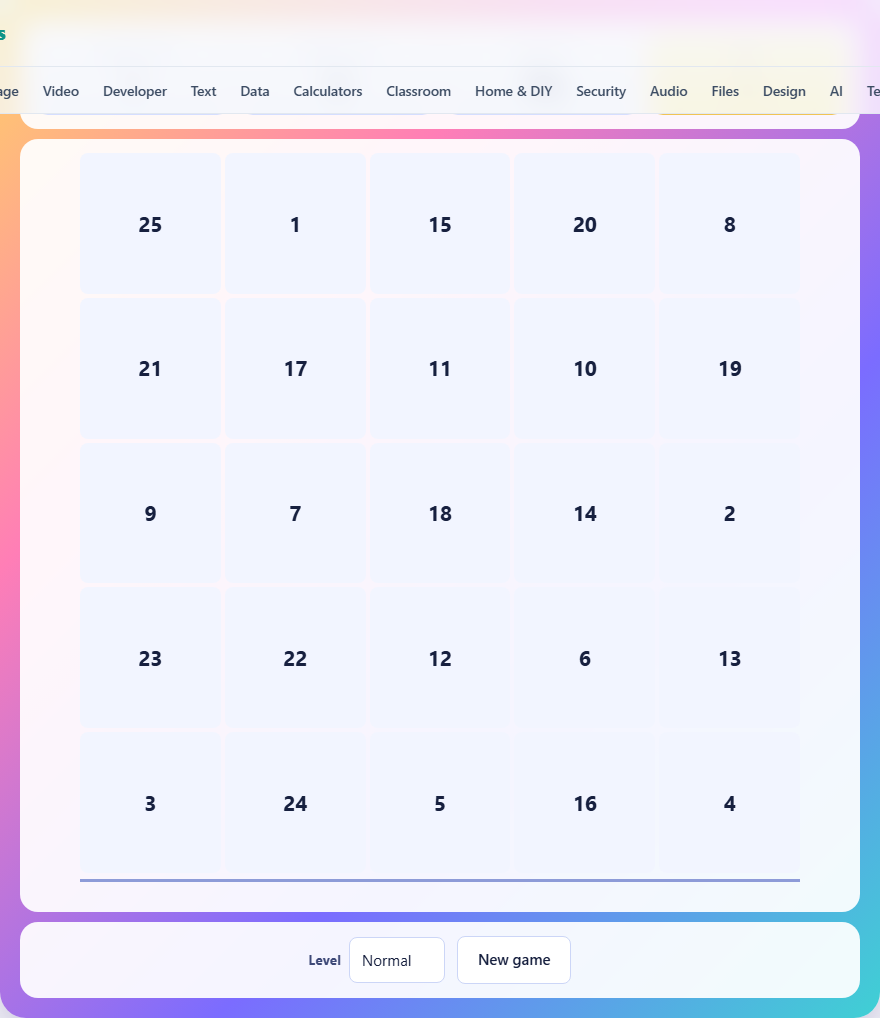
What the board looks like
The board is a square grid of numbered cells. On the default Normal level the grid is five by five, holding the numbers one through twenty-five in a random arrangement. Easy uses a four-by-four grid with numbers one through sixteen, and Hard uses a six-by-six grid with numbers one through thirty-six. The numbers are placed in a new random order at the start of every game, so you can never memorize positions from a previous round.
At the top of the game area, the scoreboard tells you three things: which number you are looking for next, how many wrong taps you have made so far, and how much time is left on the clock. The number you need is always visible in the scoreboard, so if you lose track you can glance up and confirm what comes next.
Rules and how a round works
Tap the numbers in order, beginning with one. The timer starts as soon as the board appears. When you tap the correct number, it greys out and the scoreboard advances to the next. Tap the wrong number and the cell flashes briefly. The mistake is counted but nothing resets, your progress stays where it is and you keep going. Once you reach the last number in the grid the clock stops and your time in seconds becomes your score.
Each difficulty level has its own time limit. Easy allows sixty seconds. Normal allows seventy-five seconds. Hard allows one hundred and ten seconds. If the clock reaches zero before you finish, the game ends and you are told how far you got. The goal is to complete the entire grid before time runs out, and then to beat your own time on the next attempt.
Scoring and personal records
Your score is simply the number of seconds you took to clear the grid. Lower is better. The game saves your best time in your browser so you can see it alongside your current attempt. There is no shared leaderboard. Your record stays on this device and is never sent anywhere else.
Wrong taps are counted but do not add time or any other penalty. They are shown as a separate statistic so you can track whether you are getting more accurate alongside getting faster. A round with two wrong taps and a time of twenty-eight seconds is a better score than a round with no mistakes and a time of thirty-five seconds, because the score is purely about time.
The central gaze technique
The single most effective thing you can do is stop scanning the grid with your eyes. Instead, fix your gaze on the centre of the board and let numbers come to you through peripheral vision. This sounds strange, but it is the actual method taught in speed-reading programs that use this kind of table. Your peripheral vision covers a much wider area than your focused vision, and moving your eyes around the grid wastes time because each jump takes a fraction of a second to settle.
When you first try this, it will feel slower. Your instinct is to look directly at each number to confirm it, and resisting that instinct takes practice. After a few rounds, you will notice that you start seeing two or three numbers at once without moving your eyes. That moment is the point of the exercise. The grid is deliberately sized so that a five-by-five board fits within the useful range of peripheral vision for most people sitting at a normal distance from the screen.
Planning ahead while tapping
Once you are comfortable holding your gaze in the centre, the next improvement comes from looking ahead. While your finger taps six, your eyes should already know where seven is. Better still, you should have a rough sense of where eight and nine are. This lookahead turns the task from a series of searches into a continuous flow, and it is where the biggest time savings come from.
A practical way to build this habit is to mentally note the position of the next two numbers before you tap the current one. At first you will only manage one number ahead. With practice, you will start holding a short queue of three or four positions in your mind, tapping through them smoothly without pausing to search. The difference between a fifty-second round and a twenty-five-second round is almost entirely about how far ahead you look. Players who reach the twenty-second range report that the numbers feel like stepping stones rather than hiding spots, each one leading naturally to the next.
Keeping your head still
Head movement is much slower than eye movement. If you catch yourself tilting your head toward a corner of the grid, you are searching with your body instead of your eyes. The whole point of peripheral vision training is to widen what your eyes can reach without moving anything else. Keep your head steady and let your eyes do the work.
On a phone, the grid is smaller and sits closer to your face, so peripheral coverage is naturally better. The temptation to move your head is lower but still present, especially on the six-by-six Hard grid. If you notice your times plateauing, check whether your head is drifting. Locking it in place and relying purely on eye movement often produces an immediate and noticeable improvement in your completion time.
Choosing the right difficulty
Start on Easy if you have never tried a number grid before. Sixteen numbers in a four-by-four grid is a manageable field that lets you practice the central gaze without feeling overwhelmed. Once you can clear Easy in under twenty seconds consistently, move to Normal. The jump to twenty-five numbers is significant but the extra time allowance helps.
Hard is a real test. Thirty-six numbers spread across a six-by-six grid push peripheral vision to its practical limit. Even experienced players often take over a minute on their first attempt at this size. The time limit of one hundred and ten seconds is generous enough to finish, but breaking sixty seconds on a six-by-six grid takes serious practice. Treat Hard as a long-term goal rather than something to clear on your first day.
Common mistakes and what to do about them
The most common mistake is scanning row by row. Players work across the top row looking for the next number, then the second row, then the third. This is thorough but extremely slow because you cover the entire grid in a fixed path regardless of where the number actually sits. Central gaze with peripheral awareness finds numbers faster because you cover the whole board at once rather than strip by strip.
The second mistake is panicking after a wrong tap. A wrong tap costs nothing except the fraction of a second it took. The number you need has not moved and your progress has not reset. The best response is to ignore the mistake and keep looking for the correct number. Stopping to worry about the error wastes more time than the tap itself.
A third mistake is tapping too cautiously. Some players hover over a number, double-check it, and then tap. That confirmation pause, repeated twenty-five times, adds up to several seconds. Trust your peripheral read. If you saw a seven and your finger is on a seven, tap it. Wrong taps are cheap; hesitation is expensive.
Privacy and how the game runs
The game runs entirely inside this page on your own device. Nothing is uploaded, there is no account, and your best score is stored only in this browser. Once the page has loaded it works offline. Closing the tab does not erase your saved best time, but it will not follow you to a different browser or a different machine.