
How to avoid awkward threesomes in the Salon puzzle
Salon is a puzzle about a dinner party. Every pair of guests either already knows each other or they are strangers, and you must mark every pair one way or the other. The catch is that you cannot create a threesome where all three connections are the same: three people who all know each other, or three people who are all strangers. With five guests this can be done, and there is essentially one way to do it. With six guests it is impossible, no matter how clever you are. This guide explains the rules, the controls, the mathematics of the problem, and the thinking that leads you to the right arrangement.
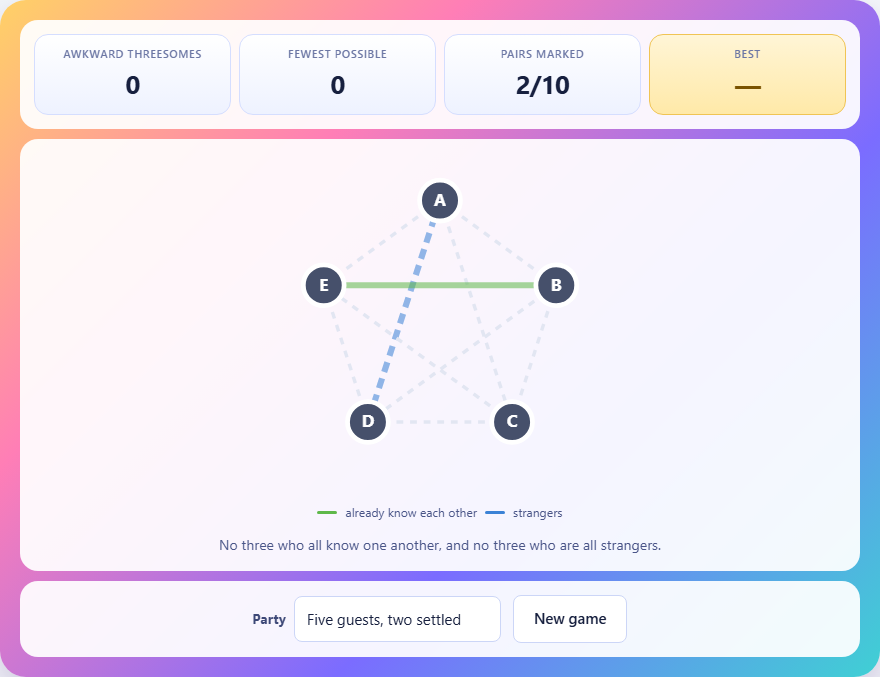
Rules of the game
The guests are arranged in a circle, and every pair is connected by a line. Tap a line to cycle it through three states: solid green for acquaintances, dashed blue for strangers, and unmarked for undecided. You must mark every line. An awkward threesome is any group of three guests whose three connecting lines are all the same, either all acquaintances or all strangers. Any such threesome is highlighted in red on the board.
Some lines may already be marked when the puzzle starts. These are given pairs that cannot be changed. They narrow your options and force you to work around the existing relationships. The puzzle is solved when every pair is marked and the number of awkward threesomes is at or below the target, which depends on the number of guests.
Controls and interface
The board shows guests as dots around a circle with their initials. Lines between every pair of dots represent the connections. Tap a line to mark it as acquaintances. Tap again to switch it to strangers. Tap a third time to clear it back to undecided. Lines that are part of an awkward threesome turn red so you can see the problem immediately.
A legend below the board shows the colour coding: solid green for acquaintances and dashed blue for strangers. The stats bar shows three figures: the number of awkward threesomes on the board, the fewest possible for this party size, and how many pairs you have marked out of the total. A selector labelled Party offers three settings, and New game generates a fresh puzzle.
Scoring and how the game counts
The game counts every tap you make, including taps that undo a previous mark. Your goal is to reach a complete marking with no more awkward threesomes than the target, using as few taps as possible. With five guests, the target is zero threesomes. With six guests, the target is two, because two is the fewest any arrangement of six guests can achieve.
Your best tap count is saved in your browser. Lower is better, because it means you found the right arrangement with less trial and error. A confident solve of the five-guest puzzle can be done in as few as six taps if you know the answer in advance. With six guests, a solid solve takes ten to fifteen taps.
The five-guest solution and why it is unique
With five guests, there is essentially one arrangement that avoids all awkward threesomes. Each guest must know exactly two others and be a stranger to exactly two others. The acquaintances form a ring: each person knows their two neighbours in the circle and nobody else. The strangers form a five-pointed star: each person is a stranger to the two guests who are not their neighbours.
Both shapes, the ring and the star, are the same graph drawn differently. This symmetry is why the solution works and why it is the only one up to relabelling. If any guest knows three others, then among those three, at least two must be strangers to each other, or you have an awkward threesome. The same argument applies in reverse for strangers. Balance at two of each for every guest is the only way through.
Why six guests is impossible
Pick any guest at a party of six. They have five connections. At least three of those five must be the same kind, either three acquaintances or three strangers, because five cannot be split into two groups of at most two. Suppose three are acquaintances. If any two of those three know each other, those two and the first guest form an awkward threesome. If none of those three know each other, the three of them are a threesome of mutual strangers.
Either way, an awkward threesome exists. This is a proof by exhaustion of all cases, and the game confirms it by trying every one of the 32,768 possible markings of six guests. The best any arrangement can do is two awkward threesomes, which is the target the hard mode asks you to achieve. Getting down to two is itself a challenge.
Strategy for the five-guest puzzle
Start by counting lines from each guest. Each guest has four connections. You need exactly two of them to be acquaintances and two to be strangers. If any given pair is already marked, use that information to narrow the choices for the adjacent lines.
Look for the ring pattern. If you can identify two neighbouring guests who know each other, extend the acquaintance ring around the circle. Each guest should know their clockwise neighbour and their counter-clockwise neighbour, and be a stranger to the two guests across the circle. Once you have the ring, fill in the star for the stranger connections. If you get a red threesome at any point, undo your last mark and try the other option.
Strategy for the six-guest puzzle
With six guests you cannot avoid threesomes entirely, so the goal shifts to minimising them. The optimal arrangement has exactly two awkward threesomes. To find it, try to keep every guest balanced at three acquaintances and two strangers, or two acquaintances and three strangers. Perfect balance is impossible with six, but getting close limits the damage.
Pay attention to which threesomes appear. When a red triangle shows up, check whether moving one of its three lines would eliminate it without creating a new one elsewhere. Often, fixing one threesome shifts the problem to a different set of three guests. The puzzle becomes a search for the arrangement where the two unavoidable threesomes are in positions that do not cause any others.
Common mistakes and how to avoid them
The most common mistake with five guests is giving someone three acquaintances. That immediately forces two of those three to be strangers to each other, or you get a threesome. But the strangers constraint then ripples outward and can force another threesome on the far side of the ring. Catch the imbalance early by counting each guest's connections as you go.
With six guests, a common mistake is trying to make every threesome disappear. This wastes taps, because two threesomes cannot be eliminated. Once you are down to two, stop and check whether all pairs are marked. If they are, you have won.
Another mistake is ignoring the given pairs. These fixed marks constrain the puzzle heavily. Start your planning from the given pairs and build outward. Treating them as an afterthought leads to contradictions that force you to undo large sections of your work.
Difficulty levels and what changes
The first level gives five guests with four pairs already marked, leaving only six undecided lines to fill. The second level gives five guests with only two pairs marked, making the search harder. The third level gives six guests with three pairs marked and sets the target at two awkward threesomes rather than zero.
The step from five guests to six is not just a bigger puzzle. It is a fundamentally different kind of problem. With five guests the answer exists and you are looking for it. With six guests the answer does not exist and you are minimising the damage. Recognising this shift in goal is the key to approaching the hard mode correctly.
Privacy and how the game runs
The entire game runs inside your browser. No moves are sent to a server, no data leaves your device, and there is no account to create. Your best score is saved in your browser's local storage on this device only. Once the page has finished loading, you can disconnect from the internet and the game will continue working without any change.