
How to beat the pattern-reading computer at Rock Paper Scissors
Rock Paper Scissors against a random opponent is pure luck. There is no skill, no strategy, and no way to gain an edge. This version is different. The computer watches what you throw after each recent pair of throws, builds a table of your habits, and counters whatever pattern it finds. Early on, while it has no data, it plays randomly. But after enough rounds, it starts predicting you, and its predictions are often right. First to ten wins. Beating it means being genuinely unpredictable, which is much harder than it sounds. This guide covers the rules, the controls, how the prediction works, and the mental tricks that keep you ahead.
Rules of the game
Rock blunts scissors, paper wraps rock, scissors cut paper. Each round, you and the computer both choose a throw. If one throw beats the other, the winner scores a point. If both throws are the same, the round is a draw and nobody scores. The first player to reach ten points wins the match.
Draws are simply replayed. They do not count toward either score and do not affect the round total. A match can take anywhere from ten rounds to fifty or more, depending on how many draws occur. There is no time limit and no penalty for thinking before you throw. Each match starts fresh, with no memory of previous matches, so the computer cannot build up a long-term profile of your playing style across games.
Controls and how to play
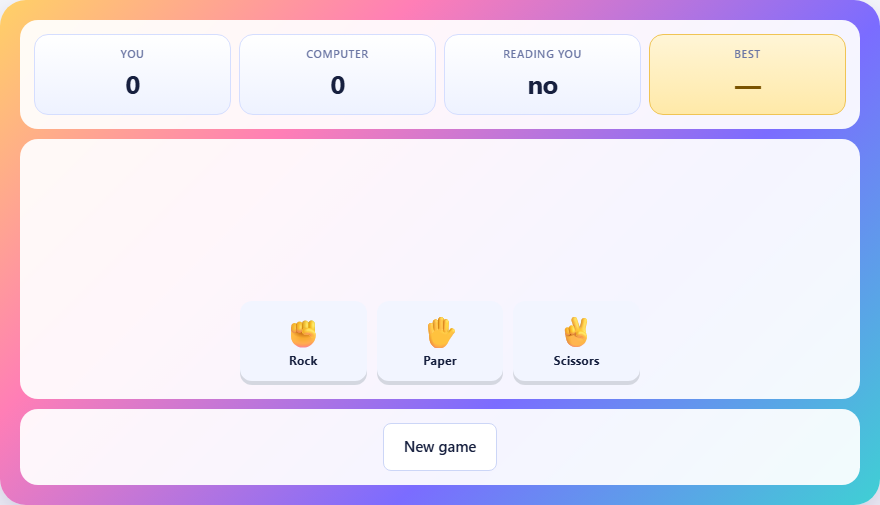
Three large buttons show the three throws: rock, paper, and scissors, each with an icon and a label. Tap one to throw, or press 1, 2, or 3 on the keyboard. After each throw, both choices appear side by side in the reveal area, and a short message says who won the round.
The stats bar shows three figures: your score, the computer's score, and whether the computer is currently reading you. The reading indicator shows no early in the match when the computer has too little data to predict, and yes once it has spotted a pattern. Press New game to reset the scores and start a fresh match with a clean history.
How the computer predicts you
The computer keeps a table of your recent behaviour. Each entry records what you threw after a specific pair of recent throws. For example, if you played rock then scissors, the computer notes what you threw next. If you have been in that same situation before and threw paper twice, the computer predicts paper and throws scissors to counter it.
The prediction needs at least two observations of the same situation before it acts. A single data point is not treated as a pattern. Once the computer has seen a situation two or more times, it plays the counter to your most frequent response. If it has no data for the current situation, it falls back to a random throw. This means the computer is weakest in the opening rounds and grows sharper as the match goes on.
Why people lose and how habits betray you
People are bad at being random. Study after study shows that humans avoid repeating the same throw, switch after losing, and follow sequences they are not conscious of. These tendencies create exactly the patterns the computer is looking for.
The most common habit is the post-loss switch. After throwing rock and losing to paper, most people switch to scissors. The computer notices this and throws rock to beat the scissors it expects. Another common habit is the win-stay response: after winning with paper, many players throw paper again. The computer learns that too and throws scissors the next time it sees the same setup. Both habits feel like natural reactions, which is why they are so hard to suppress.
Strategies for staying unpredictable
The best defence is deliberate repetition. Playing rock three times in a row feels wrong, and that instinct is exactly what the computer exploits. If you force yourself to repeat occasionally, you break the switch pattern that the computer is counting on. The discomfort you feel is a signal that you are doing something the predictor does not expect.
Another approach is to base your throws on something external rather than your own instincts. Pick a word before the match and use the letters to guide your throws: vowels mean rock, consonants from A to M mean paper, the rest mean scissors. The word has nothing to do with the game, so the sequence it produces has no connection to the outcome of earlier rounds. Any system that detaches your choice from the history of the match makes the prediction table useless. You can also try flipping between two different systems during a match. Use the letter method for the first five rounds, then switch to a counting method or pure gut feel for the next five. Changing your approach mid-match disrupts whatever pattern the computer has built up from the early rounds.
Reading the reading indicator
The stats bar tells you when the computer thinks it has spotted a pattern. When the indicator says yes, the computer is no longer guessing. It has seen your current situation before and has enough data to predict your most likely throw. This is the moment to break your pattern. If you were about to throw what feels natural, throw something else instead.
When the indicator says no, the computer is falling back to random throws. This is your safest window, because your odds are even. Early in the match, the indicator stays on no for several rounds, which is why the first five or six rounds are usually the easiest. The longer the match goes, the more situations the computer has catalogued, and the harder it becomes to find a situation it has not seen before.
Common mistakes that cost matches
The most expensive mistake is assuming the computer is random. Players who treat it as a coin flip throw whatever they feel like and lose steadily once the prediction kicks in. The reading indicator turning to yes is the warning that pure instinct is no longer enough. By that point the computer has already catalogued your most common responses and will exploit them until you change your approach.
Another mistake is overcompensating. Some players, knowing the computer tracks patterns, try to rotate through rock, paper, scissors in a fixed cycle. A fixed cycle is itself a pattern, and the computer picks it up quickly. Unpredictability means breaking every pattern, including the one you just invented to be unpredictable.
A third mistake is playing slowly when the indicator says yes and quickly when it says no. The computer does not care about your speed, but the change in tempo often causes you to overthink and fall into a new pattern. Play at the same pace regardless of what the indicator says. Consistency in your approach helps you stay loose and avoid the kind of second-guessing that creates predictable sequences.
Why true randomness is unbeatable
Against a genuinely random sequence of throws, no prediction system can gain an edge. Each throw is equally likely regardless of what came before, so the table the computer builds is useless. The game is exactly even at one third win, one third lose, one third draw. The computer's advantage comes entirely from the fact that humans are not random.
This is worth knowing because it frames the challenge correctly. You are not trying to outsmart the computer. You are trying to outsmart yourself, to suppress the instincts and habits that make your throws predictable. The computer is a mirror for your own patterns. Beating it means seeing what it sees and choosing differently. If you can win consistently, it is genuine evidence that you are producing sequences the predictor cannot exploit, which is harder than most people expect. Even players who know exactly how the prediction works still fall into habits under the pressure of an ongoing match.
Privacy and how the game runs
The entire game runs inside your browser. Nothing is uploaded, there is no account, and your best score is stored in this browser only. The prediction table is built from your throws during the current match and is cleared when you start a new game. Once the page has loaded, you can go offline and the game will keep working without any change.