
How to solve the postman's route in Rounds
Rounds gives you a map of streets and junctions and asks a simple question: if a postman must walk every street at least once and return to the starting point, which streets should he walk twice? Walking a street twice costs twice as much, so the goal is to find the set of doubled streets that adds the least extra distance while making the route possible. The puzzle is based on the Chinese postman problem, one of the few routing questions in mathematics that has a fast exact solution. This guide explains the rules, the controls, the theory behind odd junctions, and the strategies that lead to the cheapest round.
Rules of the game
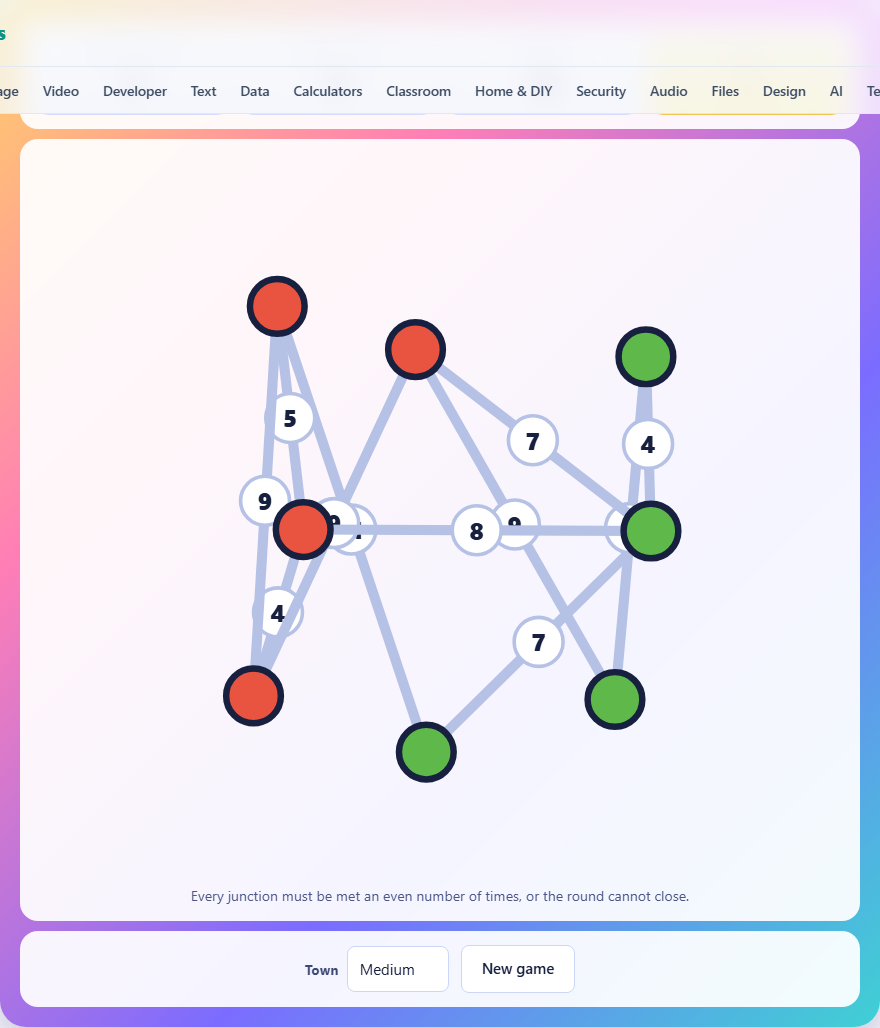
You are shown a map with junctions and streets connecting them. Each street has a cost written on it, representing its length. The postman must walk every street at least once and return to where he started. Some streets will need to be walked twice to make this possible. Your job is to choose which streets to double so that every junction has an even number of street-ends meeting it, while keeping the total extra cost as low as you can.
A junction turns green when the number of streets meeting it is even, counting a doubled street as two. A junction stays red while its count is odd. The puzzle is solved when every junction is green and your total extra cost matches the cheapest possible, which is shown at the top of the board.
Controls and interface
The map is drawn as a set of dots for junctions and lines for streets. Each street has a small circle in the middle showing its cost. Tap a street to mark it as walked twice. The street thickens and changes colour to show the doubling. Tap it again to undo. Red junctions have an odd number of streets; green junctions have an even number.
The stats bar shows three figures: how many odd junctions remain, the total extra cost of your doubled streets so far, and the cheapest possible extra cost. A level selector labelled Town lets you pick Small for six junctions, Medium for eight, or Large for nine. Press New game to generate a fresh map.
Why odd junctions are the entire problem
Every time the postman walks through a junction, he arrives on one street and leaves on another. Each visit uses two street-ends. If a junction has an even number of streets, the postman can pass through it perfectly, using every street once. If a junction has an odd number of streets, one street-end is left over. The postman either cannot leave or cannot arrive without reusing a street.
The only way to fix an odd junction is to double one of its streets. Doubling a street adds one extra street-end at each end of that street, flipping the parity of both junctions. This means every doubling fixes two junctions, but it can also break two that were already even. The trick is to choose doublings that fix the odd junctions without creating new odd ones.
Pair the odd junctions by shortest routes
There are always an even number of odd junctions, because every street contributes exactly two ends to the total count, making the sum even. With four odd junctions, you need to pair them into two groups and double the shortest route between each pair. With six odd junctions, you pair them into three groups.
The route between two paired odd junctions does not have to be a single street. It can be a path of several short streets. Doubling two short streets that connect a pair of odd junctions is often cheaper than doubling one long street that goes directly between them. Think of it as finding the shortest path through the network, not just the shortest single link. The game uses shortest-distance calculations between every pair of junctions to find the true cheapest pairing.
Try every pairing before you commit
With four odd junctions there are three ways to pair them. Call the junctions A, B, C, and D. You could pair A with B and C with D, or A with C and B with D, or A with D and B with C. The cheapest pairing is often not the obvious one. Pairing the two closest odd junctions might look right, but it can leave the other two far apart, making their route expensive.
Before you start tapping streets, trace the shortest path between each pair for all three possible pairings. Add up the total extra cost for each pairing and pick the one with the lowest total. With six odd junctions there are fifteen pairings to consider, which is more work, but the same principle applies. The game checks every pairing to find the true cheapest answer, and you should try to do the same.
When every junction is already even
Occasionally the game generates a map where every junction already has an even number of streets. In that case, no doubling is needed at all. The postman can walk every street exactly once and return to the start. This is called an Eulerian circuit, named after Leonhard Euler, who first studied this kind of question in 1736 using the seven bridges of a city.
When you see a board with zero odd junctions and a cheapest cost of zero, the puzzle is already solved. You win by not marking anything. This is rare, but it does happen, and it is worth knowing so you do not waste time looking for streets to double on a board that does not need any. The game generates boards with at least four odd junctions in practice, so you will almost always have work to do, but understanding the Eulerian case helps you recognise when a section of the map is already clean.
Common mistakes and traps
The biggest trap is pairing the two nearest odd junctions without checking the other pairings. This greedy approach works on some boards but fails badly on others. Two junctions that are close together might leave the remaining odd junctions at opposite corners of the map, where the cheapest path between them is very expensive. Always compare the total for each possible pairing.
Another mistake is doubling a street that does not lie on the shortest path between any pair. Every doubled street must contribute to fixing the parity at an odd junction. Doubling a street between two even junctions makes both of them odd, creating two new problems. If you notice the odd-junction count going up instead of down, undo your last mark and reconsider.
A subtler mistake is doubling a street that lies on the shortest path but doing it in the wrong combination. Doubling street X fixes junctions A and B, but if A is already even, you have broken it. Make sure both ends of every street you double are currently odd, or that the sequence of doublings along a path will fix the right pair. Remember that undoing a doubling is free. Only the streets marked at the end are counted toward your score, so experimenting with different routes costs nothing as long as you clean up before you finish.
Difficulty levels and map sizes
The Small town has six junctions and a handful of streets. The number of odd junctions is kept between four and six, so there is always a real puzzle to solve. The Medium town has eight junctions and more streets, making the shortest-path calculation harder. The Large town has nine junctions with even more connections, and the number of possible pairings grows.
On every size, the game generates the map randomly and solves it before presenting it to you. Boards where the optimal answer is trivially cheap or where the number of odd junctions is too small or too large are rejected. This means you always get a genuine puzzle with a meaningful solution.
Privacy and how the game runs
The entire game runs inside your browser. No moves are sent to a server, no data leaves your device, and there is no account to create. Your best score is saved in your browser's local storage on this device only. Once the page has finished loading, you can disconnect from the internet and the game will continue to work without any change.