
How to fill a round-robin fixture list in Rota
Rota gives you a set of clubs and asks you to pair them off for every day of the season. Each club plays every other club exactly once, and no club may play twice on the same day. That sounds like nothing more than bookkeeping, but it is not. The first couple of days go smoothly, and then you discover that the last two clubs left unpaired on a day have already met. The whole day has to be torn up and rebuilt. This guide explains the rules, the controls, the mathematics behind the puzzle, and the strategies that keep you out of dead ends.
Rules of the game
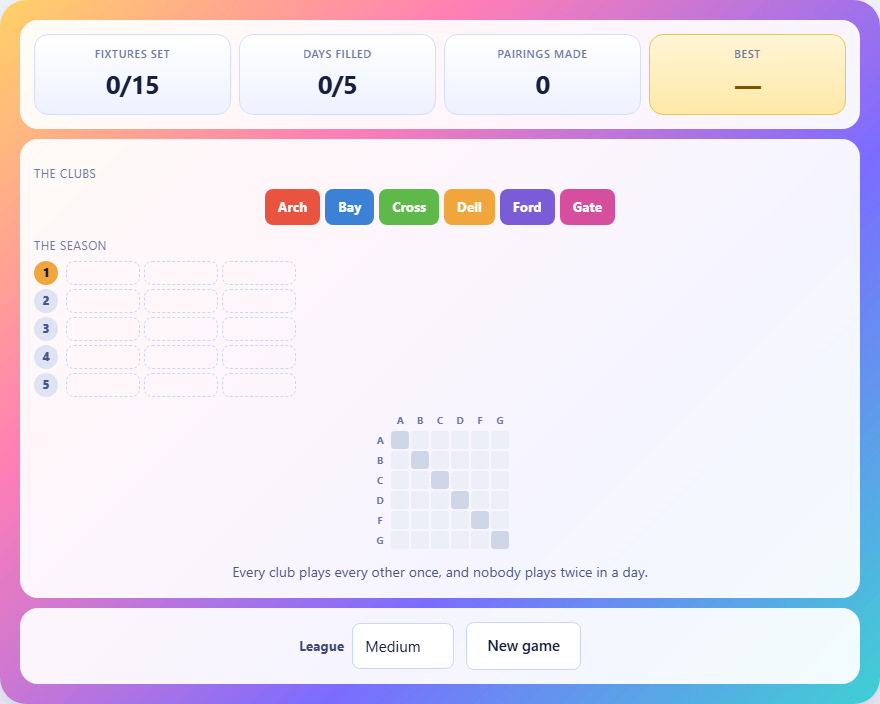
You are given an even number of clubs, each shown as a coloured button with a short name. The season has one fewer day than the number of clubs. With six clubs there are five days; with eight there are seven. Each day, every club must play exactly one fixture, and the two clubs in a fixture must not have met on any earlier day. The season is complete when every possible pair of clubs has played.
The number of clubs is always even. An odd number cannot be paired off completely, because one club would always be left sitting out. The game enforces this by only offering four, six, or eight clubs depending on the league size you choose. Each day must contain exactly half as many fixtures as there are clubs, so every club is busy on every day of the season.
Controls and how to set a fixture
Tap a club button to select it. The button highlights to show it is held. Tap a second club to pair them together on the current open day, which is marked in orange. The fixture appears in that day's row, showing both club colours and names. If you tap the same club twice, the selection is cancelled.
To remove a fixture, tap the fixture itself. This frees both clubs to be paired with someone else. The grid at the bottom of the board tracks which pairs have already played, with green squares marking completed fixtures. A level selector labelled League lets you pick Small for four clubs, Medium for six, or Large for eight. Press New game to start over at any time.
How scoring works
The game counts every pairing you make, including ones you later cancel. Your goal is to fill the entire season using as few pairings as possible. A perfect run means you never set a fixture that has to be undone, so your pairing count equals the total number of fixtures in the season. With six clubs that total is fifteen. With eight it is twenty-eight.
Your best score is saved in your browser on this device. Lower is better, because fewer pairings means fewer mistakes. The stats bar shows how many fixtures are set, how many days are filled, and how many total pairings you have made so far. When you complete the season, the game reports how many pairings it took compared to the minimum, so you can see exactly how much waste there was.
Why dead ends happen and how to spot them
The board warns you when a day cannot be finished. This happens when the clubs still unpaired on a day have all already met each other on previous days. There is nowhere to put them, and you must cancel a fixture from the current day or an earlier one to open up a new pairing.
Dead ends tend to appear late in the season, because the first few days have plenty of fresh pairings available. By the fourth or fifth day with six clubs, every club has already met most of the others, and the remaining options are thin. The grid at the bottom is your early warning system. Watch for clubs whose rows are nearly full, because those clubs have very few partners left.
Start with the most constrained clubs
The single most reliable strategy is to pair the constrained clubs first on each day. Look at the grid and find the clubs that have the fewest unplayed opponents. Those clubs have fewer choices, so pairing them first keeps your options open for the clubs that still have many potential partners.
Think of it like a jigsaw puzzle. You place the corner pieces first because they can only go in one spot. Clubs with only two or three opponents left are the corners of this puzzle. If you leave them for last, they are the ones that create the dead end. If you handle them first, the clubs with more options can fill in around them without trouble. On the large board with eight clubs, this habit is essential. By day five, several clubs will have played five opponents already and have only two left. Pairing those clubs first each day keeps the schedule from collapsing in the final rounds.
The circle method and why it always works
There is a beautiful construction that solves the puzzle for any even number of clubs. Fix one club in the centre and arrange all the others in a circle around it. On day one, the fixed club plays whoever is at the top of the circle, and every other club plays the club directly opposite them in the ring. Then rotate the ring by one position and repeat. After one full rotation, every pair has met exactly once and nobody has played twice on the same day.
This construction is called a one-factorisation of the complete graph. The complete graph connects every club to every other with a line. A single day is a set of lines where every club appears exactly once, which is called a perfect matching. The season splits the complete graph into perfect matchings with nothing left over. The circle method is both a proof that this is always possible and a recipe for doing it.
Common mistakes to avoid
The most common mistake is pairing clubs that happen to be next to each other on the screen without checking the grid. It feels natural to pair the first two available clubs, but those two may have already met. Always glance at the grid before tapping.
Another mistake is leaving two clubs for last on a day when both have played each other earlier. By the time you notice, the other fixtures on that day are set and all look correct. You have to undo one of those correct fixtures to free a club that can partner one of the stuck pair. The fix is to check the grid before you set the third or fourth fixture of the day, not after.
A third mistake is restarting the whole game when a single day goes wrong. Cancelling one or two fixtures is almost always enough. The game tracks your total pairings, so restarting resets your count but wastes everything you built.
Difficulty levels and what changes
The Small league has four clubs and three days. There are only six fixtures in total, and the grid is small enough to hold in your head. This is a good place to learn the controls and see why dead ends happen. The Medium league has six clubs and five days. Fifteen fixtures need to be set, and the grid is large enough that you need to watch it carefully. The Large league has eight clubs and seven days. Twenty-eight fixtures across seven days is a serious scheduling challenge.
The puzzle always has a solution. The game uses the circle method internally to verify that the season it gives you can be completed. You are never handed an impossible board, so every dead end is a mistake that can be undone rather than a flaw in the puzzle. The order of the days does not matter for winning. Any complete season where every pair has met exactly once and nobody has played twice on the same day counts as a valid solution.
Privacy and how the game runs
The entire game runs inside your browser. No moves are sent to a server, no data leaves your device, and there is no account to create. Your best score is saved in your browser's local storage on this device only, so it will not follow you to a different machine. Once the page has finished loading, you can play offline without any change in how the game works.