
Dig for gems, dodge what falls, and learn why boulders roll
How the fixed-tick physics make every collapse predictable, what the three difficulty settings change, the rule that separates a harmless boulder from a fatal one, and the tunnelling habits that keep you alive.
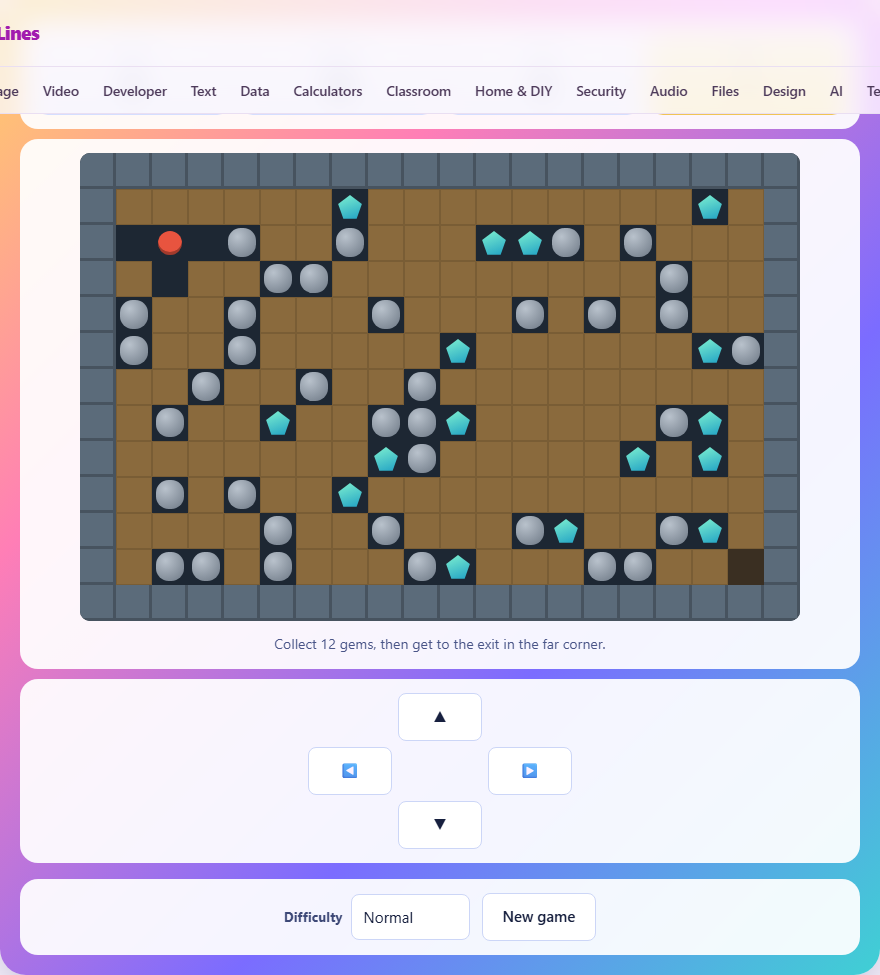
What the game asks you to do
You stand in a cave filled with earth, boulders, and gems. You can dig through the earth by moving into it. You need to collect a certain number of gems and then reach the exit in the bottom-right corner of the cave. The exit stays locked until you have enough gems.
Boulders and gems both obey gravity. Remove the earth beneath them and they fall. A boulder that is already falling will crush you. A gem that is falling is just as deadly. The challenge is to collect what you need without bringing the ceiling down on your head.
Controls on every device
On a keyboard, press the arrow keys or WASD to move one square in that direction. Each press takes one step. On a phone or tablet, use the four directional buttons beneath the board, or swipe on the board in the direction you want to go.
Every step counts. Moving into a square of earth digs it away and turns it into empty space. Moving into an empty square is just a step. You cannot move through walls or into boulders that have no room to be pushed. The game counts each step you take, so efficient routes matter.
How boulders and gems fall
Everything in the cave advances on a fixed clock. Falling, rolling, and your own movement all happen on the same tick cycle. This is not cosmetic. It means a chain of collapses resolves in a defined order every time. The bottom row is processed first, then the row above it, and so on up to the top. A stack of boulders falls as a column, one square per tick, instead of the top boulder leapfrogging the lower one.
This fixed order is what makes the game learnable. The same arrangement of boulders and earth will always collapse in the same way. Once you understand how a particular shape falls, you can rely on that knowledge in future games.
Gems follow exactly the same rules as boulders. They fall when unsupported, roll off shoulders, and crush you if they land on you while moving. The only difference is that walking into a gem collects it instead of pushing it.
The rolling rule
A boulder sitting on top of another boulder is not stable. If there is an empty square beside it and an empty square diagonally below, the upper boulder rolls off the shoulder into the gap. It checks the left side first, then the right.
This rolling is the most dangerous mechanic in the game. A tunnel that looks perfectly safe becomes a chute the moment you widen it. Dig out one extra square next to a boulder stack and the top boulder rolls sideways and drops into your path.
The rule applies to gems as well. A gem sitting on a boulder will roll off if you open up a gap beside it. Knowing when a roll will trigger and where the object will end up is the core skill of the game.
When a boulder kills you and when it does not
A boulder that is sitting still is harmless. You can walk underneath a supported boulder with complete safety. You can stand next to one, dig around it, and push it sideways. It will not hurt you until it starts moving.
The danger begins the moment a boulder falls at least one square. Once it has been in motion, landing on your square is fatal. Removing the earth directly below a boulder is safe for exactly one tick. The boulder has not started falling yet, and you can step aside. But if you stay in place for even one more tick, the boulder drops onto you.
You can push a boulder left or right, but only into an empty square. Pushing upward or downward is not allowed. Pushing a boulder sideways is how you clear paths and rearrange the cave to reach gems that are otherwise blocked.
Three difficulty settings
A dropdown next to the game lets you choose between Gentle, Normal, and Dangerous. The settings change three things: the density of boulders in the cave, the total number of gems scattered through it, and how many gems you need to collect before the exit opens.
Gentle fills about ten percent of the cave with boulders, places fourteen gems, and requires eight of them. Normal raises the boulders to sixteen percent, places sixteen gems, and requires twelve. Dangerous pushes boulder density to twenty-two percent, scatters eighteen gems, and demands sixteen.
Higher boulder density means more obstacles to navigate and more chain reactions to predict. Needing more gems forces you to travel further through the cave and take more risks. On Dangerous, nearly every gem has to be collected, leaving almost no room to skip a difficult one. Changing the difficulty starts a fresh cave. Each game is generated randomly, so no two caves have the same layout.
Dig sideways, not upward
The safest direction to dig is horizontal. A horizontal tunnel gives you room to step to either side if something falls from above. Digging upward puts you directly beneath whatever is sitting on top of the earth you just removed.
When you must dig upward, do it one square at a time and step aside immediately. Check what is above the square you are about to remove. If a boulder is sitting there, removing the earth will start a collapse and you need to be out of the way before the next tick.
Diagonal paths are a useful compromise. Dig one square to the side, then one square up, alternating. This zigzag keeps you out of the direct fall line while still making vertical progress. It takes more steps than a straight line, but those extra steps keep you alive.
Planning your route to the exit
The exit is always in the bottom-right corner. It stays shut and looks closed until you have collected enough gems. Once the requirement is met, the exit opens and a message tells you to head for the corner.
Plan your gem collection so that you end up near the exit when you hit the target number. Collecting gems on the left side of the cave first and then working your way right puts you close to the exit when it opens. Collecting the last gem in the top-left corner means a long and hazardous journey back down through a cave that is now full of loose boulders.
Keep an eye on the gem counter as you play. When you are one or two short, start thinking about your path to the exit. Do not go hunting for gems deep in the cave if you are about to hit the target.
Common mistakes that end the game
- Digging straight up into a column of boulders. They fall immediately and you are standing in their path.
- Widening a tunnel next to a boulder stack. The top boulder rolls off the shoulder and drops into the gap you just made.
- Standing under a boulder you just freed. Removing the earth beneath it is safe for one tick, but staying there is not.
- Ignoring gems that are above boulders. Digging under the boulder to reach the gem starts a chain reaction.
- Collecting gems on the far side of the cave and then having no safe route back to the exit.
Scoring
The game tracks the number of steps you take to collect all the gems and reach the exit. Fewer steps mean a more efficient run. The result screen reports your gem count and your step total.
Your best result is saved in your browser on this device. It is never sent to a server and does not follow you to another machine or browser.
No data leaves your device
The cave, the boulders, the gravity simulation and the score all run inside your browser. Nothing is uploaded, there is no account to create, and once the page has loaded the game works without an internet connection. Your result is stored in your browser's local storage on your own device. You can verify this by loading the page and then disconnecting from the network.