
How to solve every River Crossing puzzle
River Crossing collects three classic logic puzzles about getting a group across a river in a boat that is too small, with strict rules about who can be left together on a bank. The farmer and his animals, the missionaries and the cannibals, and the jealous couples each add a different constraint, and all three share the same core mechanic: think about what you leave behind, not just what you carry forward. This guide explains the rules of each puzzle, the controls, how scoring works, and the reasoning that leads to the shortest solution.
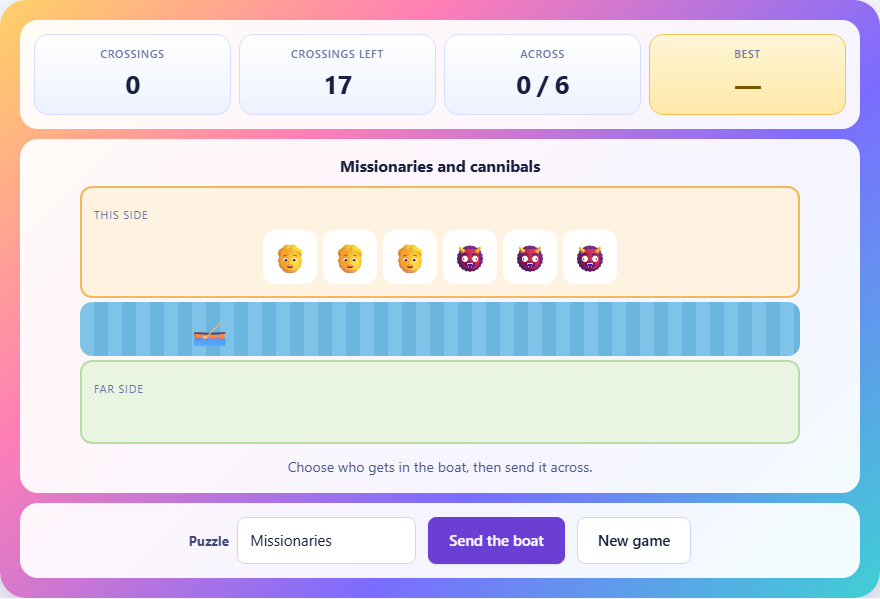
How the boat works
All three puzzles use the same boat. It sits at one bank and can carry up to two passengers across to the other side. It cannot cross empty, because somebody has to row it. Tap the people on the bank where the boat is sitting to load them into the boat, then press the Send the boat button to make the crossing.
After the boat arrives at the far bank, its passengers step off and the boat stays there. To send someone back, you load passengers from the far bank and send it again. Every crossing counts as one move, whether the boat carries one person or two. The game gives you a move limit equal to the shortest known solution plus six extra crossings, so there is room to experiment but not to wander forever.
The game tracks your total crossings and displays them in the stats bar. Your score is the number of crossings used, and lower is better. If you solve the puzzle in the fewest crossings possible, you have found the shortest path. The game tells you the shortest known count at the end so you can see how close you came.
The wolf, goat, and cabbage
The first puzzle has a farmer, a wolf, a goat, and a cabbage. Only the farmer can row. The wolf will eat the goat if they are left alone together, and the goat will eat the cabbage if left alone with it. The farmer's presence prevents any eating, so the rule only applies to a bank the farmer has left.
The key is that the goat is the troublemaker. It cannot be left with the wolf and it cannot be left with the cabbage. The wolf and the cabbage, on the other hand, are perfectly safe together. So the goat must go first. Take the goat across, come back alone, take the wolf across, bring the goat back, take the cabbage across, come back alone, and take the goat across one last time. That is seven crossings, the shortest possible.
There is an alternative path where you take the cabbage instead of the wolf on the third crossing, then bring the goat back and take the wolf. Both solutions use seven crossings. What they share is the same structure: the goat goes first, comes back once, and goes last. That pattern is forced by the fact that the goat conflicts with both the other passengers.
Missionaries and cannibals
Three missionaries and three cannibals must cross the river. Anyone can row. The constraint is that missionaries may never be outnumbered by cannibals on either bank, because outnumbered missionaries would be in danger. A bank with no missionaries at all is safe, since there is nobody to outnumber.
The difficulty comes from the fact that every crossing changes both banks at once. Sending two cannibals across removes them from one bank and adds them to the other. You must check both sides after every move. The shortest solution takes eleven crossings. One common path starts by sending two cannibals across, bringing one back, sending two cannibals again, bringing one back, then switching to missionaries for the middle section.
A useful thing to remember is that a bank with zero missionaries is always safe, no matter how many cannibals stand there. This means you can safely move all three missionaries away from a bank as long as you do it in one crossing or arrange the intermediate states carefully. The constraint only bites when at least one missionary is present but outnumbered.
The jealous couples
Three married couples must cross the river. Anyone can row. The rule is that no wife may be on a bank with another husband unless her own husband is present. A wife alone or with her own husband is always fine. A wife with someone else's husband is only fine if her own husband is standing right there too.
This puzzle adds a third dimension of tracking because you need to consider three pairs at once. The shortest solution is also eleven crossings, but the reasoning is harder. Typically two wives cross first, one comes back, two more cross, one comes back, then the husbands begin crossing. The exact sequence depends on which wives you pair up, but every solution requires at least one round trip where a wife goes back to let a husband cross safely.
Controls and what happens on an illegal move
Tap a person on the bank where the boat sits to add them to the boat. Tap them again to remove them. You can load one or two passengers. The Puzzle dropdown at the bottom lets you switch between the three puzzles. Pressing New game resets the current puzzle to its starting position.
If you try to send the boat and the bank you are leaving behind would violate the rule, the move is refused immediately. The boat comes back, nobody changes sides, and you do not lose a crossing. This means you can always experiment safely. Try a move, see if it is refused, and think about why. The game never lets you reach a broken state.
Thinking backwards from the goal
Every river crossing puzzle can be thought of as a path through a set of states. A state is simply who is on which bank and where the boat is. The goal state has everybody on the far bank. Working backwards from the goal is often easier than working forwards from the start.
Ask yourself: what does the second-to-last state look like? Somebody must be on the near bank ready to row the boat across for the last time. In the wolf puzzle, that somebody is the farmer and the goat. In the missionaries puzzle, it is one cannibal. Knowing the final move tells you what the board must look like one step before, and from there you can trace back to the present.
The return trip is the hard part
New players resist bringing someone back. It feels like wasted progress. But almost every solution requires return trips, and sometimes the person who comes back is someone you just carried across. In the wolf puzzle, the goat crosses to the far bank and then comes back with the farmer to let the cabbage go. That round trip is the heart of the solution.
Accepting that return trips are necessary changes how you think about the problem. Instead of asking who should go, ask who is safe to come back. The person who can return without breaking the rule on the far bank is usually the right passenger. In the missionaries puzzle, a single cannibal can almost always return safely because one cannibal never outnumbers anyone.
Common mistakes and how to avoid them
The most common mistake is only checking the bank you are going to. Every crossing changes two banks. Sending two missionaries across might leave one missionary alone with two cannibals on the near bank. The game catches this and refuses the move, but understanding why it was refused saves time.
Another mistake is using all your extra crossings by going back and forth without progress. The limit is the shortest solution plus six, which sounds generous but disappears quickly if you make the same loop twice. When a move is refused, stop and reason about the constraint rather than trying a different pair at random.
A third error is skipping the easiest puzzle. The wolf and goat puzzle is not just for beginners. Its tight structure makes the logic of return trips obvious, and that logic applies directly to the harder two. Solve it once, understand why each step is needed, and the patterns carry forward.
Finally, players sometimes load only one person into the boat when they could send two. Sending one person is sometimes correct, especially on return trips where you just need the boat back. But on a forward trip, carrying two people gets more passengers across in fewer crossings. Before pressing the send button, check whether a second passenger would be safe to add.
Privacy and how the game runs
The entire game runs inside your browser. No moves are sent to a server, no data leaves your device, and there is no account. Your best crossing count is stored in local storage on this device only and will not appear on another machine. Once the page has loaded, the game works offline without any change in behaviour.