
How to clear the board in Ripple Tap
Ripple Tap turns a question from geometry into a satisfying visual puzzle. Tap anywhere on the water and a bright ring spreads outward from that point. The ring is the only thing that pops a target. The calm water inside does nothing, and neither does the water the ring has already crossed. So a single tap clears whichever targets happen to sit at the same distance from it, and your job is to find the spot that puts as many targets as possible on one circle. This guide explains the rules, the controls, and the spatial reasoning that saves taps.
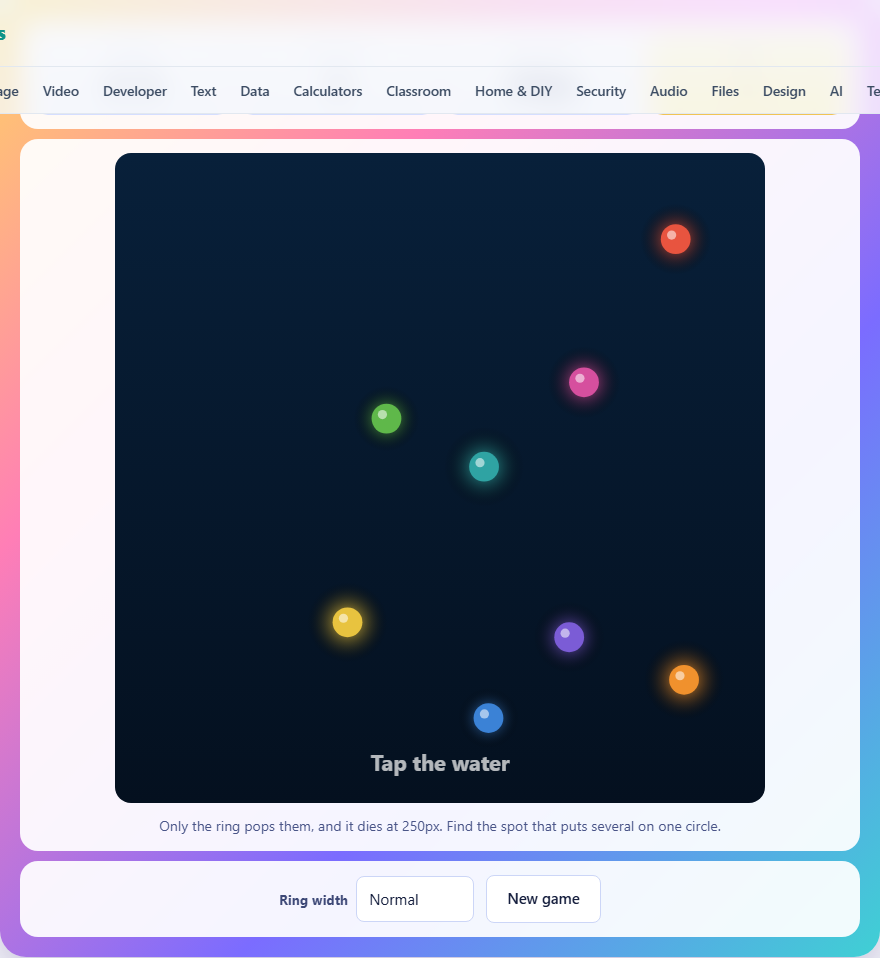
What the board looks like and what you do
The board is a dark square of water dotted with glowing coloured targets. Each target pulses gently so it is easy to spot. You have a small number of taps, shown in the stats bar, and every target must be popped before those taps run out. Tap the water and a ring appears at that point, expanding outward. As the ring's bright edge passes through a target, the target pops and is removed. Anything the ring has already passed is safe from that tap forever.
The ring is a band, not a line. It has a certain width, which means a target does not need to sit at the exact distance from your tap. It only needs to be close enough for the band to overlap it. But the ring does have a maximum reach. It fades as it expands and dies at a fixed distance, so targets beyond that reach cannot be hit by that tap no matter where you place it.
The ring does not stop when it hits a target. It keeps expanding and can pop several targets in one sweep if they all sit at roughly the same distance from the tap point. It also does not stop at the edge of the board. A ring aimed at a nearby pair can keep going and catch something further away on the far side, which is easy to forget but can save a valuable tap.
Controls and difficulty settings
Tap or click anywhere on the water to send out a ring. There is no time limit on choosing where to tap, so you can study the board for as long as you like before committing. Each tap reduces your count by one. The Ring width dropdown below the board changes how forgiving the ring is. Wide rings have a thick band that pops targets even if your aim is a bit off. Normal is the default. Thin rings demand that your centre is very close to the right spot.
On Wide, the board has six targets and five taps. Normal raises the count to eight targets and six taps. Thin gives ten targets with only six taps. The ring's maximum reach also shrinks slightly as the level goes up, making distant targets harder to sweep. Press New game at any time to reset with a fresh random layout.
Why two targets are always easy
Any two points in the plane sit on a circle together. There is not just one such circle. There are infinitely many, all with their centres somewhere along the perpendicular bisector of the line between the two targets. In plain language, the midpoint between two targets is always a valid centre, though it might not be the best one if the reach limit matters.
Because of this, popping two targets with one tap is never really hard. Find the midpoint between them, tap there, and the ring will pass through both. The real challenge begins when you try to pop three or more at once, because that saves a tap and you almost certainly need to save taps to clear the board.
Even when aiming for a pair, the midpoint is not always the best choice. If a third target sits near the line between the two, sliding the centre slightly to one side can catch all three on the same ring. Always scan the area around your planned tap to see if a minor shift picks up a bonus target.
Finding the centre for three targets
Three points that do not lie in a straight line always sit on exactly one circle. The centre of that circle is the point that is the same distance from all three. In geometry class you would construct it by drawing the perpendicular bisectors of two pairs and seeing where they cross. In the game, you do it by eye.
The trick is to look at the triangle formed by the three targets and ask where the centre of balance seems to be. It is not the middle of the triangle. It is the point that looks equally far from each vertex. Aim for that spot and tap. If your ring is wide enough to forgive a small error, all three will pop. On the thin setting, you need to be more precise, but the geometry still works the same way.
Using distance from the edge
A ring launched from well outside a cluster of targets arrives almost straight across the cluster rather than curving around it. This means a tap placed far from a group of targets that sit roughly in a line can sweep them all, because a large circle looks nearly flat over a small stretch. The ring passes through each target in quick succession as it rolls across the line.
This is especially useful when three or four targets sit in a rough row. Tapping near them would produce a tight circle that misses the ones on the ends. Tapping far away produces a wide arc that catches them all. The trade-off is that a distant tap uses up more of the ring's reach getting to the cluster, leaving less reach for targets further on.
Planning your taps before you start
The strongest habit you can build in Ripple Tap is to study the whole board before your first tap. Group the targets visually. Which ones look like they sit at the same distance from some point? Which ones form a cluster and which are isolated? An isolated target will almost certainly cost its own tap, so plan for that and spend the remaining taps on groups.
On Normal, you have six taps for eight targets. That means you need to pop at least two targets with two of your taps. On Thin, you have six taps for ten targets, which means several multi-pops are required. Counting the groups before you start tells you whether your plan is even possible. If you see only pairs and singles, you know you need to find at least one triple to have enough taps.
After each tap, re-examine the board. The remaining targets form a new layout, and a group that was hard to reach before may now be the obvious next move. Do not commit to your original plan if the board looks different after your first ring clears. Flexibility matters more than sticking to a fixed strategy.
Common mistakes and how to fix them
The most common mistake is tapping too quickly. There is no time pressure, so there is never a reason to rush. Every wasted tap brings you closer to running out. Take a breath, study the remaining targets, and find the best centre before you commit.
Another mistake is thinking a target inside the ring has been popped. The ring is a band on the expanding edge. Once the edge has passed a target, that target is inside the circle but not on it, and it is safe from that ring forever. If a target is closer to your tap point than you expected, the ring passes over it before reaching the ones you were aiming for, and it stays untouched.
A third error is ignoring the reach limit. On higher difficulties, the ring dies before it can cross the whole board. If you tap in one corner to hit targets in the far corner, the ring may fade out before it arrives. Check whether the distance is roughly within reach before committing the tap.
A subtler mistake is wasting taps on single targets too early. If you use three taps to pop three singles, you have only three left for the remaining five or seven targets. Save the singles for last, when you have a clear picture of how many taps remain. Pop the groups first, because each group you clear with one tap saves one tap for the singles at the end.
Privacy and how the game runs
Everything runs inside your browser on your own device. Nothing is uploaded, there is no account, and your best score is kept in local storage on this device only. It will not carry over to a different browser or machine. Once the page has finished loading, the game works without an internet connection.