
How to beat the computer at Reversi
Reversi is a game of territory that disguises itself as a game of counting. Two players take turns placing discs on an eight-by-eight board, flipping the opponent's pieces every time they get trapped in a straight line. The player with more discs when no moves remain wins, but chasing a high count in the middle of the game is the fastest way to lose. This guide explains the rules, the controls on the page, and the positional thinking that separates a winning game from a frustrating one.
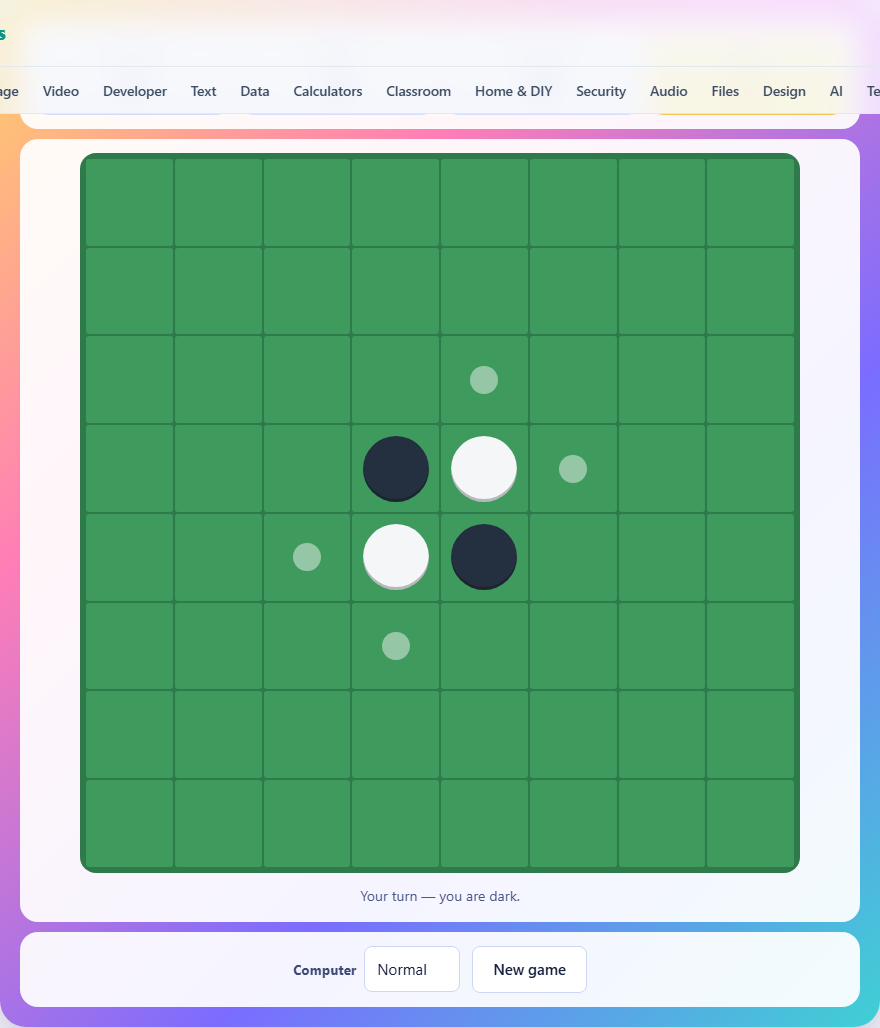
The board and the opening position
The game starts with four discs in the centre of the board: two dark and two light, placed diagonally from each other. You play the dark discs. The rest of the board is empty. From this small seed the board fills outward over roughly thirty turns per side, and the final count is usually much closer than it looks at any point during play.
Legal squares are highlighted for you on every turn. Only squares that would trap at least one of the computer's discs between the new disc and one of your existing discs are allowed. If no legal move exists for you, the turn passes automatically and the computer plays again. The game ends when neither side can move, which usually means the board is full or nearly full. The total number of discs at the end is always sixty-four or close to it, since nearly every square ends up occupied.
How flipping works
When you place a disc, every straight line running out from it in all eight directions is checked. A line counts if it contains one or more of the computer's discs followed immediately by one of yours. Every disc in between flips to your colour. A single placement can flip discs in several directions at once, and a well-chosen move can turn a dozen pieces in one turn.
This is also why disc counts swing so wildly. A row of five that you built last turn can flip to the opponent's colour in a single move. Counting who is ahead in the midgame is almost meaningless because of this constant overturning. What matters instead is where your discs sit and how hard they are to flip.
Flipping happens in all eight directions at once, including diagonals. A disc placed in the right spot can flip pieces going up, down, left, right, and along both diagonals in a single turn. These multi-direction flips are the most powerful moves in the game and are worth watching for, especially late in the match when the board is crowded.
Controls and difficulty levels
The Computer dropdown offers three levels. Easy looks only one move ahead and often leaves good squares untaken. Normal searches three moves deep and plays a solid positional game. Hard searches five moves deep, weighs corners and mobility carefully, and will punish loose play. Changing the level and pressing New game starts a fresh match at the chosen strength.
On a phone, tap the highlighted square where you want to place your disc. The game rejects any tap on a square that would not flip anything. After you move, the computer thinks for a moment and replies. A message below the board tells you whose turn it is and shows the disc count in the stats bar.
Why corners decide the game
A disc in a corner can never be flipped because there is no square beyond it in any direction. Once you own a corner, it anchors the two edges running away from it. As you fill those edges with your own discs, they become permanent too, because the corner blocks any line that would try to flip them. One corner is often worth more than twenty discs in the open centre.
The practical lesson is simple. Every move you make should consider whether it brings a corner closer or gives one away. If the computer has no way to take a corner this turn, you are free to play elsewhere. If a corner is available for you, take it even if it means flipping fewer discs than another move would.
The danger squares next to each corner
The squares diagonally adjacent to each corner are the most dangerous on the board. Taking one of these squares before the corner is occupied usually hands the corner straight to your opponent. The reason is geometric. Once your disc sits on the diagonal, the opponent can place a disc in the corner and flip yours along the diagonal in the same move. The corner is theirs forever, and your diagonal disc is gone.
The squares directly beside a corner along the edge are risky too, though not as lethal. A good rule for beginners is to avoid all squares touching an empty corner unless the move is forced. Once the corner is taken, those squares become safe because the flipping line is blocked by the corner disc.
Mobility and why fewer discs can be better
Having more legal moves than your opponent is a stronger sign of winning than having more discs. When you have many options and the opponent has only one or two, you can choose the best square on the board while they are stuck with whatever is left. This idea is called mobility, and the computer uses it in its own evaluation on Normal and Hard.
Flipping too many discs early actually hurts your mobility. Each disc you flip becomes yours, which means the opponent has fewer discs and therefore fewer possible outflanking targets for you next turn. Keeping your disc count low in the early game keeps the opponent's options limited and gives you more legal squares to choose from. It feels wrong to hold back, but it wins more games.
A practical way to apply this is to prefer moves that flip only one disc when you have a choice. A single flip extends your reach by one square without flooding the board with your colour. It also keeps the opponent surrounded by their own discs, which limits where they can play. Later, when corners are settled and stable edges are forming, flipping more aggressively becomes safe.
Edge play and stable discs
A disc on the edge of the board can only be flipped along that edge or diagonally inward. If you build a row of your discs from a corner along an edge, every disc in the row is stable, meaning it can never be flipped for the rest of the game. Stable discs are the safest form of territory you can hold.
Playing on the edge without a corner to anchor it is more dangerous. An edge disc with empty squares on both sides can be outflanked. But if you can extend from a corner along the edge in one direction, each disc you add to that line is locked in permanently. This is why grabbing a corner early and then filling the edge outward from it is such a strong pattern.
Watch for the chance to fill an entire edge from corner to corner. When both corners of an edge belong to you, every disc between them is stable no matter what. That is sixteen guaranteed points from two edges, often enough to decide the whole game. Building toward this position is one of the clearest long-term goals you can set in any match.
Common mistakes beginners make
The biggest mistake is playing for the highest flip count on every turn. A move that flips eight discs looks impressive but often spreads your colour across the board in ways that give the opponent corner access or reduce your future mobility. A move that flips only one or two discs in a safe position is usually stronger.
Another mistake is panicking when behind on the count. Disc leads change hands constantly, and a player trailing with twelve discs against twenty can still win by holding corners and edges. Focus on board position and trust that the count will swing back your way at the end.
A third error is playing too fast. The computer takes a fraction of a second to decide, but you should take longer. Before tapping, ask whether your move opens a corner for the opponent. If it does, look for a safer square, even if it flips fewer discs.
Privacy and how the game runs
The whole game runs inside your browser. Nothing is sent to a server, there is no account, and your best score is saved in local storage on this device only. It will not appear on a different computer or a different browser. Once the page has loaded, you can disconnect from the internet and keep playing without any change.