
How to balance chemical equations in the Retort puzzle
Retort turns a real piece of chemistry into a pure counting puzzle. The reactions are genuine, the formulae are fixed, and all you do is set the numbers in front of each substance until every element tallies on both sides. No chemistry knowledge is needed beyond the ability to count, yet the puzzle teaches one of the deepest facts in science: atoms are never created or destroyed. This guide covers the rules, every control, the scoring, and the thinking that gets you to the smallest answer in the fewest adjustments.
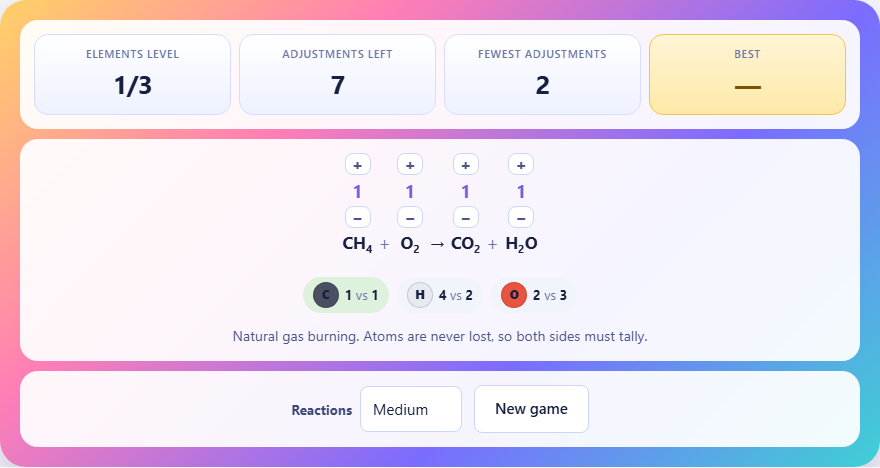
What the puzzle asks you to do
Each round shows a chemical equation with real substances on the left and right of an arrow. The arrow reads as becomes. Hydrogen and oxygen become water, for example, or methane and oxygen become carbon dioxide and water. The formulae are locked. Water is always H2O, and you cannot turn it into anything else. What you control is the small number in front of each substance, called a coefficient. That number says how many copies of that substance take part.
Below the equation is a tally. It lists every element in the reaction and shows how many atoms of it appear on each side. When both counts match, that row turns green. Your job is to make every row green. Once they all agree, the equation is balanced and the round is won.
Every reaction in the game is something that really happens. The small level includes hydrogen burning in air and magnesium catching fire. The medium level adds things like iron rusting, zinc dissolving in acid, and baking soda breaking down in the oven. The large level brings in reactions like a leaf making sugar from carbon dioxide and water, or ethane burning. Knowing what the reaction is helps you picture what is happening but does not change the counting.
Controls and how a round flows
Each coefficient has a small plus button above it and a minus button below it. Tapping plus raises the number by one. Tapping minus lowers it, but it will never go below one. Every tap counts as one adjustment. The game gives you a budget of adjustments, shown in the stats bar as Adjustments left. Use them all before the tally matches and the game ends.
The Reactions dropdown below the board sets the size of the equations. Small gives short reactions with few substances and few elements. Medium adds compounds with more atoms. Large brings in brackets, longer formulae, and reactions that need larger coefficients. The New game button picks a fresh reaction at random from the current level.
How scoring works
The score is the number of adjustments you used. Lower is better. Each round also shows the fewest adjustments possible, which is the total distance between every coefficient at one and the correct answer. If the answer is 2, 1, 2 then par is two adjustments, because only two of the three coefficients need to change from one.
When you balance the equation, the game checks whether your numbers match the smallest whole-number answer. If they do, you see Balanced. If your answer works but uses larger numbers, the game still accepts it and tells you what the smallest set is. For example, 4, 2, 4 balances hydrogen burning just as well as 2, 1, 2, but it is not the smallest answer.
Start with the rarest element
Look at the tally and find the element that appears in the fewest substances. If hydrogen shows up in three different compounds but nitrogen appears in only one substance on each side, nitrogen is the easier place to start. When an element sits in just one place on the left and one place on the right, changing those two coefficients fixes that element without disturbing much else.
This approach works because each coefficient you change affects every element in that substance. Changing the coefficient in front of CH4, for instance, moves carbon and hydrogen at the same time. Starting with the element that involves the fewest substances means fewer side effects to clean up afterward.
Leave oxygen until the end
Oxygen turns up in nearly everything. In a combustion reaction it appears in the oxygen gas on the left, in the carbon dioxide on the right, and in the water on the right. Trying to fix oxygen first means touching coefficients that shift carbon and hydrogen at the same time, and every fix breaks something else.
If you set carbon and hydrogen first, their coefficients lock down most of the equation. By the time you reach oxygen, only one coefficient is still free, and it is usually the oxygen gas itself. Adjusting that single number finishes the balance in one step. This ordering saves several wasted adjustments on nearly every medium or large reaction.
Using the tally to find what is wrong
The tally is more useful than the formula itself once you get the hang of reading it. If three rows are green and one is red, the red element tells you exactly where the problem is. Look at which substances contain that element and adjust only those coefficients. You do not need to re-examine the whole equation.
A mismatch of one atom on one side often means one coefficient is off by one. A mismatch that doubles the right count versus the left usually means a coefficient needs to be two instead of one, or four instead of two. Read the numbers, not just the colour, and the fix often becomes obvious.
Working with brackets in larger formulae
Some substances have brackets, like Ca(OH)2. The bracket groups two atoms, O and H, and the subscript two outside the bracket means the group appears twice. So Ca(OH)2 has one calcium, two oxygens, and two hydrogens. The coefficient in front multiplies everything in the formula, brackets included. Setting the coefficient to three in front of Ca(OH)2 gives three calciums, six oxygens, and six hydrogens.
Brackets can make the arithmetic harder to do in your head, but the tally handles it for you. Whenever you change a coefficient, the tally updates instantly. Trust the tally counts, and you do not need to track the bracket multiplication yourself.
Odd and even traps
A common source of wasted adjustments is the parity trap. Oxygen gas is O2, so it always contributes an even number of oxygen atoms. If the products need an odd number of oxygens, no single coefficient in front of O2 will produce that count. You have to go back and change a product coefficient to make the right side even as well.
The quick test is to look at the tally. If one side gives an even count and the other gives an odd count, something else needs to double. Doubling the substance that produces the odd number fixes the parity and usually costs only one extra adjustment.
Combustion reactions are the most common place this trap appears. Anything made of carbon and hydrogen burning in oxygen gives carbon dioxide and water on the right. The hydrogen atoms in water come in pairs, and the oxygen atoms in O2 come in pairs, but the carbon dioxide only has one carbon. If the fuel has an odd number of hydrogens per molecule, the water coefficient must be a fraction until you double everything to clear it.
Common mistakes and how to avoid them
The most frequent mistake is adjusting coefficients at random and hoping the tally will eventually agree. Every tap costs an adjustment, and you only have a few spare. Think before you tap. Count what the current mismatch is, decide which coefficient to change, and predict whether the count will match before you press the button.
Another mistake is trying to change a formula. The game does not allow it, and the rule exists for a deep reason. Water is H2O, not H3O or H2O2. Changing a formula changes the substance itself. The only thing you may change is how many copies take part in the reaction.
A third mistake is ignoring the par number. The game shows the fewest possible adjustments. If you are many taps above par, you may have overshot a coefficient and then corrected it, which costs two adjustments for no gain. Keeping close to par means you are taking the direct path.
Finally, beginners sometimes set a coefficient too high, overshoot the count, and then lower it back down. Each of those taps costs one adjustment, so an overshoot of two followed by a correction of two wastes four moves for nothing. If you are not sure whether to go up or down, check the tally first. The numbers on each side tell you which direction the coefficient needs to move.
Privacy and how the game runs
The entire game runs inside your browser. No answers are sent to a server, no data leaves your device, and there is no account. The reactions are not stored as a lookup table of answers either. The game reads each formula, counts the atoms, and solves the system in exact fractions to produce the smallest whole-number answer on the spot. Your best score is kept in your browser's local storage on this device only, and the page works offline once it has loaded.